Every school in Karachi, from small tuition centers to large campuses, carries a responsibility that goes far beyond exam results and report cards. It has to keep hundreds of children, teachers, and staff safe every single day. Fire safety is one part of that responsibility that is often overlooked until it is too late. A fire extinguisher hanging on a corridor wall gives everyone a sense of security, but that sense of security is false if the extinguisher has not been checked, serviced, or refilled on time. This guide explains, in simple terms, how schools in Karachi should maintain their fire extinguishers so that this equipment actually works the day it is needed.
Why Fire Extinguisher Maintenance Matters More in Schools
Fire Safety Trading (Pvt)
ToggleSchools are unique buildings. They have science labs with flammable chemicals, kitchens or canteens with cooking equipment, computer labs full of electrical wiring, and generators or electrical panels tucked away in store rooms. Add to this the fact that a school is full of children who may not react calmly in an emergency, and it becomes clear why fire safety cannot be treated casually. An extinguisher that has lost its pressure, has a rusted valve, or is past its refilling date is essentially a decoration, not a safety tool. Regular maintenance is the only way to make sure that decoration becomes a life-saving device when seconds matter.
Types of Fire Extinguishers a School Should Have
Different areas of a school face different fire risks, so a single type of extinguisher is rarely enough for the whole campus.
- ABC Dry Powder Extinguishers – suitable for classrooms, corridors, offices, and libraries where paper, furniture, and general combustibles are the main risk.
- CO2 Extinguishers – best placed near computer labs, server rooms, and electrical panels since they do not damage sensitive equipment.
- Foam or Wet Chemical Extinguishers – ideal for school canteens and kitchens where cooking oil fires are a real possibility.
Having the right type of extinguisher in the right location, and keeping every unit properly maintained, forms the foundation of a school’s fire safety plan.
Monthly Visual Inspection Checklist
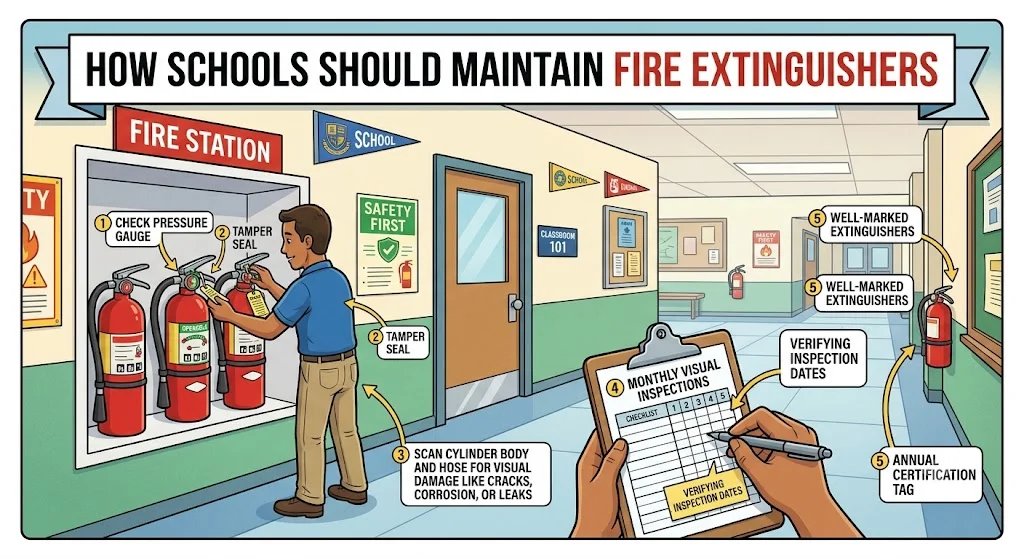
A school does not need to wait for an annual service visit to catch obvious problems. A staff member, usually from the admin or facilities team, should walk through the building once a month and check each extinguisher for the following:
- The pressure gauge needle is in the green zone, not the red.
- The safety pin and tamper seal are intact and unbroken.
- There is no visible rust, dent, or corrosion on the cylinder body.
- The nozzle or hose is not cracked, blocked, or missing.
- The extinguisher is mounted at an accessible height and not blocked by furniture, boxes, or decorations.
- The inspection tag or label is up to date and clearly visible.
These checks take only a few minutes per extinguisher but catch most problems before they become dangerous.
Annual Professional Servicing and Refilling
Visual checks are not a substitute for professional servicing. Every extinguisher, regardless of how new it looks, should be inspected, pressure tested, and refilled by a certified technician at least once a year. Powder extinguishers typically need refilling every 12 months, while CO2 cylinders should be weighed and checked for gas leakage on the same schedule. Schools that skip this step often discover during an actual emergency that the extinguisher was empty or under-pressurized, which defeats the entire purpose of having one installed.
Karachi’s humid, coastal climate also accelerates corrosion on extinguisher cylinders and valves, which is another reason annual servicing should never be delayed or skipped, especially for schools located near industrial or high-humidity areas.
Common Mistakes Schools Make with Fire Extinguishers
- Installing extinguishers once and never checking them again for years.
- Storing extinguishers in locked cabinets or storerooms where they cannot be reached quickly.
- Ignoring expired refilling tags because the extinguisher still looks fine from the outside.
- Not training any staff or teachers on how to actually operate an extinguisher.
- Placing all extinguishers on one floor instead of distributing them across the entire campus.
Fire Extinguisher Placement Guidelines for School Buildings
Placement is as important as maintenance. Fire safety guidelines generally recommend one extinguisher for every 15 to 20 meters of floor distance, so no one in the building should ever have to run far to reach one. Extinguishers should be mounted near exits, staircases, science labs, kitchens, and electrical rooms, at a height that both staff and older students can reach without difficulty. Every extinguisher should also be clearly labeled and visible from a distance, ideally with a sign above it so it is not hidden by notice boards or furniture.
Training Staff and Conducting Fire Drills
Even a perfectly maintained extinguisher is not much use if nobody on site knows how to operate it. Schools should arrange a short annual training session, often provided free of cost by professional fire safety companies, where teachers and support staff learn the PASS technique: Pull the pin, Aim at the base of the fire, Squeeze the handle, and Sweep side to side. Combining this training with a scheduled fire drill twice a year helps both staff and students understand evacuation routes and builds confidence in case of a real emergency.
Choosing a Reliable Fire Extinguisher Refilling Service in Karachi
Because Karachi has a large number of schools spread across different areas, from Gulshan and North Nazimabad to Clifton and DHA, school administrations need a refilling partner who can service multiple campuses reliably and on schedule. A good provider will maintain proper records of every extinguisher’s last service date, issue renewal reminders, and use genuine refilling chemicals rather than substandard powder that loses effectiveness quickly.
Schools looking for a dependable fire extinguisher refilling in Karachi service can rely on Fire Safety Trading, which offers scheduled inspections, ISO-standard refilling, and quick turnaround so that campuses are never left without working fire protection.
Working with an established local provider also means faster response times if an extinguisher needs emergency replacement or a school is preparing for a safety audit or inspection from education authorities.
Conclusion
Fire extinguisher maintenance in schools is not a one-time installation task, it is an ongoing responsibility that protects the lives of children and staff. Monthly visual checks, annual professional servicing, correct placement, and basic staff training together create a safety net that actually works when needed. Karachi schools that partner with a trustworthy refilling service and build fire safety into their routine maintenance calendar are far better prepared to handle an emergency than those that treat extinguishers as a one-time purchase.
Frequently Asked Questions
- How often should a school’s fire extinguishers be refilled in Karachi?
Most fire extinguishers used in schools should be refilled once every 12 months, though this can vary slightly depending on the type of extinguisher and how often it has been used or exposed to humidity.
- Who is responsible for fire extinguisher maintenance in a school?
Usually the school’s administration or facilities department is responsible, but the hands-on inspection, testing, and refilling should always be carried out by a certified fire safety company.
- How many fire extinguishers does a school need?
As a general rule, schools should have at least one extinguisher for every 15 to 20 meters of floor space, with extra units placed near labs, kitchens, and electrical rooms.
- What type of fire extinguisher is best for a school canteen?
Wet chemical or foam extinguishers are best for canteens and kitchens because they are designed to handle cooking oil and grease fires safely.
- Can an old or expired fire extinguisher be dangerous?
Yes, an expired or poorly maintained extinguisher may fail to discharge properly, have reduced pressure, or in rare cases the cylinder can become unsafe due to corrosion, so timely refilling is essential.
- How do I know if a school’s fire extinguisher needs refilling?
Check the pressure gauge for a reading outside the green zone, look for a missing or expired service tag, or notice visible rust and damage on the cylinder body.
- Should teachers be trained to use fire extinguishers?
Yes, at least a few staff members on every floor should receive basic hands-on training so they can respond quickly and safely during a small fire before it spreads.
- Where should fire extinguishers be placed in a school building?
They should be mounted near exits, staircases, labs, kitchens, and electrical rooms, at an easily reachable height and never blocked by furniture or storage.
- Is fire extinguisher servicing required by law for schools in Pakistan?
Fire safety regulations and building codes generally require functional fire equipment in institutional buildings, and regular servicing is necessary to pass safety inspections and insurance requirements.
- How can a school find a trusted fire extinguisher refilling service in Karachi?
Look for a provider with proper certification, transparent service records, genuine refilling materials, and a track record of servicing other institutions such as schools, offices, or hospitals in Karachi.