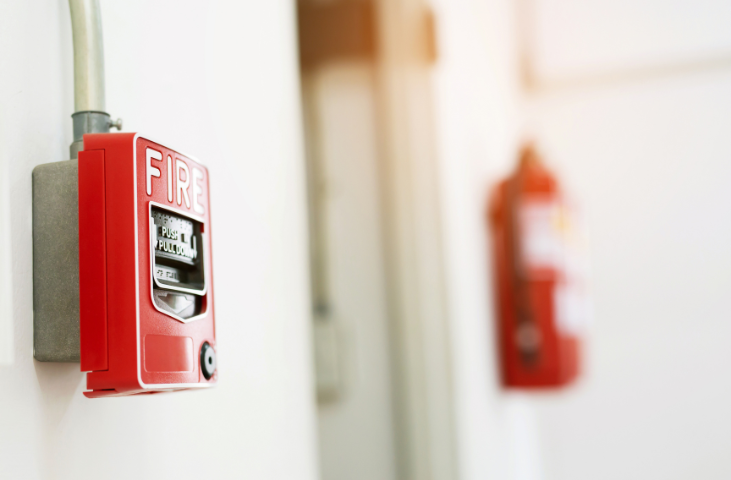
Fire Alarm System Services
Fire Safety Trading (Pvt)
ToggleA comprehensive life-safety solution including the installation, programming, and integration of advanced smoke detection, heat sensing, and manual alarm systems to ensure early warning and rapid evacuation.
Maintenance & Compliance
Professional testing of sensors, control panels, and notification devices to ensure your alarm system is fully functional, reliable, and compliant with all mandatory fire safety regulations.

Fire Alarm System in Pakistan The Complete Guide to Types,
Working, Installation, Price and Maintenance
Fire is one of the fastest and most destructive emergencies a building can face. In a few minutes, a small flame can turn into a blaze that fills corridors with toxic smoke, damages expensive equipment and puts lives at risk. In Pakistan, where dense markets, high-rise plazas, hospitals, factories and crowded residential buildings are common, early warning is not a luxury. It is a necessity.
A fire alarm system is the first line of defense against fire. It detects smoke, heat, flame or dangerous gases, warns everyone inside the building through sirens and flashing lights, and can notify the fire brigade or security team automatically. In modern buildings it also controls other safety systems, such as unlocking exit doors, shutting down ventilation and recalling elevators.
This guide explains everything you need to know about fire alarm systems in Pakistan: how they work, what components they include, which type suits which building, what standards apply, what affects the price, and how to keep the system reliable for years. Whether you are a homeowner, a facility manager, an architect or a business owner, it will help you make an informed decision.
Fire Safety Trading (Pvt) Ltd supplies, installs and maintains fire alarm systems in Rawalpindi, Islamabad, Lahore, Karachi, Faisalabad, Quetta, Peshawar, Gilgit, Muzaffarabad, Gwadar and other cities of Pakistan. You can contact us on 0315-4233313.
What Is a Fire Alarm System?
A fire alarm system is a network of electrical devices that work together to detect a fire at an early stage and alert the people in and around a building. It usually consists of a control panel (the “brain”), detectors, manual call points, alarm sounders and strobes, power supply with backup batteries, and wiring or wireless links.
Depending on the building, the system may also include:
- Speaker strobes that sound an alarm followed by a recorded or live voice evacuation message, for example instructing people not to use the elevators.
- Interfaces that connect to sprinklers, smoke extraction fans, fire doors, gas suppression systems and elevator controllers.
- Remote monitoring that sends signals to a central station, a fire brigade or a mobile phone.
The goal is simple: detect early, warn quickly, and help people escape safely while limiting damage.
How Does a Fire Alarm System Work?
Although systems differ in size and technology, the working principle is the same.
1. Detection. A smoke detector senses smoke particles, a heat detector senses a rise in temperature, a flame detector senses infrared or ultraviolet radiation, and a gas detector senses carbon monoxide. Alternatively, a person who notices a fire breaks the glass of a manual call point.
2. Signal transmission. The detector or call point sends an electrical signal to the fire alarm control panel through cables or radio waves.
3. Analysis. The panel checks the signal. In a conventional system it identifies the zone where the alarm came from. In an addressable or intelligent system it identifies the exact device, and in some cases evaluates whether the reading is a real fire or a nuisance.
4. Alarm activation. The panel activates sounders, bells, strobes and voice evacuation speakers. Occupants know they must leave.
5. Automatic actions. Depending on the design, the panel can:
- Release magnetic door holders so fire doors close
- Shut down air-handling units to stop smoke spreading
- Start smoke extraction fans and pressurization fans
- Bring elevators to the ground floor
- Unlock security doors on escape routes
- Start sprinkler pumps or release suppression gas
- Send a notification to the fire brigade, security room or building manager
6. Display and logging. The panel shows the location of the alarm and records the event in memory, which is useful for investigation and for the fire brigade when they arrive.
Purpose of a Fire Alarm System
A fire alarm system is more than a siren. It serves several important purposes.
1. Early Detection
The most important job is to detect fire at the smoldering or incipient stage, before flames spread. Smoke detectors and heat detectors continuously watch the surroundings, even when nobody is present, such as at night or during holidays.
2. Alerting Occupants
After detection, the system warns people through loud audible alarms and visible flashing strobes. Strobes are especially important for people with hearing impairment and for noisy environments such as factories. Voice evacuation systems reduce panic by giving clear instructions.
3. Safe Evacuation
Time is the most valuable resource in a fire. Studies of building fires consistently show that early warning greatly increases the chance of safe escape. The system gives occupants the time to use exits before smoke blocks the path.
4. Limiting Fire Spread
By triggering fire doors, shutting ventilation and starting extraction, the system helps contain smoke and fire in one area and protects the remaining parts of the building.
5. Notifying Emergency Services
A connected system can alert the fire brigade or Rescue 1122 quickly, which reduces response time and helps control the fire sooner.
6. Protecting Property and Business Continuity
Buildings, machinery, stock, servers and documents can be worth far more than the alarm system. Early detection reduces damage and downtime, and many insurers view a properly installed and maintained system favorably.
7. Legal and Regulatory Compliance
Many commercial, industrial, healthcare and high-rise buildings are expected to follow fire safety provisions. A compliant system helps you satisfy inspectors, insurers and authorities.
Main Components of a Fire Alarm System
Understanding the components helps you compare quotations and ask the right questions.
1. Fire Alarm Control Panel (FACP)
The control panel is the heart of the system. It powers the devices, monitors their condition, receives signals, activates outputs and displays alarms and faults. Panels range from small 2-zone conventional units to large networked addressable panels that connect multiple buildings. A good panel offers clear display, event memory, network capability, battery charger and multiple relay outputs.
2. Smoke Detectors
Smoke detectors are the most widely used detectors. The main types are:
- Photoelectric (optical) detectors: A light beam inside the chamber is scattered by smoke particles onto a sensor. They respond well to slow, smoldering fires such as burning cables, upholstery and paper, and they are the most common choice for offices, hotels and residences.
- Ionization detectors: These respond quickly to fast-flaming fires with tiny particles. Because of the radioactive source they contain and disposal concerns, many regions have moved to optical and multi-sensor technology.
- Multi-sensor detectors: These combine optical, heat and sometimes CO sensing. Their algorithms compare readings and reduce false alarms, which suits kitchens’ surroundings, hospitals and data centers.
- Beam detectors: A projector and receiver span a large open space such as an atrium, warehouse or mall. Smoke crossing the beam reduces the received signal and raises an alarm.
- Aspirating (air-sampling) detectors: A network of pipes constantly draws air to a highly sensitive central unit. These are used in clean rooms, data centers, museums and telecom exchanges where extremely early detection is required.
3. Heat Detectors
Heat detectors respond to temperature. Fixed-temperature detectors activate at a preset temperature, commonly around 57°C or 68°C for general use. Rate-of-rise detectors activate when temperature increases quickly. Heat detectors are ideal for kitchens, boiler rooms, garages, dusty workshops and other areas where smoke detectors would give false alarms.
4. Carbon Monoxide (CO) Detectors
Carbon monoxide is a colorless, odorless and highly dangerous gas produced by incomplete combustion. CO detectors are useful in parking areas, generator rooms, homes with gas heaters and sleeping accommodation. During winters in northern Pakistan, gas heaters and closed rooms make CO detection especially valuable.
5. Flame Detectors
Flame detectors use ultraviolet, infrared or combined sensors to detect the radiation of an open flame. They react in seconds and are used in fuel stations, oil and gas facilities, chemical plants, generator rooms and aircraft hangars.
6. Manual Call Points (MCP)
These are the “break glass” or resettable push-button units installed near exits and along escape routes. They let a person raise the alarm immediately when they see a fire before detectors have activated.
7. Sounders, Bells and Horns
These produce the audible alarm. Modern sounders offer selectable tones and volume levels. In commercial buildings, the sound level must be clearly above background noise so everyone hears it, including people asleep.
8. Strobes and Visual Alarms
Flashing beacons warn people who cannot hear the alarm or work in noisy areas. Combined sounder-strobes save space and wiring.
9. Voice Evacuation System
Voice evacuation uses speakers and an amplifier to broadcast pre-recorded messages in English, Urdu or local languages, or to allow live announcements from a fire warden. Clear messages help people move calmly, and they can be zoned so only affected floors are told to evacuate first.
10. Loop Isolators and Short-Circuit Isolators
Isolators divide an addressable loop into sections. If a short circuit occurs, only the section between two isolators is lost, and the rest of the loop keeps working.
11. Input/Output Modules
Interface modules connect the fire alarm system to other equipment. Input modules monitor flow switches, pressure switches and valve tamper switches. Output modules control fans, doors, dampers, elevators and pumps.
12. Power Supply and Batteries
A fire alarm must work even during a power failure, which is common in Pakistan. Systems use a mains supply with sealed lead-acid backup batteries, sized to keep the system in standby for many hours and then sound the alarm for a specified period. Battery capacity calculations are an essential part of correct design.
13. Cables
Fire-rated, low-smoke, halogen-free cables are recommended so that circuits keep working long enough during a fire. Poor-quality cable is a common cause of faults and false alarms.
14. Remote Annunciators and Repeater Panels
These show the alarm location at a reception desk or security room, so guards do not have to run to the main panel.
Types of Fire Alarm Systems
There are four main technologies used in Pakistan. Choosing the correct one depends on building size, layout, budget and risk level.
1. Conventional Fire Alarm System
In a conventional system, detectors and manual call points are wired to the control panel in zones. A zone is a circuit covering a floor, wing or area of the building. Several devices share a single zone circuit.
When any device in a zone triggers, the panel lights up that zone’s indicator. It tells you which zone has an alarm but not which exact device triggered it. The more zones you create, the easier it is to locate the fire, so dividing the building into smaller zones speeds up the response of both the fire brigade and building management.
Conventional systems normally include at least two sounder circuits wired to the panel, so that if one circuit develops a fault, the other still sounds. Sounders may be bells, electronic sounders or any audible device.
Advantages:
- Lowest cost and simple technology
- Easy to understand, install and repair
- Suitable for small buildings
- Widely available spare parts
Limitations:
- Cannot identify the exact device in alarm
- Requires a lot of cable in larger buildings
- Limited flexibility and features
- More difficult to expand
Best for: Small shops, clinics, small offices, schools, guest houses, homes and buildings with fewer floors or rooms.
2. Addressable Fire Alarm System
An addressable system works on the same basic idea as a conventional system, but every device has a unique address set through a dip-switch, rotary switch or programming tool. The control panel knows exactly which detector or call point has been triggered, for example “Smoke detector, 3rd floor, Room 305”.
Devices are wired on a loop: the cable starts at the panel, passes through each device and returns to the panel. A typical loop can support up to around 99 devices (some manufacturers support more). Because the loop is fed from both ends, a single break in the cable does not disable the devices. Loop isolators split the loop into sections so a short circuit affects only a small area.
Advantages:
- Exact location of alarm displayed immediately
- Less cabling than conventional systems in medium and large buildings
- Faster fault finding
- Easier to expand
- Event logging and detailed reporting
Limitations:
- Higher initial cost than conventional
- Requires trained technicians for programming
- In basic addressable systems, detectors send only on/off signals rather than analyzing the environment
Best for: Hotels, hospitals, shopping malls, office buildings, universities, factories and high-rise buildings.
3. Intelligent (Analog Addressable) Fire Alarm System
Intelligent systems are the most advanced category. Each detector contains a microprocessor that continuously measures the surrounding conditions (smoke density, temperature, contamination) and sends actual values to the control panel. The panel, using software algorithms, decides whether the reading is a fire, a fault or simply a dirty detector head that needs cleaning.
Because decisions are made on real data instead of a simple trigger, intelligent systems can:
- Greatly reduce unwanted alarms
- Compensate automatically for dust build-up and environmental drift
- Provide early “pre-alarm” warnings
- Adjust sensitivity by time of day (for example, lower sensitivity in a workshop during working hours and higher sensitivity at night)
- Report maintenance needs before failure
- Support 2-, 4- or 8-loop panels, allowing very large areas to be monitored by one panel or a network of panels
Advantages:
- Highest reliability and fewest false alarms
- Detailed diagnostics and maintenance information
- Excellent scalability for large sites
- Integration with building management systems (BMS)
Limitations:
- Highest cost
- Complex to design and commission
- Needs experienced engineers
Best for: Large hospitals, airports, high-rise towers, data centers, industrial complexes, banks, and critical facilities.
4. Wireless Fire Alarm System
Wireless systems use secure, encrypted radio communication between detectors and the control panel instead of cables. Devices are powered by long-life batteries, and the panel monitors battery level, signal strength and tamper conditions.
Advantages:
- No cable installation, so minimal disruption and damage to walls and ceilings
- Fast installation, ideal for heritage buildings, occupied buildings, and temporary structures
- Easy to relocate when layouts change
Limitations:
- Battery replacement is required periodically
- Radio range can be affected by thick concrete walls and metal structures
- Generally more expensive per device than wired conventional devices
Best for: Heritage buildings, museums, rented offices, temporary sites, and buildings where cabling is difficult.
5. Hybrid Systems
Some projects combine technologies, such as an addressable main system with wireless devices for hard-to-reach areas. A qualified designer can mix technologies to achieve the best cost and coverage.
Comparison of Fire Alarm Systems
| Feature | Conventional | Addressable | Intelligent | Wireless |
|---|---|---|---|---|
| Location identification | By zone | Exact device | Exact device with analysis | Exact device or zone |
| Cost | Lowest | Medium | Highest | Medium to high |
| Wiring | Many cables | Loop wiring | Loop wiring | None |
| False alarm control | Basic | Better | Best | Depends on devices |
| Scalability | Limited | Good | Excellent | Good |
| Best for | Small buildings | Medium to large | Large and critical | Heritage, temporary |
Fire Alarm Standards and Regulations
A fire alarm system must be designed and installed according to recognized standards. The commonly referenced ones include:
- NFPA 72 (National Fire Alarm and Signaling Code, USA), widely used in Pakistan for design, installation, testing and maintenance.
- NFPA 101 (Life Safety Code) for building egress and safety requirements.
- EN 54 (European standard) for the performance and testing of individual components such as detectors, panels and sounders.
- BS 5839 (British standard) for design, installation and servicing of systems.
- UL and FM approvals for product listing and testing.
- Building Code of Pakistan, Fire Safety Provisions and requirements of local authorities and fire departments.
Using approved and certified products, designed by qualified engineers and commissioned with proper documentation, protects you legally and technically. Always ask your supplier for product certifications, datasheets and as-built drawings.
Where Are Fire Alarm Systems Needed in Pakistan?
Hospitals and Clinics
Patients cannot evacuate quickly, so early warning is critical. Hospitals need addressable or intelligent systems with zoned evacuation, connection to oxygen and medical gas shut-off, and door control.
Shopping Malls and Plazas
High occupancy and multiple shops with electrical loads and storage make malls high-risk. Systems should include voice evacuation, smoke control and integration with sprinklers.
High-Rise Buildings
Elevators cannot be used during a fire, so voice messages, stair pressurization and floor-by-floor evacuation are essential.
Hotels and Guest Houses
Sleeping guests are at high risk. Detectors in each room, sounders that wake sleeping guests and clear escape signage are required.
Factories and Industrial Units
Textile mills, chemical plants, paper mills and warehouses have combustible materials. Heat detectors, flame detectors, beam detectors and explosion-proof devices may be needed depending on the process.
Schools, Colleges and Universities
Large numbers of children and students require reliable alarms, regular drills and clear evacuation routes.
Offices and Banks
Electrical equipment, servers, records and cash are concentrated here. Early detection protects both people and critical assets.
Data Centers and Server Rooms
Aspirating smoke detection and gas suppression integration are recommended to prevent expensive data loss.
Mosques, Community Halls and Marriage Halls
Large gatherings in confined spaces with decorations and kitchens create risk. Marriage halls, in particular, benefit from strong alarm coverage and exit planning.
Warehouses and Cold Storage
Large open spaces are best covered by beam detectors or aspirating systems, along with heat detection in high racks.
Homes and Apartments
Standalone battery-powered smoke detectors are an affordable way to protect families, and larger apartment buildings should have a central system in common areas.
How to Choose the Right Fire Alarm System
Follow these steps before you buy.
1. Assess the building. Note the number of floors, area, occupancy, use of each space and layout.
2. Identify risks. Kitchens, generator rooms, storage areas, electrical rooms and workshops each need different detector types.
3. Check regulations and insurance. Confirm what your local authority and insurer expect.
4. Decide the system type. Small building with limited rooms: conventional. Medium to large building: addressable. Complex or critical site: intelligent. Difficult-to-wire or temporary site: wireless.
5. Plan for the future. Choose a panel that can be expanded if you add floors or wings.
6. Prioritize quality. Certified equipment from reputed brands has longer life, better spare part availability and fewer false alarms.
7. Choose an experienced installer. The best equipment can fail if it is badly designed or installed. Ask about previous projects, certifications, after-sales support and response time.
8. Budget for maintenance. Include yearly maintenance in the cost plan.
Fire Alarm System Installation Process
A professional installation normally follows these stages.
1. Site Survey and Requirement Analysis
Engineers visit the site, review drawings, study the risk and decide on system type and detector locations.
2. Design and Drawings
The layout shows detector positions, cable routes, panel location, zones or loops, sounder coverage and battery calculations. Detector spacing follows the standard, for example the maximum coverage area per smoke detector depends on ceiling height and detector type.
3. Material Approval
Datasheets and certifications are reviewed before purchase.
4. Cable Laying and Conduit Work
Fire-rated cables are laid in conduit or trays, and separated from power cables to avoid interference.
5. Device Installation
Detectors, call points, sounders, modules and the panel are mounted at correct positions. Detectors should be installed after dusty construction work is complete or protected by dust covers until then.
6. Programming and Configuration
Addresses, zones, cause-and-effect logic and messages are programmed into the panel.
7. Testing and Commissioning
Every device is tested with smoke or heat test equipment, sounder levels are measured, and the interfaces with other systems are checked.
8. Handover and Training
The client receives drawings, manuals, test reports and training for staff on how to operate the panel, silence and reset alarms, and respond to faults.
Maintenance and Testing of Fire Alarm Systems
A fire alarm that is not maintained can fail exactly when it is needed. Regular inspection is as important as the installation itself.
Weekly: Check that the panel shows normal condition and no faults. Test at least one manual call point on a rotating basis.
Monthly: Inspect the control panel, indicators and battery condition. Check that there are no obstructions in front of detectors and call points.
Quarterly to semi-annually: Test a sample of detectors, sounders and interfaces.
Annually: Perform a full functional test of every detector, call point, sounder and output, clean detectors, test battery capacity and update the log book.
Good practices:
- Keep a fire alarm log book recording tests, alarms, faults and repairs.
- Never paint over detectors or cover them with plastic.
- Inform the maintenance company before renovation, ceiling work or welding.
- Replace batteries every three to five years, or as recommended by the manufacturer.
- Replace detectors at the end of their service life, commonly around ten years, according to the manufacturer’s guidance.
- Sign an Annual Maintenance Contract (AMC) with a qualified company so inspections are scheduled and emergency support is available.
Reasons for False Alarms and How to Prevent Them
False alarms disturb operations, reduce trust in the system and can lead people to ignore real alarms. Typical causes include:
- Dust and insects inside detectors
- Cooking fumes, steam or aerosol sprays near smoke detectors
- Construction dust and welding work
- Wrong detector type for the environment
- Damaged or wet cables and poor-quality connections
- Unstable power or a faulty battery
- Lack of regular cleaning and maintenance
Prevention tips: Use heat or multi-sensor detectors in kitchens and dusty zones, choose intelligent detectors with drift compensation, protect detectors during construction, maintain regularly and train staff not to use aerosols or cooking equipment close to detectors.
Fire Alarm System Price in Pakistan
Prices vary widely depending on the type, brand, number of devices and complexity. Instead of a single number, it is more helpful to understand what drives the cost.
Factors that affect price
- System type: Conventional systems cost less than addressable or intelligent systems.
- Number of devices: More detectors, call points and sounders increase the cost.
- Brand and certification: Internationally certified brands cost more but offer reliability and support.
- Building size and height: Larger and taller buildings need more cable and labor.
- Additional features: Voice evacuation, graphic monitoring, network panels and integration with other systems.
- Cable type: Fire-resistant cable costs more than ordinary cable.
- Installation complexity: Retrofitting in an occupied building can cost more than installation during construction.
- After-sales service: AMC and warranty terms.
Smoke detector price in Pakistan
Basic standalone battery-operated smoke detectors for home use are commonly available in the range of roughly PKR 2,000 to PKR 5,000, with an average of around PKR 3,000. Higher-quality, certified and system-connected detectors cost more, and the price of imported addressable detectors is often linked to the US dollar exchange rate. Because market prices change frequently, contact a supplier for a current quotation.
Get an accurate quotation
The most reliable way is a free site survey and a written quotation listing brands, quantities, warranty and scope of work. Avoid quotations that are unusually low. They often use uncertified devices, thin cable or skip commissioning.
Common Mistakes to Avoid
- Choosing the cheapest offer. Low price often means poor quality and hidden costs later.
- Installing the wrong detector type. For example, smoke detectors in a kitchen cause repeated false alarms.
- Ignoring maintenance. Systems degrade over time.
- Poor detector placement. Detectors near air vents, fans or dead-air corners may not work properly.
- No backup power. A system without healthy batteries is useless during load-shedding.
- No training for staff. People must know how to react.
- Disconnecting or bypassing the system. Some users silence alarms permanently after false alarms, which is extremely dangerous.
- Not updating the system after renovation. New partitions and rooms may leave uncovered areas.
Fire Safety Beyond the Alarm
An alarm works best as part of a complete fire safety strategy:
- Fire extinguishers of the right type (water, foam, CO₂, dry powder) placed near exits and hazards
- Sprinkler systems to control or extinguish fire automatically
- Fire hydrants and hose reels for building and site protection
- Emergency lighting and exit signs to guide people in smoke or power failure
- Clear escape routes and fire exits that are never blocked or locked
- Fire drills at least once or twice a year
- Electrical safety inspections since faulty wiring is a leading cause of fires
- Fire wardens trained to guide evacuation
Combining detection, warning, suppression and trained people gives the best protection.
Why Choose Fire Safety Trading (Pvt) Ltd?
Fire Safety Trading (Pvt) Ltd is a trusted name in fire protection in Pakistan. We provide quality products together with complete installation and maintenance services so that you get one accountable partner from planning to after-sales support.
- All types of fire alarm systems: conventional, addressable, intelligent and wireless
- Complete service: site survey, design, supply, installation, testing, commissioning and training
- Maintenance and AMC: scheduled inspections and quick emergency response
- Nationwide coverage: Rawalpindi, Islamabad, Lahore, Karachi, Faisalabad, Quetta, Peshawar, Gilgit, Muzaffarabad, Gwadar and other cities
- Quality products: certified equipment suitable for homes, offices, hospitals, factories and commercial buildings
- Competitive pricing: solutions to fit different budgets without compromising safety
Looking for the best fire alarm system suppliers near you? Contact us for a free consultation and quotation.
Frequently Asked Questions (FAQs)
1. What is the difference between conventional and addressable fire alarm systems?
A conventional system shows only the zone in which an alarm occurred, while an addressable system identifies the exact device. Addressable systems use loop wiring and are better for larger buildings.
2. Which fire alarm system is best for a hospital?
Addressable or intelligent systems are generally recommended because they give exact location, allow zoned evacuation and integrate with door control, ventilation and medical gas systems.
3. How many devices can be connected to one addressable loop?
It depends on the manufacturer. A commonly used figure is around 99 devices per loop, but some panels support more.
4. How often should a fire alarm system be tested?
Basic checks should be done weekly, with inspections monthly or quarterly and a full functional test at least once a year, following local requirements and manufacturer guidance.
5. Why does my fire alarm keep giving false alarms?
Common reasons are dust, steam, cooking fumes, wrong detector selection, moisture and lack of maintenance. A professional inspection can find the root cause.
6. Is a wireless fire alarm system reliable?
Yes. Modern wireless systems use encrypted radio communication and supervise the batteries and signals of all devices. They need regular battery replacement and proper radio planning.
7. Do I need a fire alarm system in my house?
It is strongly recommended. At minimum, install smoke detectors in bedrooms, corridors and near the kitchen (heat detector for the kitchen itself), and consider CO detectors if you use gas heaters or generators.
8. What is the life of a smoke detector?
Most manufacturers suggest replacement after about ten years, although regular testing and cleaning are needed throughout its life.
9. Can a fire alarm system automatically call the fire brigade?
Yes, when connected to a monitoring device such as a dialer, GSM communicator or central monitoring station. Otherwise, the alarm alerts people in the building, who then call the emergency service (Rescue 1122).
10. Can fire alarm systems work during load-shedding?
Yes, provided the system has healthy backup batteries of correct capacity. Regular battery testing is essential.
11. What is the difference between a fire alarm and a sprinkler system?
A fire alarm detects fire and warns people. A sprinkler system discharges water to control or extinguish fire. Both should work together in most commercial buildings.
12. How can I get a quotation for a fire alarm system in Pakistan?
Send your building details and drawings or request a site visit. Fire Safety Trading (Pvt) Ltd provides a free consultation and quotation.
A fire alarm system is one of the most valuable safety investments you can make. It warns people in time, helps them escape, limits damage and protects the buildings, assets and documents that took years to build. Because every building is different, the best system is the one designed for your risk, layout and budget, then installed correctly and maintained regularly.
Conventional systems suit small buildings, addressable systems serve medium and large properties, intelligent systems protect critical and complex sites, and wireless systems solve installation challenges in existing or heritage structures. Whatever you choose, insist on certified equipment, qualified installers and a maintenance plan.
Do not wait for an incident to realize the importance of fire safety. Contact Fire Safety Trading (Pvt) Ltd at 0315-4233313 for professional fire alarm system supply, installation and maintenance anywhere in Pakistan
Get Quotation