Fire Suppression Testing
Fire Safety Trading (Pvt)
ToggleFire extinguisher refilling is an extremely important phenomenon, inspect fire extinguishers at least once a month (more often in severe environments).
Refilling & Maintaince
Thorough inspections and risk assessments to identify vulnerabilities and ensure compliance.
What Is Fire Suppression Testing?
Fire suppression testing is the planned inspection, testing and verification of every part of a fire suppression system to confirm that it will detect a fire, activate on time, discharge the right amount of extinguishing agent in the right place, and keep the people in the building safe while doing so.
A suppression system is not a single device. It is a chain of parts that must all work together:
- Detection: smoke, heat or flame detectors that sense the fire
- Control: a releasing control panel that decides when to discharge
- Warning: alarms, strobes and signs that warn people to leave before discharge
- Release: solenoids, actuators and valves that open the agent supply
- Agent storage: cylinders, tanks, pumps or pressurized vessels holding the extinguishing agent
- Distribution: pipes, nozzles and sprinklers that deliver the agent
- Enclosure or hazard: the protected room or equipment that must hold the agent long enough to put the fire out
- Supporting systems: ventilation shutdown, damper closing, door closers, power cut-off and fire alarm interface
If any link in this chain fails, the whole system can fail. Testing finds weak links before a fire does.
Why Fire Suppression Testing Is Essential
- Systems fail silently
A closed valve, a leaking cylinder, a dead battery, a disconnected release circuit or a blocked nozzle gives no warning. The system appears normal until it is needed. Only inspection and testing reveal these hidden faults.
- Buildings change over time
Walls are added or removed, doors are replaced, cable penetrations are drilled, ventilation is modified, and equipment is moved. For a gas suppression system, a small unsealed opening in the room can let the agent escape and make the system fail. For a sprinkler system, new racks, partitions or ducts can block the spray. Regular testing makes sure the system still matches the building.
- Equipment ages
Batteries weaken, seals dry, pressure gauges drift, pipes corrode, solenoid valves stick, and detectors become dirty. In Pakistan’s heat, humidity, dust and coastal air, deterioration can be faster than many owners expect.
- Life safety
Some agents, particularly CO2, can be dangerous to people if released without warning. Testing makes sure pre-discharge alarms, time delays, abort switches, lockout valves and warning signs work as they should.
- Insurance and compliance
Insurers, auditors and authorities increasingly ask for proof that fire protection systems are maintained. A dated test report from a qualified contractor protects you in an audit or insurance claim.
- Avoiding costly accidental discharge
A faulty detector or wiring problem can cause an unwanted discharge of expensive gas, shut down operations and require refilling. Testing finds the cause before it happens.
- Business continuity
For a data center, a hospital, a pharmaceutical store or a production line, the cost of downtime after a fire is far greater than the cost of regular testing.
Fire Suppression Systems We Test
Clean Agent (Gas) Suppression Systems
Clean agent systems extinguish fires without leaving residue, and are used where water would damage valuable equipment.
- FM-200 (HFC-227ea) systems: widely used in server rooms, control rooms, telecom rooms and archives.
- Novec 1230 systems: a low-global-warming-potential agent used in similar applications.
- Inert gas systems (such as IG-541 and IG-55): use naturally occurring gases to reduce oxygen to a level that stops combustion.
These systems are covered by NFPA 2001 and the manufacturer’s instructions.
Carbon Dioxide (CO2) Systems
CO2 systems displace oxygen to put out fires and are used for generator rooms, turbine enclosures, paint booths, flammable liquid storage and industrial machinery. Because CO2 is dangerous to people at fire-extinguishing concentrations, safety interlocks and warning devices are especially important. NFPA 12 applies.
Water Sprinkler Systems
Wet, dry, pre-action and deluge sprinkler systems need regular testing of valves, alarms, pumps, flow, pressure and piping. NFPA 25 is the main reference, and NFPA 13 for installation requirements.
Fire Pump Systems
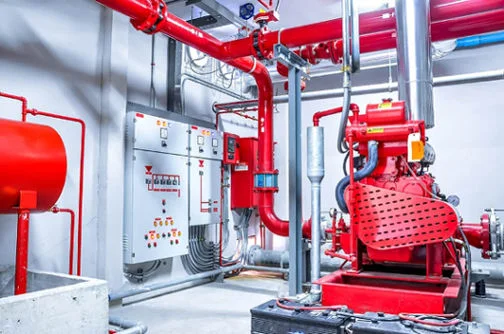
Electric and diesel fire pumps, jockey pumps, controllers and tanks are tested for starting, pressure, flow and performance under load, based on NFPA 20 and NFPA 25.
Foam and Foam-Water Systems
Used for fuel storage, loading racks, hangars and flammable liquid hazards. We test foam concentrate quality, proportioning, discharge devices and system readiness, in line with NFPA 11 and related standards.
Water Mist Systems
We test pumps, nozzles, valves, detection and control equipment according to NFPA 750 and manufacturer requirements.
Dry Chemical Systems
Used in industrial applications, paint spray booths, fuel dispensing areas and similar hazards. We inspect and test cylinders, expellant gas, piping, nozzles and release mechanisms under NFPA 17.
Wet Chemical Kitchen Suppression Systems
Restaurants, hotel kitchens, canteens and food courts use wet chemical systems to protect cooking appliances, hoods and ducts. These are tested under NFPA 17A and NFPA 96 practices, including checks of fusible links, nozzles, gas shut-off valves and manual pull stations.
Pre-Engineered and Local Application Systems
Smaller self-contained systems for cabinets, generator canopies, CNC machines, battery rooms and electrical panels.
Detection and Releasing Control Systems
For all suppression systems, we test the detectors, releasing panels, manual release stations, abort switches, sounders and interface with the building fire alarm system under NFPA 72 principles.
Our Fire Suppression Testing Services
- Gas Suppression System Inspection and Testing
For FM-200, Novec 1230, inert gas and CO2 systems, our engineers carry out:
Cylinder and agent inspection
- Checking that cylinders are secure, undamaged, correctly labeled and free from corrosion
- Weighing cylinders, where the agent is stored as a liquid, and checking pressure gauges, to confirm the agent quantity has not leaked out
- Checking cylinder valve condition and pressure switches
- Verifying hydrostatic test dates and service life, and recommending retesting or replacement when due
Release mechanism testing
- Testing solenoid valves and actuators with the discharge outputs safely disconnected so that no agent can be released
- Checking manual release levers and pull stations
- Checking the pneumatic and electrical release path
Pipework and nozzle inspection
- Visual inspection of pipework, supports and nozzles for damage, blockage, incorrect orientation or modification
- Checking nozzle location against the approved design
Detection and control panel testing
- Functional testing of each smoke and heat detector in the protected zone
- Testing cross-zone logic, countdown timers and discharge delays
- Testing abort and hold switches
- Verifying battery condition and standby power
- Checking alarm, strobe and sign operation
- Testing the interface with the main fire alarm panel and building systems
Interlocks and shutdowns
- Checking that ventilation, air-conditioning, dampers, doors and power supplies respond properly on alarm and discharge
- Enclosure Integrity Testing (Door Fan Test)
A gas suppression system works only if the room can hold the extinguishing concentration for the required hold time. A room integrity test, commonly called a door fan test, measures the leakage in the protected enclosure.
A calibrated fan is fitted into a doorway, and the room is pressurized and depressurized while the airflow and pressure are measured. Specialized software then predicts how long the agent concentration will stay above the required level, and shows the location and size of leakage paths, such as gaps under doors, cable penetrations, ducts, ceiling voids and raised floors.
We recommend room integrity testing:
- After a new installation, as part of commissioning
- After any modification to the room, such as new cabling, walls, doors or ventilation
- At regular intervals, as required by the standard in force, the authority or the insurer
- Whenever there is doubt about the room’s integrity
This test is non-destructive, avoids a full gas discharge, and often reveals problems that visual inspection cannot.
- Sprinkler System Testing
Our sprinkler system testing services cover:
Hydrostatic pressure testing (new or modified pipework) The pipework is pressurized to the test pressure specified in the standard (for example, commonly 200 psi for two hours, or as required by the design and standard) and checked for leaks and pressure drop.
Main drain test Verifies the water supply condition by measuring static and residual pressure at the riser, and comparing results over time to detect closed valves, obstructions or supply deterioration.
Alarm and flow switch testing Operating the inspector’s test connection to confirm that the water flow alarm, flow switch and fire alarm panel respond correctly.
Valve inspection Checking that control valves are fully open, properly supervised with tamper switches, and operate freely.
Sprinkler head inspection Looking for corrosion, paint, loading with dust or grease, mechanical damage, leakage, wrong temperature ratings, obstructions, and incorrect distance from storage or ceilings.
Piping and hanger inspection Checking for corrosion, damage, sagging, leaks and loose supports.
Dry pipe and pre-action valve trip tests Verifying valve operation, air or nitrogen pressure, compressor performance, water delivery time (where applicable) and detection interface.
Internal pipe inspection (long interval) Where required, assessing the internal condition of pipes for corrosion, scale or blockage.
- Fire Pump Testing
Fire pumps are the heart of most sprinkler and hydrant systems. Our pump testing services include:
- Automatic start test: confirming that the pump starts when system pressure falls
- No-flow (churn) test: running the pump under no-flow conditions to check for abnormal noise, vibration, heating and pressure
- Flow test: measuring pump output at rated flow and at higher flow points (such as 150% of rated flow) with flow meters and pressure gauges, and comparing results with the pump’s performance curve
- Diesel engine checks: fuel level and quality, oil, coolant, batteries, charger, starting system and exhaust
- Electric pump checks: controller, power supply, phase and voltage, changeover to standby power
- Jockey pump checks: start and stop settings, cycling frequency, and leak indications
- Pump room inspection: ventilation, lighting, drainage, access and signage
Because power failure is common in Pakistan, we place special emphasis on the diesel standby pump and automatic transfer arrangements.
- Kitchen Fire Suppression System Testing
Commercial kitchens are among the highest fire risks in hotels, restaurants and food courts. We test:
- Wet chemical cylinder pressure and agent condition
- Fusible links and detection devices (replacing as required)
- Nozzle position, caps and blockages
- Manual pull stations and remote release devices
- Gas and electrical shut-off devices that must operate when the system discharges
- Hood, duct and appliance coverage, to check that cooking equipment has not been changed without updating the system
- Interface with the building fire alarm system
- Foam and Fuel Hazard System Testing
For fuel stations, tank farms, loading bays and hangars, we check foam tanks, proportioners, pumps, valves, nozzles and discharge devices, and test foam concentrate samples where required.
- Cylinder Hydrostatic Testing and Recharging Support
High-pressure cylinders must be inspected and hydrostatically tested at periodic intervals required by the applicable standard and cylinder regulations. We arrange cylinder removal, testing, refilling or recharging, reinstallation and re-commissioning, keeping your system out of service for the shortest possible time and, where needed, arranging temporary protection.
- Detection and Alarm Interface Testing
We test all detectors, manual call points and releasing panels associated with the suppression system, plus the signals that go to the main fire alarm panel and building management system.
- Full Functional and Acceptance Testing
For new installations and major modifications, we carry out acceptance testing against the approved design, checking that the system performs as intended, with documentation for the consultant, authority and insurer.
- Fire Protection Audit and Condition Assessment
For buildings with older or undocumented systems, we perform a condition survey and gap analysis, listing defects, risks and priorities for repair or upgrade.
Our Testing Process
Step 1: Pre-Testing Consultation and Documentation Review
We review your system type, drawings, previous reports, manuals and manufacturer data, so that testing is carried out correctly.
Step 2: Planning and Safety Preparation
We agree the testing date and procedures with your management, notify building occupants, arrange for the disconnection of discharge outputs, make sure the fire watch is in place if protection will be impaired, and prepare safe isolation of the system.
Step 3: Visual Inspection
Our engineers visually inspect all components, enclosures, signs, labels, access, clearances and general condition.
Step 4: Functional Testing
Detection, control, alarm, release, interlock and shutdown functions are tested systematically.
Step 5: Performance Testing
Where applicable, we carry out flow tests, pressure tests, pump tests, door fan tests and trip tests to measure real performance.
Step 6: Restoration
All isolations are removed, discharge connections are reconnected under safe procedures, the system is returned to normal operating condition, and the fire alarm panel is reset.
Step 7: Reporting
You receive a clear written report that includes the following:
- Scope and date of testing
- System description and location
- Test results for each component, with pass or fail
- Measurements, readings and test data
- Defects, with a priority rating
- Recommended repairs or upgrades
- Photographs where useful
- Our engineer’s certification
Step 8: Follow-Up
We help you to correct defects, supply spare parts, recharge systems, repeat failed tests, and set up a regular testing schedule.
Recommended Testing Frequency
The correct frequency depends on the system type, the edition of the standard in force, the manufacturer’s instructions, the authority and your insurer. The table below shows typical practice that we use as a starting point, and we prepare a tailored schedule for each client.
|
System |
Typical Frequency |
Typical Activities |
|
Clean agent / gas systems |
Semi-annual inspection; annual comprehensive service |
Cylinder weight/pressure checks, release circuit tests, detector tests, hose and nozzle inspection, signage |
|
Gas systems, enclosure |
After commissioning, after modifications, and periodically as required |
Door fan (room integrity) test |
|
High-pressure cylinders |
Per applicable standard (often 5 to 12 years, depending on cylinder type and regulation) |
Hydrostatic test and recertification |
|
CO2 systems |
Semi-annual and annual |
Cylinder weights, safety devices, lockout valves, pre-discharge alarms, release tests |
|
Sprinkler systems |
Weekly/monthly visual; quarterly, annual and five-year tests |
Valve checks, gauge readings, alarm tests, main drain tests, internal inspection |
|
Fire pumps |
Weekly or monthly run tests; annual performance test |
Churn test, flow test, controller and engine checks |
|
Kitchen wet chemical systems |
Semi-annual |
Fusible link replacement, nozzles, agent, pull station, gas shutoff |
|
Foam systems |
Semi-annual and annual |
Foam tank inspection, proportioner tests, concentrate sampling |
|
Detection and releasing panels |
Quarterly to annual |
Detector tests, battery tests, cause-and-effect tests |
|
Portable extinguishers (support service) |
Monthly visual; annual maintenance; periodic hydrostatic testing |
Checks under NFPA 10 |
Safety During Testing
Testing suppression systems involves risks. Accidental discharge of a gas system can be dangerous to people and expensive for the owner. We therefore follow strict safety practices:
- Written test procedures and method statements
- Disconnecting and locking out discharge actuators before functional testing
- Using safe test methods that do not release the agent into occupied spaces
- Communicating with building staff, security and the fire alarm monitoring contact before testing
- Using trained, competent personnel who understand the manufacturer’s systems
- Verifying system restoration and reactivation after testing, with a second-person check on critical systems
- Providing fire watch or alternative protection during any period when the system is impaired
We never leave a system in a disabled state at the end of a visit, unless specifically agreed, documented and communicated, with alternative protection in place.
Common Problems We Find During Testing
Based on typical findings in fire suppression inspections, these are issues that testing often reveals:
- Closed or partially closed control valves on sprinkler systems
- Low cylinder pressure or agent weight caused by slow leaks
- Failed or expired batteries in releasing panels and pump controllers
- Disconnected or faulty release circuits, left that way after earlier maintenance
- Detectors that are dirty, damaged, painted over, or missing
- Enclosure leakage in protected rooms because of new cable penetrations, gaps and ventilation openings
- Blocked or misdirected nozzles
- Corroded pipes, brackets and fittings, especially in humid or coastal areas
- Diesel pump faults, such as flat starting batteries, low fuel or contaminated fuel
- Sprinkler heads painted, loaded with dust, or obstructed by stock
- Changes in occupancy or storage that make the original design inadequate
- Missing or faded warning signs and incomplete staff training
- Out-of-date cylinder test certificates
- Kitchen appliances moved or replaced without updating the suppression system layout
Finding these problems during a planned test, instead of during a fire, is the whole purpose of the service.
Industries and Facilities We Serve
- Data centers, server rooms and telecom exchanges: clean agent systems, pre-action sprinklers and very early smoke detection
- Hospitals and laboratories: sprinklers, clean agent systems for imaging rooms and electrical rooms
- Banks and financial institutions: vaults, server rooms and archives
- Hotels, restaurants and food courts: kitchen suppression systems, sprinklers and fire pumps
- Factories and textile units: sprinklers, CO2 and dry chemical systems, and fire pumps
- Warehouses and cold storage: sprinklers, ESFR systems and pump rooms
- Power plants, substations and generator rooms: CO2, clean agent, deluge and water spray systems
- Oil, gas, fuel stations and chemical plants: foam, dry chemical and deluge systems
- Commercial towers and malls: sprinklers, pumps, hydrants and fire alarm integration
- Government and institutional buildings, museums and archives: gas and pre-action systems
- Telecom towers and battery rooms: small pre-engineered systems
Fire Suppression Testing in Our Core Cities
Fire Suppression Testing in Lahore
Lahore’s mix of large commercial towers, malls, hospitals, universities, textile units, food industry and logistics facilities means a wide variety of suppression systems. Fire Safety Trading provides testing in Lahore for:
- Server rooms and data centers in commercial towers and IT companies
- Sprinkler and fire pump systems in malls, factories and warehouses
- Kitchen suppression systems in hotels and restaurants
- Generator rooms and electrical rooms
- Hospitals and educational institutions
Fire Suppression Testing in Karachi
Karachi has the country’s largest concentration of factories, ports, warehouses, banks and high-rise buildings. Fire Safety Trading provides testing in Karachi for:
- Industrial sprinkler, CO2 and foam systems
- Gas suppression systems in banks, IT facilities and telecom rooms
- Fire pump testing for towers, malls and warehouses
- Hotel and restaurant kitchen systems
- Port-related logistics and storage facilities
Karachi’s coastal, humid environment accelerates corrosion, so we place extra emphasis on pipe condition, cylinder corrosion, valve operation and electrical components in pump rooms and panels.
Fire Suppression Testing in Rawalpindi
Rawalpindi’s commercial plazas, hospitals, educational institutions, hotels and industries need reliable testing of sprinkler, pump and kitchen systems. Fire Safety Trading provides:
- Sprinkler and pump testing for plazas and hospitals
- Kitchen suppression testing for hotels, restaurants and marriage halls
- Gas suppression testing for server rooms and communications rooms
- Inspection support for housing society commercial buildings
Fire Suppression Testing in Islamabad
Islamabad has corporate offices, government buildings, embassies, hotels, hospitals, data centers and modern towers, many with advanced suppression systems and strict documentation requirements. Fire Safety Trading provides:
- Clean agent and pre-action system testing for data centers and IT rooms
- Comprehensive sprinkler and fire pump testing for towers and institutional buildings
- Enclosure integrity testing for server and control rooms
- Audit-ready test reports for consultants, authorities and insurers
Fire Suppression Testing in Peshawar
Peshawar’s plazas, hospitals, universities, hotels, markets and industrial units rely on both sprinklers and portable systems. Fire Safety Trading provides:
- Sprinkler and pump system testing for commercial buildings and hospitals
- Kitchen suppression and extinguisher support for hotels and restaurants
- Gas suppression system inspection for telecom and server rooms
- Advice on upgrading older or poorly maintained systems
Other Cities
We also support clients in Faisalabad, Multan, Gujranwala, Sialkot, Hyderabad, Quetta and across Pakistan.
Standards and References We Follow
Our testing procedures are based on recognized international standards, manufacturer instructions, and local fire safety requirements.
- NFPA 2001: Standard on Clean Agent Fire Extinguishing Systems
- NFPA 12: Standard on Carbon Dioxide Extinguishing Systems
- NFPA 13: Installation of Sprinkler Systems
- NFPA 25: Inspection, Testing and Maintenance of Water-Based Fire Protection Systems
- NFPA 20: Installation of Stationary Pumps for Fire Protection
- NFPA 11: Low-, Medium- and High-Expansion Foam
- NFPA 17: Dry Chemical Extinguishing Systems
- NFPA 17A: Wet Chemical Extinguishing Systems
- NFPA 96: Ventilation Control and Fire Protection of Commercial Cooking Operations
- NFPA 750: Water Mist Fire Protection Systems
- NFPA 72: National Fire Alarm and Signaling Code (for detection and alarm interface)
- NFPA 10: Portable Fire Extinguishers
- Pakistan Building Code, Fire Safety Provisions, together with requirements of local development authorities and emergency services
- Manufacturer maintenance manuals for each system
Standards are updated periodically, and requirements depend on your building, your insurer and your authority, so we confirm the applicable editions and requirements for each project.
What You Receive After Testing
- A signed test and inspection report with results for each component
- A defect and deficiency list with priority levels
- Recommendations for repair, replacement or upgrade, with cost estimates on request
- Test data, such as pump flow readings, pressure measurements and room integrity results
- Updated service tags and system labels, where applicable
- Documentation for insurers, consultants and authorities
- A recommended testing schedule for the next year
- Optional staff awareness briefing on system operation and emergency procedures
Annual Maintenance Contracts (AMC) for Fire Suppression Systems
Instead of arranging testing ad hoc, many clients prefer a yearly agreement that gives them predictable cost and guaranteed attention. A Fire Safety Trading AMC can include:
- Scheduled inspections and tests for all suppression systems
- Priority emergency call-out
- Replacement of consumables, such as fusible links, batteries and seals (as agreed)
- Reports after every visit
- Fire watch support during impairments
- Reminders for cylinder hydrostatic testing, extinguisher servicing and certificate renewals
- Support for insurer and authority inspections
Contact us to build a package suited to your building and budget.
Fire Suppression Testing Cost in Pakistan: What Affects the Price?
People often search for “fire suppression testing cost in Pakistan.” There is no fixed price, because every site is different. The main factors are:
- Number and type of systems: a single server room differs greatly from a factory with sprinklers, pumps and foam.
- Size of the protected area: the number of sprinklers, detectors, cylinders and pipe length.
- Type of tests required: simple inspections cost less than flow tests, door fan tests and trip tests.
- Access and working conditions: high ceilings, shift work, occupied buildings and restricted areas.
- Location: travel and logistics to different cities.
- Condition of the system: older or poorly documented systems take more time.
- Required reporting: additional documentation for insurers or authorities.
- Contract type: one-time test or yearly AMC.
We provide a clear quotation after understanding your systems and requirements, and many clients find that regular testing costs far less than a single repair or refill after a failure.
Why Choose Fire Safety Trading for Fire Suppression Testing?
Complete fire protection capability. We design, install, test and maintain fire alarm, sprinkler, suppression, hydrant, pump and extinguisher systems, so we understand how all the parts work together.
Standards-based procedures. Our methods follow NFPA standards and manufacturer instructions, with written procedures and reports.
Safety first. We use safe isolation and lockout methods to avoid accidental discharge.
Proper instruments and methods. We use calibrated pressure gauges, flow measuring devices and door fan equipment where required.
Honest findings. Our reports tell you what passed, what failed and what needs attention, with priorities, without unnecessary upselling.
Trained engineers and technicians. Testing is carried out by people who understand the systems they are working on.
Presence in Pakistan’s key cities. We serve Lahore, Karachi, Rawalpindi, Islamabad and Peshawar, with understanding of local conditions and requirements.
Support after testing. We help you repair, recharge, replace and upgrade, and keep a schedule so that nothing is forgotten.
Frequently Asked Questions
What is fire suppression testing? It is the inspection and testing of fire suppression systems, including detection, control, alarm, release, agent storage and distribution components, to confirm that the system will work correctly in a fire.
How often should a fire suppression system be tested? It depends on the system type and the standard in force. Many systems need visual checks weekly or monthly, semi-annual inspections, and a full annual test by a qualified contractor, with longer-interval tests such as cylinder hydrostatic testing and internal pipe inspection. We prepare a tailored schedule for you.
Do you discharge the gas during testing? Usually not. Standard functional testing is carried out with discharge outputs safely disconnected, and enclosure integrity is checked with a door fan test, so that the expensive agent is not released. A full discharge test is not routine and is considered only if specifically required.
What is a door fan test (room integrity test)? It is a test in which a fan is fitted into the doorway of the protected room to measure leakage. Software then predicts how long the extinguishing agent will remain at the required concentration, and shows leakage paths that need to be sealed.
Why does my gas suppression room need an integrity test? Because the agent must stay in the room at the right concentration for a minimum time. Gaps, openings or modifications can let the agent escape and cause the system to fail.
How do you check if a clean agent cylinder has lost gas? By weighing the cylinder or checking pressure with calibrated gauges and comparing readings with the nameplate values, as required by the manufacturer and standard.
What is cylinder hydrostatic testing? It is a pressure test of the cylinder at a specified test pressure, done at defined intervals, to make sure the cylinder is still safe to hold high pressure.
Can you test fire pumps? Yes. We perform automatic start, churn and flow tests, and inspect controllers, diesel engines, batteries, fuel and pump rooms.
Do you test kitchen fire suppression systems? Yes. We inspect and test wet chemical cylinders, fusible links, nozzles, manual pull stations and gas shut-off devices, usually every six months.
What happens if the system fails a test? You receive a written list of defects with priorities and recommendations. We can repair, replace, recharge and retest to bring the system back to full working condition.
Will testing disrupt my operations? We plan testing around your schedule, notify staff, and keep disruption to a minimum. Where a system must be taken out of service, we recommend a fire watch or alternative protection.
Do you provide reports accepted by insurers and authorities? We provide detailed signed reports based on recognized standards, which are widely used for audits and insurance. Specific acceptance requirements vary by insurer and authority, so please share them with us in advance.
Can you test systems that someone else installed? Yes. We can test and service systems regardless of who installed them, subject to access to documentation and manufacturer information, and the availability of spare parts.
How much does fire suppression testing cost in Pakistan? The cost depends on the number and type of systems, size, test requirements, location and contract type. We give a detailed quotation after a survey or review of your system details.
Make Sure Your Fire Suppression System Will Work When It Matters
A suppression system is a major investment in protecting your people, property and business, but only if it is ready. Regular testing is the difference between a system that exists and a system that works.
Speak to the Fire Safety Trading team about fire suppression testing in Lahore, Karachi, Rawalpindi, Islamabad, Peshawar or anywhere in Pakistan. We will review your systems, plan safe testing, and give you the clear, documented assurance that you need.
Get Quotation
Fire Suppression Testing is the inspection and functional testing of automatic fire suppression systems to ensure they activate properly and release the extinguishing agent effectively during a fire.
It ensures your suppression system works in real emergencies, protects critical equipment and lives, and helps maintain compliance with fire safety standards and insurance requirements.
Fire suppression systems should typically be inspected every 6 months to 1 year, depending on system type, manufacturer guidelines, and building safety regulations.
Testing includes system pressure checks, nozzle inspection, detection system verification, control panel testing, agent level checks, and full system functionality testing
We test FM-200 systems, CO₂ suppression systems, NOVEC 1230 systems, foam suppression systems, kitchen hood suppression systems, and other automatic fire suppression systems.
The cost of Fire Suppression Testing in Pakistan depends on system type, size, and installation complexity. Fire Safety Trading Pvt Ltd offers customized and competitive pricing for all system types.
If a system fails, our technicians identify the issue and provide repair, refilling, replacement, or recalibration services to restore full operational safety.
Not always. Refilling is only required if the system discharges or if pressure or agent levels are found below required limits during inspection.
Yes, Fire Safety Trading Pvt Ltd provides official testing reports and compliance certificates for insurance and regulatory requirements.
Yes, we provide specialized testing for kitchen hood systems, industrial units, warehouses, data centers, and high-risk environments.
Yes, Fire Safety Trading Pvt Ltd provides Fire Suppression Testing, inspection, maintenance, and servicing across Lahore, Karachi, Rawalpindi, and Peshawar.
Fire Safety Trading Pvt Ltd offers experienced technicians, accurate testing procedures, reliable reporting, and complete fire safety solutions to ensure your suppression systems remain fully operational and compliant.