Room Integrity testing Service
Fire Safety Trading (Pvt)
ToggleComprehensive enclosure integrity testing (Fan Door Test) to ensure your protected rooms can retain clean agent fire suppression gases for the required duration.
Maintaince
Thorough inspections and pressure testing to identify air leakages, seal vulnerabilities, and ensure compliance with international safety standards.
What Is a Room Integrity Test?
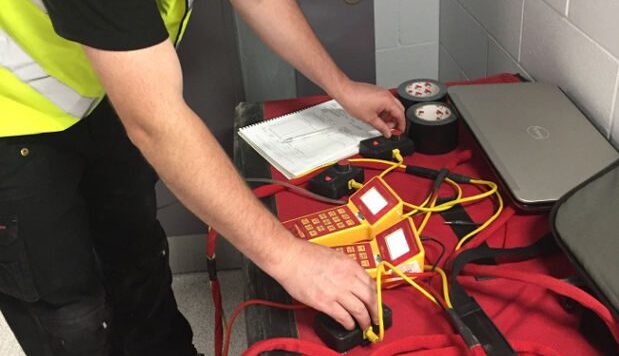
A room integrity test is a measurement of how leaky a protected room is, and what this leakage means for the performance of the gas suppression system. It is commonly called a door fan test because the equipment used is a calibrated fan fitted into a doorway.
In a gas suppression system, the extinguishing agent is discharged into the room in seconds, reaching a design concentration. That concentration must then be maintained for a minimum period, called the hold time or retention time, to make sure the fire is completely extinguished and does not re-ignite as hot surfaces cool down. The tighter the room, the longer the gas stays.
The test answers three practical questions:
- Will the agent stay in the room long enough to extinguish the fire and prevent re-ignition?
- Where are the leaks that need to be sealed?
- Can the room safely withstand the pressure created during discharge, or does it need pressure relief?
How Does Room Integrity Testing Work?
In room integrity testing, pressure is created in the room or area where the gas suppression system is installed. Two things are measured:
- Integrity of the room against leakage. The test confirms that the gas does not escape from the room before the fire is extinguished. Leakage is measured by recording how much air flow is needed to maintain a given pressure difference between the inside and outside of the room. The result is expressed as the equivalent leakage area (ELA), which is the total area of all the small gaps in the room, as if they were combined into one single hole.
- Strength of the room against excess pressure. When a gas system discharges, it introduces a large volume of gas into a closed space in a very short time, and the pressure inside the room can rise sharply, particularly with inert gas systems. If the room is sealed too tightly and has no way to release this extra pressure, the walls, ceilings, doors and windows can be damaged. The test and calculations help determine whether pressure relief venting is needed to protect the internal structure of the room, while keeping the room tight enough to retain the gas.
The test, step by step
- A calibrated fan is fitted in a doorway using an adjustable frame and a sealing panel, so the fan is the only air path for the test.
- Dampers, ducts and openings are set in their discharge condition, as they will be when the system activates (for example, closed dampers and shut-down ventilation), and temporary sealing is applied where required.
- The fan pressurizes the room (positive pressure), and then depressurizes it (negative pressure). At a range of pressures, the air flow through the fan is recorded.
- Software calculates the equivalent leakage area from the measured air flow and pressure.
- The results are used to predict the retention time, based on the type of agent, design concentration, room volume, room height, temperature, and the height to which the agent must be held.
- Leaks are located using smoke, and where useful, other tools such as thermal imaging or acoustic detection, during pressurization.
- The results are compared with the required hold time and design limits.
- A report is issued with the results, findings and recommendations.
The test does not need any gas discharge, so there is no release of costly agent, no environmental impact, and no risk to people.
What Is the Minimum Retention Time?
The room integrity test ensures that the agent that is meant to extinguish the fire will maintain the correct concentration, after attaining it, for a specific period of time. This period is called the minimum retention time or hold time.
Why does this matter? A fire does not die instantly the moment the gas reaches the design concentration. Hot surfaces, overheated cables, glowing materials and equipment can stay hot enough to re-ignite for some time after the flames have been extinguished. If the gas leaks away too quickly, the concentration falls and the fire can restart. The agent must therefore remain at an effective concentration long enough for materials to cool down and for the fire to be properly extinguished.
Under European and international practice, such as EN 15004-1 and ISO 14520, the typical minimum retention time for gaseous extinguishing agents is ten minutes. For carbon dioxide systems, and for hazards that involve deep-seated fires or materials which stay hot for a long time, a longer retention time may be required, and a figure of twenty minutes is commonly cited for CO2. NFPA 2001 also requires clean agent systems to hold the design concentration for a minimum period of ten minutes, unless the authority having jurisdiction approves a different time. The exact required time for your project depends on the agent, the hazard, the system design and the standard and authority applicable to you.
What Is the Minimum Protected Height?
The agent does not leak out evenly. Because of density differences between the agent and air, the gas mixture inside the room forms a gradually changing interface. In many agents, the heavier gas settles lower, while the lighter air moves upward, and the boundary between them slowly descends as leakage continues.
The minimum protected height is the height above the floor up to which the agent concentration must be maintained for the required hold time. It normally starts from the floor and extends to the top of the equipment or hazard to be protected. All the equipment that needs protection must be below this level, so that the fire cannot restart in any part of the protected hazard.
The minimum protected height is set by the system designer and the responsible person for the installation, in accordance with the standard. It is important to use the figure suggested by the designer and the responsible person, because using an incorrect height can give a false pass or a false fail. For example, a room that has equipment racks up to 2.4 meters high needs a protected height above that level, not just a lower, easier figure.
Why Room Integrity Testing Is Important
- The system is only as good as the room
Many system owners assume that if the cylinders are full and the panel shows normal, the system will work. In reality, the best system in the world cannot compensate for a room that leaks.
- It prevents re-ignition
Short retention time means the gas leaves the room before the fire is out and before hot surfaces have cooled. Re-ignition can be as damaging as the first fire.
- It avoids wasted investment
Gas suppression systems are a significant investment. A system that fails because the room was not tested, or was modified after installation, wastes that investment and leaves critical assets unprotected.
- It finds problems before a fire does
Cable openings, ceiling gaps, pipe penetrations, unsealed ducts, door gaps and cracks in walls are common. Testing finds them in a calm and controlled situation.
- It protects the room from over-pressure
If the room is too tight and has no relief vent, discharge can damage ceiling tiles, doors and partitions. In the worst case, structural damage and injury can occur. Testing and calculation help avoid this.
- It supports compliance and insurance
Standards recommend room integrity testing before installation handover and at regular intervals. A dated test report from a competent contractor is strong evidence of compliance for insurers, consultants and authorities.
- It protects critical operations
In a server room, telecom exchange, bank vault, control room or hospital imaging suite, a failed fire protection system can mean a prolonged shutdown, data loss and heavy financial damage.
Which Systems Need Room Integrity Testing?
Room integrity testing is required for rooms protected by total flooding gas suppression systems, including:
- FM-200 (HFC-227ea) clean agent systems
- Novec 1230 (FK-5-1-12) clean agent systems
- Carbon dioxide (CO2) systems
- Inergen (IG-541) inert gas systems
- IG-55 inert gas systems
- Other inert gas and clean agent systems designed for total flooding of an enclosure
The tightness of the room needed depends on the agent used. For example, the amount of leakage a room can tolerate differs between clean agents and inert gases because of differences in their design concentrations, density and discharge characteristics. Some agents are more sensitive to leakage than others, which affects the amount of sealing that a room requires and therefore the construction cost. The system designer’s calculations show the maximum leakage allowed for each system.
Rooms that were originally designed for older fire protection systems, including Halon, should not be assumed to be tight enough for a modern replacement. Performance must be verified by testing, since an older room that passed in the past may fail for a new agent, and improvements in the room’s construction (such as sealing walls, floor slabs, ceiling voids and penetrations) may be needed. It is always more economical to find this out during design and testing than after a failure.
Typical Rooms Protected by Gas Systems
- Data centers and server rooms
- Telecom exchanges, switch rooms and BTS rooms
- Banking vaults and cash rooms
- Control rooms and SCADA rooms
- Electrical switchgear rooms and MCC rooms
- UPS and battery rooms
- Generator rooms (CO2 or clean agent systems)
- Hospital imaging and diagnostic rooms (MRI, CT)
- Archives, record rooms, libraries and museums
- Laboratories and clean rooms
- Broadcast studios and equipment rooms
- Pharmaceutical and sensitive storage areas
How Often Is a Room Integrity Test Required?
A gas suppression system extinguishes a fire without water damage, and can protect the environment and critical assets, so the room it protects should be tested regularly. Standards such as ISO 14520 and BS EN 15004, together with NFPA 2001, recommend a room integrity test:
- Before the system is handed over, as part of commissioning and acceptance
- At least once a year afterward, or the enclosure checked for changes and retested as the standard, authority or insurer requires
- After any modification to the room, such as new walls, doors, windows, cable routes, ducts, equipment installations or changes in ventilation
- After any event that could have affected the room, such as building works, renovation, earthquake, water damage or a fire
Requirements can vary by standard edition, authority and insurer, and some owners choose to test more often for critical rooms. We prepare a tailored schedule for each client.
What to Do If the Room Fails
A failed room integrity test is common and fixable. It simply means there are leaks to seal. If your room fails, Fire Safety Trading provides a complete, detailed report, and then helps you fix the problem.
Step 1: Find the leaks
We use smoke to find the leakage points while the room is under pressure. The smoke is drawn toward or blown out of the gaps, showing exactly where air is moving. Leaks are marked and photographed.
Step 2: Identify the leakage paths
Typical leakage points include:
- Gaps under, around or between doors
- Cable openings and cable trays passing through walls and floors
- Pipe and conduit penetrations
- Ducts, grilles and dampers that do not close completely
- False ceiling and raised floor voids that connect with adjacent areas
- Gaps at the junction between walls and slabs
- Unsealed or cracked block walls, especially where partition walls stop at the false ceiling and do not reach the slab above
- Windows, vision panels and glazing frames
- Light fittings and ceiling tile gaps
- Floor drains, sleeves and risers
Step 3: Seal the leaks
After identifying the leakage points, they are sealed with suitable sealing products, such as fire-rated sealants, intumescent putty or mastic, cable transit systems, fire-rated pillows and boards, door seals and drop seals, damper actuators, and wall and ceiling extensions to the slab. The right materials depend on the fire rating, cable movement and maintenance access needs.
Step 4: Retest
Once the sealing work is complete, we repeat the test to confirm that the room now meets the requirements. We repeat this cycle until the room achieves a pass.
Step 5: Consider pressure relief
If the test and calculations show that the room is too tight and needs pressure relief venting, we advise on the proper size and type of vent, and its location, so that the room can safely release excess pressure on discharge without losing too much gas.
Step 6: Final report
You receive a final report that records the initial result, the corrective works, and the final pass result, which you can keep with your fire system documentation.
Our Room Integrity Testing Process
Step 1: Consultation and Information Gathering
We collect information about your gas system and room: agent type, design concentration, discharge time, room dimensions, ceiling height, protected height, ventilation arrangements and any previous test reports. A site visit can be arranged if needed.
Step 2: Preparation
We coordinate access to the room and agree on the time of test with your IT, facilities or operations team, since the test often needs ventilation to be shut down and dampers closed. We also confirm that discharge is disabled during the testing and the gas system is in a safe, isolated mode.
Step 3: Set-Up
We fit the door fan assembly, set the room in its discharge condition, and prepare monitoring equipment.
Step 4: Testing
The fan creates pressure and depressurization in steps, the readings are recorded, and the leakage area is calculated.
Step 5: Leak Location
Smoke and other methods help to find individual leaks, and these are documented with photographs.
Step 6: Analysis
Software analysis predicts the retention time for the agent and compares it to the minimum requirement. We also review the pressure relief requirements.
Step 7: Immediate Feedback
You receive a quick verbal summary on the day of testing: pass, fail or marginal, and the main leakage points.
Step 8: Reporting
A formal written report follows, with all test data, calculations, findings and recommendations.
Step 9: Remedial Work and Retest
If required, we help you plan, carry out or supervise the sealing work, and then retest to confirm the final result.
Step 10: Next Test Reminder
We note the date by which your next room integrity test is due and, if you ask, remind you before that date.
What Is Included in Our Room Integrity Test Report?
- Project and room identification, date and time of the test
- System details: agent, design concentration, discharge time and quantity
- Room details: dimensions, volume, height and protected height
- Test equipment and calibration details
- Test conditions (temperature, ventilation state, damper positions)
- Measured leakage results and equivalent leakage area
- Predicted retention time and comparison with requirements
- Pressure relief assessment
- Photographs and descriptions of leakage paths
- Pass, fail or conditional result
- Recommendations for sealing and improvement
- Retest results after remedial works (if applicable)
- Date of next recommended test
- Engineer’s signature and certification
How to Prepare Your Room for the Test
You can help to make the test quicker and more accurate.
- Tell us the system details. Provide drawings, system design data and the agent type, if available.
- Arrange access and timing. Choose a time that does not disrupt operations, and inform security and building management.
- Make sure ventilation can be shut down. The room should be tested in the same condition as it will be during a real discharge.
- Check that doors are in their final form. Doors, frames, seals and closers should be installed.
- Complete construction work. Wall finishes, sealing works, cable entries and ceiling works should be finished so that the test reflects the real condition.
- Do not seal temporarily without telling us. Temporary tapes and fillers can give a false pass.
- Keep the room clear. Remove obstacles so that we can reach the doors, ceilings and floor openings.
- Notify your fire alarm monitoring company if the fire alarm panel will be affected.
Design Tips for Gas-Protected Rooms
Good integrity starts at the design stage. Practical tips include:
- Build partition walls from slab to slab, not just up to the false ceiling
- Specify tight-fitting doors with seals and drop seals, and use self-closing devices
- Provide sealed cable entry systems with room to add cables later without compromising the seal
- Use dampers with fast-closing actuators on ventilation openings, linked to the gas system
- Avoid unnecessary windows, glass partitions and louvers
- Consider the raised floor and ceiling void as part of the protected volume, or isolate them properly
- Plan pressure relief venting at the design stage for inert gas systems
- Include room integrity testing in the project program, before the final handover, so there is time to fix problems
Involving your fire protection contractor early often saves money and avoids delays at handover.
Industries We Serve
- IT and data centers: server rooms, colocation facilities, disaster recovery sites
- Telecommunications: exchanges, switch rooms, towers’ equipment rooms
- Banking and finance: data rooms, vaults, record rooms, ATM switching centers
- Power and energy: control rooms, switchgear rooms, battery rooms, generator rooms
- Healthcare: imaging rooms, laboratories, server rooms
- Government and defense: control centers, archives, communication rooms
- Industrial plants: MCC rooms, PLC rooms, process control rooms
- Oil, gas and petrochemicals: control rooms, turbine enclosures, analyzer houses
- Culture and heritage: museums, libraries, archives
- Broadcasting and media: studios, master control rooms
Room Integrity Testing in Our Core Cities
Room Integrity Testing in Lahore
Lahore is a major hub for IT companies, banks, telecom operators, hospitals, universities and industry, many with gas-protected server rooms, electrical rooms and archives. Fire Safety Trading provides room integrity testing in Lahore for:
- Server rooms and data centers in business towers and technology parks
- Bank data rooms and vaults
- Telecom switch rooms
- Electrical and control rooms in industrial estates
- Hospital imaging rooms and records rooms
Room Integrity Testing in Karachi
Karachi is the center of Pakistan’s banking, industrial, shipping and telecom sectors, with a high concentration of critical rooms. Fire Safety Trading provides room integrity testing in Karachi for:
- Banks, financial institutions and data centers
- Industrial control rooms and substations
- Port, logistics and energy facilities
- Telecom exchanges and network operations centers
- Hospitals and corporate head offices
Karachi’s humid, coastal environment can age sealing materials and cause corrosion of dampers and fittings, so we recommend periodic integrity checks and sealing inspections, particularly for rooms with outside walls or roof exposure.
Room Integrity Testing in Rawalpindi
Rawalpindi’s hospitals, commercial buildings, telecom facilities and institutions rely on protected equipment rooms. Fire Safety Trading provides room integrity testing in Rawalpindi for:
- Server and communications rooms
- Hospital diagnostic and imaging rooms
- Electrical and switchgear rooms
- Government and institutional records rooms
Room Integrity Testing in Islamabad
As the federal capital, Islamabad has a heavy concentration of government data centers, telecom operators, corporate offices, embassies and technology companies, and its projects frequently require detailed documentation. Fire Safety Trading provides room integrity testing in Islamabad for:
- Government and enterprise data centers
- Telecom network operations centers and switch rooms
- Corporate head offices and IT facilities
- Embassy and institutional communication rooms
- Hospitals and research institutions
Room Integrity Testing in Peshawar
Peshawar’s hospitals, universities, telecom networks, banks and industries also depend on gas-protected rooms. Fire Safety Trading provides room integrity testing in Peshawar for:
- Bank and financial institution data rooms
- Hospital and medical college imaging and server rooms
- University data centers and archives
- Telecom switch rooms and industrial control rooms
Other Cities
We also support clients in Faisalabad, Multan, Gujranwala, Sialkot, Hyderabad, Quetta and across Pakistan.
Standards and References
Our procedures and reporting draw on recognized standards and manufacturer instructions:
- ISO 14520: Gaseous fire-extinguishing systems, including the enclosure integrity procedure
- BS EN 15004-1: Fixed firefighting systems, gas extinguishing systems, design, installation and maintenance
- NFPA 2001: Standard on Clean Agent Fire Extinguishing Systems, including enclosure integrity requirements
- NFPA 12: Standard on Carbon Dioxide Extinguishing Systems
- NFPA 72: National Fire Alarm and Signaling Code, for detection and control interfaces
- Manufacturer’s design manuals for each agent and system
- Pakistan Building Code, Fire Safety Provisions and requirements of local authorities and insurers
Standards are updated from time to time, and the required test method, pass criteria and retention time depend on the edition in force, your system design and your authority, so we confirm the applicable requirements for each project.
Room Integrity Testing Cost in Pakistan: What Affects the Price?
There is no one fixed price for a room integrity test, since every room and every project is different. Typical factors include:
- Number and size of rooms: larger rooms and multiple rooms take longer.
- Complexity of the enclosure: raised floors, false ceilings, multiple doors, ducts and connected voids.
- Test scope: a single test, or testing combined with leak location, analysis and retesting.
- Access and timing: night or weekend work for critical rooms in continuous operation.
- Location: travel to different cities.
- Remedial work: sealing materials and labor, if you want us to correct the leaks.
- Reporting needs: extra documentation for consultants, insurers or authorities.
- Contract type: a one-time test, or a yearly plan combined with gas system maintenance.
We provide a clear quotation after understanding your rooms and requirements. Compared with the cost of a failed fire protection system in a critical room, the cost of testing is small.
Why Choose Fire Safety Trading for Room Integrity Testing?
Specialized gas suppression knowledge. We understand how FM-200, Novec 1230, CO2, Inergen (IG-541) and IG-55 systems behave, and how room leakage affects each of them.
Proper equipment and methods. We use calibrated door fan equipment and analysis software, and follow recognized procedures.
More than a pass or fail. We locate the leaks, advise on sealing, assess pressure relief and retest until the room achieves a pass.
Clear, detailed reports. You receive full test data, photographs, calculations and recommendations suitable for audits and insurers.
Complete fire protection capability. We can also inspect and maintain your gas system, detection, alarms, sprinklers and pumps, so everything works together.
Minimal disruption. We plan around your operations and complete tests quickly.
Presence in Pakistan’s key cities. We serve Lahore, Karachi, Rawalpindi, Islamabad and Peshawar, and understand local building practices and conditions.
Reminders for the next test. We record your next due date and can remind you in advance.
If you are looking for the best technicians for room integrity testing services near you, Fire Safety Trading is just a phone call away for a consultation.
Frequently Asked Questions
What is a room integrity test? It is a test that measures how leaky a room protected by a gas suppression system is, and predicts how long the extinguishing gas will stay at the required concentration after discharge.
What is a door fan test? It is the common name for a room integrity test. A calibrated fan is fitted in a doorway to pressurize and depressurize the room, and the airflow and pressure readings are used to calculate leakage.
Why does my gas-protected room need this test? Because the system will only extinguish the fire and prevent re-ignition if the gas stays in the room long enough. Leaks reduce the hold time and can cause system failure.
What is the minimum retention time? It is the minimum period for which the extinguishing agent must stay at the required concentration after discharge. In many standards, this is ten minutes, with longer periods specified for some agents or hazards (for example, twenty minutes is commonly cited for CO2). The exact requirement depends on the standard, design and authority.
What is the minimum protected height? It is the height above the floor up to which the agent must be maintained for the full hold time, normally above the top of the equipment to be protected, and set by the system designer.
Which systems need room integrity testing? Total flooding gas systems such as FM-200, Novec 1230, CO2, Inergen (IG-541) and IG-55.
Does the test involve discharging the gas? No. The test uses a fan and does not release any agent, so there is no cost for refilling and no risk to people or the environment.
How often should the test be carried out? Standards such as ISO 14520, BS EN 15004 and NFPA 2001 recommend testing before handover, at least once a year afterward (or checking the enclosure and retesting as required), and after any modification to the room.
How long does the test take? It depends on the size and complexity of the room. A single room is often completed within a few hours, and leak finding or sealing can add time.
What happens if my room fails? We give you a detailed report, use smoke to find the leaks, and advise on sealing them. After sealing, we retest to confirm that the room passes.
Do you also do the sealing work? We can advise on sealing methods and, where agreed, carry out or supervise the work with suitable sealing products, then retest.
Why is too much sealing a problem? If a room is extremely tight and has no pressure relief, the pressure rise during discharge can damage doors, ceilings and walls. Testing and calculation help decide if pressure relief venting is needed.
Will the test disturb my operations? We plan the test around your needs. Ventilation may need to be shut down briefly, and the room may need to be accessible, but the test is non-destructive and does not shut down your equipment.
Can you test rooms where the system was installed by someone else? Yes. We can test any gas-protected room, subject to getting the system design information.
How much does a room integrity test cost in Pakistan? The price depends on the number and size of rooms, complexity, test scope, location and any remedial work. We give a clear quotation after understanding your requirements.
Make Sure Your Gas Will Stay Where It Is Needed
A gas suppression system is a serious investment in protecting your most critical rooms. A room integrity test is the only practical way to be sure the room will do its part.
Contact Fire Safety Trading today for room integrity testing in Lahore, Karachi, Rawalpindi, Islamabad, Peshawar or anywhere in Pakistan. We will test your room, locate the leaks, help you seal them, and give you the documented assurance that your system will work when it matters.
Get Quotation
Informational FAQs
Room Integrity Testing, also known as a Door Fan Test, is a procedure used to verify whether an enclosed room can retain a fire suppression agent, such as FM-200 or Novec 1230, for the required hold time during a fire emergency.
Room Integrity Testing ensures that the extinguishing agent remains inside the protected area long enough to suppress the fire effectively. It also helps meet fire safety standards, insurance requirements, and manufacturer recommendations.
Room Integrity Testing is recommended for data centers, server rooms, control rooms, electrical rooms, UPS rooms, telecom facilities, archives, laboratories, and other spaces protected by clean agent fire suppression systems.
Room Integrity Testing should be carried out after a new fire suppression system is installed, after major building modifications, or as part of periodic maintenance according to applicable fire safety standards.
The service includes door fan testing, enclosure leakage measurement, hold time calculation, leak detection, detailed inspection, and a comprehensive test report with recommendations for improving room integrity if required.
The cost of Room Integrity Testing in Pakistan depends on the room size, enclosure complexity, number of protected areas, and testing requirements. Fire Safety Trading Pvt Ltd provides competitive pricing for commercial and industrial projects.
Room Integrity Testing prices vary depending on the project scope and facility size. Contact Fire Safety Trading Pvt Ltd for a customized quotation in Lahore, Karachi, Rawalpindi, and Peshawar.
If the room does not meet the required hold time, our technicians identify leakage points around doors, walls, ceilings, cable penetrations, ducts, and other openings. We provide recommendations to seal the leaks before retesting.
Yes, Fire Safety Trading Pvt Ltd provides detailed Room Integrity Testing reports, hold time calculations, and testing documentation to support compliance, audits, and insurance requirements.
Room Integrity Testing is commonly performed for FM-200, Novec 1230, Inergen, Argonite, CO₂, and other clean agent fire suppression systems installed in enclosed spaces.
Yes, Fire Safety Trading Pvt Ltd provides professional Room Integrity Testing services in Lahore, Karachi, Rawalpindi, and Peshawar for data centers, server rooms, industrial facilities, and commercial buildings.
Fire Safety Trading Pvt Ltd offers experienced engineers, calibrated testing equipment, accurate hold time analysis, detailed reporting, and reliable technical support to ensure your protected rooms comply with international fire safety standards.
Fire Safety Trading Pvt Ltd offers Room Integrity Testing services across Pakistan, helping businesses verify the effectiveness of clean agent fire suppression systems and maintain compliance with fire safety regulations.
Yes, Room Integrity Testing is highly recommended for FM-200, Novec 1230, and other clean agent fire suppression systems to confirm that the protected enclosure can retain the extinguishing agent for the required design hold time.
Yes, Fire Safety Trading Pvt Ltd provides complete services including Room Integrity Testing, FM-200 System Testing, Novec 1230 System Testing, Fire Suppression Testing, Fire Alarm Testing, inspection, maintenance, and certification for commercial and industrial facilities across Pakistan.