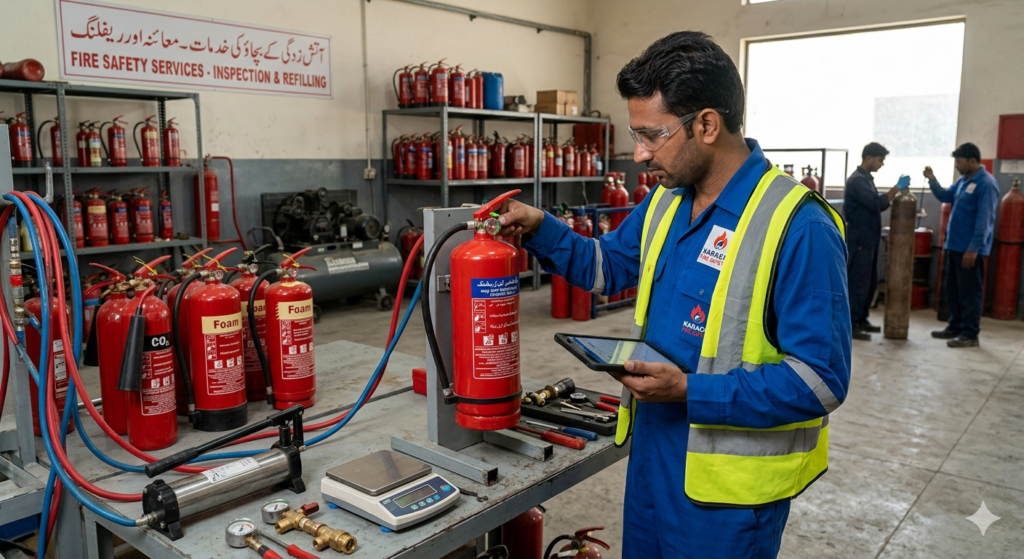
Fire Extinguisher Refilling
Fire Safety Trading (Pvt)
ToggleFire extinguisher refilling is an extremely important phenomenon, inspect fire extinguishers at least once a month (more often in severe environments).
Refilling & Maintaince
Thorough inspections and risk assessments to identify vulnerabilities and ensure compliance.

Fire extinguishers are only as reliable as their last inspection. A cylinder sitting quietly in a corridor for years can look perfectly fine on the outside while being completely useless on the inside low pressure, clumped powder, an expired seal, or a corroded valve. When a real fire breaks out, that gap between “looks fine” and “actually works” is what decides whether a small flare-up stays small or turns into a major loss.
This is why fire extinguisher refilling in Pakistan is not a one-time purchase decision but an ongoing safety commitment. Whether you run a textile mill in Faisalabad, a restaurant kitchen in Lahore, a corporate office in Islamabad, a warehouse in Karachi, or a school in Peshawar, the extinguishers protecting your building need periodic inspection, pressure testing, and refilling to stay emergency ready.
This guide walks through everything a building owner, facilities manager, or safety officer in Pakistan needs to know extinguisher types, refilling agents, inspection schedules, the refilling process itself, costs, common mistakes, and how to choose a refilling company you can actually trust.
Why Fire Extinguisher Refilling Matters So Much
A fire extinguisher works on a simple principle: pressurized gas forces an extinguishing agent out through a hose or nozzle, allowing the user to attack a fire from a safe distance. That entire mechanism depends on internal pressure staying within a specific range, shown on the pressure gauge as a green “operable” zone.
Over time, several things can quietly compromise that readiness:
- Pressure loss: through micro-leaks at the valve or hose connections
- Powder caking: inside DCP cylinders due to humidity, especially in coastal cities like Karachi
- Agent degradation: in foam and wet chemical extinguishers, which can separate or lose effectiveness
- Corrosion: of the cylinder body, valve, or siphon tube, particularly in industrial or high-humidity environments
- Partial discharge: from accidental bumps, testing, or minor use that isn’t reported
None of these issues are visible from a quick glance at the cylinder. Only a proper inspection checking the gauge, weighing the cylinder, and where necessary opening it for a full service reveals whether the unit will actually perform when needed. This is the entire reason refilling and periodic maintenance exist as a discipline separate from simply “having extinguishers” in a building.
There’s also a compliance dimension. Insurance policies, NFPA-referenced fire safety plans, factory inspection regimes, and increasingly the requirements of corporate landlords and multinational tenants in Pakistan all expect documented, dated proof that extinguishers are inspected and refilled on schedule. An extinguisher with an expired service tag can become a liability during an audit even if it happens to still hold pressure.
Understanding the Types of Fire Extinguishers and Their Refilling Agents
Not every extinguisher is refilled the same way. The agent, the fire class it’s rated for, and the internal mechanism all differ, so refilling has to be matched precisely to the extinguisher type.
Dry Chemical Powder (DCP) Fire Extinguishers
DCP extinguishers are the most common type installed across Pakistan in shops, offices, factories, and vehicles. They’re rated as Class A (ordinary combustibles), Class B (flammable liquids), and Class C/E (electrical fires), which makes them a practical, all-purpose choice for most commercial premises.
The extinguishing agent is typically a blend of mono-ammonium phosphate and ammonium sulfate powder, engineered to smother flames by interrupting the chemical reaction and coating the burning material. Refilling a DCP cylinder requires:
- Completely emptying and depressurizing the old charge
- Weighing and inspecting the cylinder body for corrosion or damage
- Filling with the correct grade and exact weight of dry chemical powder, matched to the cylinder’s rated capacity
- Recharging with nitrogen or dry air to the specified working pressure
- Testing the valve and gauge before resealing
Getting the powder-to-pressure ratio wrong is one of the most common refilling mistakes too little powders reduce discharge time and firefighting capacity, while incorrect pressurization can affect discharge range.
Carbon Dioxide (CO2) Fire Extinguishers
CO2 extinguishers are widely used around electrical panels, server rooms, generators, and laboratories because the gas is non-conductive and leaves no residue an important consideration for sensitive equipment.
CO2 units work differently from other extinguishers: the gas itself is stored as a liquefied compressed gas, and there’s no separate propellant. Refilling involves weighing the cylinder precisely (CO2 extinguishers are checked by weight, not just gauge pressure, since standard pressure gauges don’t reliably indicate CO2 fill level), then recharging to the exact weight specified on the extinguisher’s nameplate. Even a small underfill significantly reduces discharge time in a real fire.
Water-Type Fire Extinguishers
Suitable only for Class A fires (wood, paper, textiles, and other ordinary combustibles), water-type extinguishers should never be used on electrical or flammable-liquid fires. Several sub-types exist plain water jet, water spray, water with additives, and water mist/fog each suited slightly different applications.
Refilling is comparatively simple: the cylinder is emptied, inspected internally for corrosion (a common issue given the extinguisher’s constant exposure to water), refilled with the specified water volume or additive mixture, and repressurized with air or nitrogen.
AFFF Foam-Type Fire Extinguishers
AFFF (Aqueous Film-Forming Foam) extinguishers are effective on Class A and Class B fires, particularly flammable liquid fires in industrial and warehouse settings, since the foam forms a smothering film over the fuel surface that also helps prevent reignition.
Because the foam concentrate can degrade or separate over time, refilling AFFF units requires more careful agent handling than DCP or water types of old concentrate must be fully drained, the cylinder cleaned, and fresh, correctly proportioned foam concentrate added before repressurizing.
Halotron (Clean Agent) Fire Extinguishers
Halotron extinguishers use an HCFC-based clean agent combined with dry nitrogen, designed to leave no residue making them the extinguisher of choice for server rooms, control rooms, museums, laboratories, and anywhere sensitive electronics or valuable materials are present.
Refilling requires precise measurement of both the Halotron agent and the nitrogen propellant, since an imbalance between the two directly affects discharge performance. This is one of the more technically demanding refilling jobs and should always be handled by a trained technician with the correct charging equipment.
Wet Chemical Fire Extinguishers
Increasingly common in commercial kitchens restaurants, hotels, and catering facilities wet chemical extinguishers are specifically designed for Class F/K fires involving cooking oils and fats. The agent reacts with hot oil to form a soap-like layer that cools the surface and prevents reignition, something a standard DCP or CO2 unit cannot do safely on a deep-fat fryer fire.
When Should a Fire Extinguisher Be Refilled?
There’s no single universal answer refilling frequency depends on extinguisher type, usage, and environment but general good-practice guidelines apply across Pakistan:
- Monthly visual inspection: check the pressure gauge is in the green zone, the pin and tamper seal are intact, and there’s no visible damage or corrosion.
- Annual professional inspection: a certified technician checks weight, pressure, hose condition, and valve function, and refills or services as needed.
- Immediate refilling after any use: even a brief discharge to test the trigger drops the pressure enough to compromise readiness.
- Refilling at manufacturer-specified intervals: for the agent itself DCP and CO2 units, for example, often have a recommended hydrostatic test interval (commonly every 5 years) in addition to routine refilling.
- Refilling immediately if the gauge needle sits outside the green zone: if the powder feels caked when the cylinder is shaken, or if there’s visible corrosion around the valve or base.
Environments matter too. A DCP extinguisher installed in a humid coastal warehouse in Karachi will typically need more frequent powder checks than the same unit in a dry, climate-controlled office in Islamabad.
The Fire Extinguisher Refilling Process, Step by Step
Refilling isn’t just “adding powder and closing the cap.” A proper service follows a defined sequence to make sure the extinguisher performs exactly as rated once it’s back in service.
- Depressurize and empty the cylinder: The cylinder is held vertically, and the discharge handle is gently pressed until the gauge reads zero, fully releasing any remaining pressure before the valve is opened.
- Clean the exterior: The outer body is wiped down with a solvent-free cleaner to remove dust, grime, and any residue, which also allows the technician to inspect the shell for dents, rust, or damage.
- Remove the valve assembly and siphon tube: The valve, valve stem, and internal siphon tube are removed for cleaning and inspection. This is also when any internal corrosion or blockage is caught.
- Inspect and clean the valve: The valve mechanism is checked for wear, cleaned, and if any component is damaged replaced before reassembly.
- Select the correct refill agent: The technician selects the exact agent type and grade matching the extinguisher’s original rating (DCP, CO2, foam, water, Halotron, or wet chemical) never mixing agents of different types or qualities.
- Refill to the specified quantity: Using a funnel or calibrated filling equipment, the agent is added to the precise weight or volume specified on the extinguisher’s nameplate underfilling is one of the most common causes of extinguisher failure in the field.
- Reassemble and pressurize: the valve is reassembled, tightened to prevent leakage, and the cylinder is recharged with nitrogen or dry air (or, for CO2 units, the CO2 itself) to the correct working pressure.
- Leak and pressure test: Before the extinguisher goes back into service, the technician tests the valve seal and pressure retention to confirm there’s no leakage.
- Final clean and tag: the exterior is cleaned again, and the extinguisher is fitted with a new service tag showing the refill date, technician details, and next due date the documentation that matters most during audits and inspections.
- Reinstallation: The extinguisher is remounted on a proper stand or bracket at an accessible height, away from obstructions, so it’s genuinely usable in an emergency rather than just present in the room.
Can You Refill a Fire Extinguisher Yourself?
Technically, yes, the process above can be performed by anyone with the right materials, tools, and care. Pakistani law doesn’t prohibit self-refilling, and many small businesses attempt it to save cost.
In practice, though, professional refilling is strongly recommended for a few reasons:
- Precision matters: Getting powder weight, gas pressure, or foam concentration even slightly wrong can significantly reduce an extinguisher’s real-world performance, a risk you only discover during an actual fire.
- Equipment matters: Professional refilling stations use calibrated filling and pressure-testing equipment that most businesses simply don’t have access to.
- Certification matters: A properly tagged, professionally serviced extinguisher is what insurers, auditors, and fire safety inspectors expect to see. A self-refilled unit without documentation can create compliance headaches even if it was done correctly.
- Hydrostatic testing: of the cylinder itself checking the metal shell can safely hold pressure requires specialized equipment that isn’t available for DIY use.
For a single household extinguisher, a careful DIY refill following manufacturer instructions may be reasonable. For any commercial, industrial, or multi-unit setting, professional refilling is the safer and more compliant route.
What Does Fire Extinguisher Refilling Cost in Pakistan?
Refilling costs in Pakistan vary based on several factors, so there’s no single fixed price across the market:
- Extinguisher type: CO2 and Halotron refills are typically more expensive than DCP or water-type refills due to the cost of the agent itself.
- Cylinder capacity: is a 2kg DCP unit costs less to refill than a 9kg or 25kg industrial cylinder.
- Condition of the cylinder: if valve components, hoses, or seals need replacement, this adds to the base refilling cost.
- Whether hydrostatic testing is due: pressure-testing the cylinder shell is an additional service beyond a routine refill.
- Volume and contract terms: businesses refilling dozens or hundreds of units under an Annual Maintenance Contract (AMC) typically get better per-unit rates than one-off refills.
- Location and logistics: onsite collection and delivery across cities like Lahore, Karachi, Rawalpindi, Islamabad, and Peshawar can factor into the final quote.
The most reliable way to get an accurate figure is a direct quotation based on your specific extinguisher inventory type, capacity, and quantity rather than relying on a generic per-unit price, since the range across extinguisher types can be significant.
Fire Extinguisher Refilling Services Across Pakistan
Fire safety needs don’t stop at any one city, and refilling requirements are broadly similar whether the premises is a factory floor or a retail outlet though local climate and industry mix shift the details slightly.
Lahore: With its dense mix of textile units, retail centers, and residential high-rises, Lahore sees consistent year-round demand for DCP and CO2 refilling, particularly across industrial zones where powder caking from humidity is a recurring issue.
Karachi: As Pakistan’s largest industrial and port city, Karachi’s coastal humidity accelerates corrosion in metal cylinders and valve components, making more frequent inspection cycles especially important for warehouses, manufacturing plants, and port-adjacent facilities.
Rawalpindi and Islamabad: the twin cities’ mix of corporate offices, government buildings, and residential complexes generates steady demand for both routine refilling and full AMC-based maintenance contracts, often tied to formal compliance and audit requirements.
Peshawar: Refilling demand spans commercial markets, educational institutions, and industrial units, with particular attention to accessible service given the city’s geography.
Faisalabad: As a major textile hub, Faisalabad’s mills and factories rely heavily on properly maintained DCP and foam extinguishers rated for the specific fire risks of fabric, dust, and machinery.
Other cities like: Quetta, Multan, Gujranwala, Sialkot, Hyderabad, Sukkur, Gilgit, Muzaffarabad, and Gwadar all have active commercial and industrial sectors that require the same standard of periodic refilling and inspection, regardless of city size.
Wherever your premises are located, the underlying requirement is the same: extinguishers that are inspected on schedule, refilled with the correct agent and quantity, and properly documented.
Signs Your Fire Extinguisher Needs Refilling Right Now
Don’t wait for the annual inspection if you notice any of these warning signs:
- The pressure gauge needle sits outside the green “operable” zone
- The tamper seal or pin is broken or missing
- Visible rust, dents, or corrosion on the cylinder body
- The powder feels solid or clumped when the extinguisher is gently shaken (common in DCP units)
- The hose or nozzle shows cracks, blockage, or wear
- The extinguisher has been discharged, even partially, for any reason
- The service tag shows a due date that has already passed
- The cylinder has failed a due hydrostatic pressure test
Anyone of these is reason enough to schedule an immediate inspection rather than waiting for the next routine cycle.
Common Mistakes Businesses Make with Fire Extinguisher Maintenance
- Treating extinguishers as a one-time purchase rather than an ongoing service commitment
- Skipping monthly visual checks because “nothing’s happened yet”
- Mixing refill agents of different qualities or brands in the same cylinder
- Ignoring minor pressure drops, assuming the extinguisher still “basically works”
- Installing the wrong extinguisher type for the specific fire risk for example, a DCP unit in a commercial kitchen instead of a wet chemical extinguisher rated for cooking-oil fires
- Placing extinguishers behind obstructions or at inaccessible heights, undermining even a perfectly serviced unit
- No centralized maintenance record, making it difficult to track due dates across a large site or multiple locations
Why Choose a Professional Fire Extinguisher Refilling Company
A qualified refilling provider brings more than just the ability to fill a cylinder with powder or gas. Look for a company that offers:
- Certified, trained technicians who follow documented refilling procedures for each extinguisher type
- Calibrated equipment for accurate weight-based and pressure-based filling
- Proper agent sourcing genuine DCP, CO2, foam, Halotron, and wet chemical agents rather than substandard alternatives
- Hydrostatic testing capability for cylinders due to pressure testing
- Complete documentation dated service tags, inspection reports, and certificates suitable for insurance and audit purposes
- Multi-city service coverage, useful for businesses with branches across Pakistan
- Annual Maintenance Contracts (AMCs) that bundle inspection, refilling, and testing into a predictable, scheduled service rather than reactive one-off calls
Fire Safety Trading (Pvt) Ltd Refilling Services Across Pakistan
Fire Safety Trading (Pvt) Ltd provides professional fire extinguisher refilling, inspection, installation, and maintenance services across Pakistan, including Rawalpindi, Islamabad, Lahore, Karachi, Faisalabad, Quetta, Peshawar, Gilgit, Muzaffarabad, and Gwadar.
Our services cover:
- Refilling of DCP, CO2, Water Type, AFFF Foam, Wet Chemical, and Halotron Clean Agent fire extinguishers
- Installation of new fire extinguishers matched your building’s specific fire risk profile
- Scheduled inspection and maintenance to keep extinguishers audit-ready year-round
- Onsite technician visits for collection, refilling, and reinstallation with minimal disruption to your operations
- Annual Maintenance Contracts (AMCs) for businesses managing multiple extinguishers across one or several sites
Whether you’re maintaining a handful of extinguishers in a single office or managing fire safety compliance across a multi-site industrial operation, our trained technicians handle the full process from initial inspection through certified refilling and reinstallation.
Building a Reliable Fire Safety Routine Around Refilling
Fire extinguisher refilling works best as part of a broader, consistent safety routine rather than an isolated task handled only when someone remembers. Businesses that get the most protection out of their extinguishers tend to follow a similar pattern:
- A centralized inventory listing every extinguisher on the premises, its type, capacity, location, and next due date
- A designated safety officer or team responsible for the monthly visual checks
- A standing relationship with a refilling provider, so annual servicing happens on schedule rather than reactively
- Staff awareness training, so employees know where extinguishers are located, which type applies to which fire risk, and how to use one correctly
- Clear signage and unobstructed access, ensuring every extinguisher is visible and reachable within seconds
None of this replaces professional refilling, it simply ensures that a properly refilled extinguisher is also properly placed, properly understood, and properly maintained between service visits.
Final Thoughts
A fire extinguisher is a piece of standby equipment it does nothing for months or years, then suddenly has to work perfectly the first time it’s needed, under pressure, often in the hands of someone who has never used one before. That’s an unusual demand to place on any piece of equipment, and it’s exactly why refilling and maintenance can’t be treated as optional.
Across Lahore, Karachi, Rawalpindi, Islamabad, Peshawar, Faisalabad, and every other city where businesses and homes rely on fire extinguishers, the underlying principle is the same: an extinguisher is only as good as its last professional service. Regular refilling done correctly, with the right agent, the right quantity, and proper documentation is what keeps that piece of equipment ready for the one moment it actually matters.
Fire Safety Trading (Pvt) Ltd has been providing certified fire extinguisher refilling, inspection, and maintenance services across Pakistan since 2010, helping homes, offices, factories, and commercial buildings stay genuinely fire-ready rather than just fire-equipped.
Inforamtional FAQs
Fire extinguisher refilling ensures that your extinguisher remains fully charged, operational, and ready to use during a fire emergency. An empty or low-pressure extinguisher may fail when needed most.
Most fire extinguishers should be inspected annually and refilled whenever pressure drops, after any discharge, or according to the manufacturer's maintenance schedule.
Yes. Over time, pressure can decrease and extinguishing agents may deteriorate. Regular inspection and maintenance help ensure the extinguisher remains effective.
Common signs include a pressure gauge outside the green zone, damaged safety seals, corrosion, leakage, or an expired service date.
Yes. Even if only a small amount of extinguishing agent was discharged, the extinguisher should be professionally refilled and tested before being returned to service.
The refilling process typically takes a short time, depending on the extinguisher type, condition, and whether additional testing or maintenance is required.
Most rechargeable fire extinguishers, including DCP (Dry Chemical Powder), CO₂, Foam, Water, and Clean Agent extinguishers, can be professionally refilled and serviced.
Professional technicians use certified equipment, proper extinguishing agents, and pressure testing procedures to ensure compliance with fire safety standards and reliable performance.
Yes. Fire Safety Trading Pvt Ltd provides professional fire extinguisher refilling, maintenance, inspection, and testing services in Lahore, Karachi, Rawalpindi, and Peshawar for commercial, industrial, and residential clients.
You can contact Fire Safety Trading Pvt Ltd to schedule onsite inspection, collection, refilling, testing, and certification services for your fire extinguishers in Lahore, Karachi, Rawalpindi, and Peshawar.
The cost of fire extinguisher refilling in Pakistan depends on the extinguisher type, capacity, extinguishing agent, and service requirements. Contact Fire Safety Trading Pvt Ltd for a customized quotation for Lahore, Karachi, Rawalpindi, and Peshawar.
Yes. Fire Safety Trading Pvt Ltd provides fire extinguisher inspection, maintenance, pressure testing, refilling, and certification services to help businesses comply with fire safety requirements and workplace safety standards.