Fire Hose Reel Testing
Fire Safety Trading (Pvt)
ToggleProfessional testing and inspection of fire hose reels to ensure optimal water pressure, flow rate, and instant readiness during a fire emergency.
Maintaince
Thorough inspections, pressure tests, and risk assessments to identify vulnerabilities and ensure full safety compliance.
What Is a Fire Hose Reel?
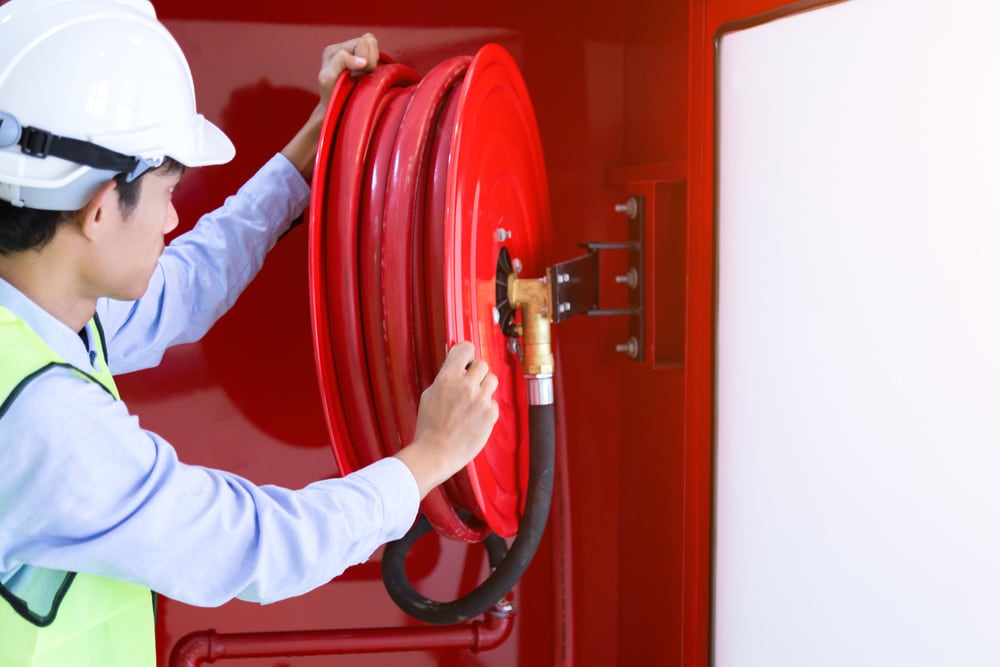
A fire hose reel is a firefighting device permanently connected to a building’s water supply. It consists of a drum, or reel, holding a length of hose, a nozzle at the end, a shut-off valve at the inlet, and a pipe connecting it to the fire water system. When a fire occurs, a person unwinds the hose, opens the valve and directs water at the fire.
The main purpose of fire hose reels is to supply water to the firefighting equipment so that it works immediately in case of a fire incident, and the fire is brought under control before it grows. Unlike a portable extinguisher, which holds a limited quantity of agent, a hose reel is fed from the water supply and can keep discharging as long as the supply lasts. This makes it very useful for fires that are beyond the capacity of a single extinguisher but still small enough for building occupants to attack safely.
Fire hose reels are usually installed along escape routes, near stairs and exits, in corridors, in warehouses, factories, parking areas, hospitals, hotels, malls and other buildings. They are often supplied from the same tank and pump set as the sprinklers and hydrants, or from a dedicated hose reel system.
How a Fire Hose Reel Works
- A small fire is discovered. Someone raises the alarm and, if it is safe to do so, goes to the nearest hose reel.
- The hose is pulled out. The reel is mounted on a swing arm or fixed bracket, so the drum rotates freely and the hose can be pulled out in the direction of the fire without kinking.
- The water valve is opened. The user opens the isolating valve at the reel inlet (on some models, the valve opens automatically when the hose is pulled out). Water flows through the hollow reel shaft into the hose.
- The nozzle is controlled. A shut-off nozzle allows the user to start, stop and sometimes adjust the water stream or spray.
- The fire is attacked. The user directs the water at the base of the fire, keeping a safe exit route behind them.
- The system is shut down. After use, the water is turned off, the hose is drained, rewound and the reel is checked and returned to service.
Because the water comes from the building’s fire water supply, the reel only works if the entire chain is working: the water source, the pump, the pipes, the valves, the reel and the hose. That is why testing a hose reel means more than just looking at it.
What Fires Can Hose Reels Be Used On?
Areas equipped with fire hose reels have a high level of protection against fire. People, buildings and the assets inside are at lower risk when hose reels are installed, properly maintained and used correctly.
However, fire hose reels are connected to the water supply, so they should be used only on fires of ordinary combustible materials such as wood, paper, cloth, cardboard and similar solids (Class A fires).
Do not use water from a hose reel on:
- Electrical fires. Water conducts electricity and can cause electric shock to the user. Fires involving live electrical equipment should be tackled with a suitable extinguisher, after isolating the power if it is safe to do so.
- Oil, petrol, diesel and other flammable liquid fires. Water can spread burning liquid, cause violent splashing, and make the fire much worse.
- Cooking oil and fat fires. Water can cause a violent flare-up. Kitchens should have wet chemical extinguishers or kitchen suppression systems.
- Fires involving reactive chemicals or metals. Water can react dangerously.
Throwing water on these materials will cause more damage. Make sure your staff know which fires a hose reel can and cannot be used on, and that suitable extinguishers are available for other types of fire.
Why Fire Hose Reel Testing Is Important
- A hose reel that does not work is worse than none
People trust hose reels. When an occupant runs to a reel and finds that the hose is cracked, the valve is stuck, the nozzle is blocked, or no water flows, precious seconds are lost, and the fire grows.
- Hidden faults are common
Hose reels often go years without being used. Rubber and plastic hoses can perish in heat and sunlight, hoses can be damaged by being crushed or folded, valves can seize, packing can leak, swing arms can corrode, and pipes can become blocked with scale or debris. None of these faults is obvious from a glance.
- Pakistan’s climate is hard on equipment
High temperatures, strong sunlight, dust, humidity and, in coastal cities, salt in the air all affect hoses, seals, valves, brackets and paint. Water supply interruptions and poor water quality can also lead to corrosion and blockages inside pipes.
- Obstructions and misuse
Reels are often blocked by furniture, stock, boxes and parked vehicles. Signage can be missing or faded. Hoses are sometimes used for cleaning or removed for other purposes. Regular checks find these problems.
- Safety of users
A burst hose or a faulty valve under pressure can injure the user and prevent the fire from being fought. Testing confirms that the equipment is safe to operate.
- Compliance and insurance
Building authorities, consultants and insurers expect firefighting equipment to be maintained. A dated inspection record from a competent contractor demonstrates that you take your duty of care seriously.
- Protection of lives and assets
When a small fire is controlled in its first minutes, the damage to the building, stock and records is small. Reliable hose reels give your people the ability to do that safely.
When Should Fire Hose Reels Be Tested?
Fire Safety Trading can carry out inspections as frequently as you want, but it is recommended to check your fire hose reels every six months and once every year. The tests at each interval cover different items.
Every Six Months
After every six months, our experts check:
- Accessibility: the reel is clear of obstructions and can be reached quickly
- Signage: hose reel signs are present, visible and in good condition
- Operating instructions: clear and legible instructions are displayed on or near the reel
- Damage: the reel, cabinet, hose, nozzle and fittings are free of visible damage
- Testing parts: the working parts of the reel are tested to make sure they operate correctly
- Nozzle interlock: the nozzle shut-off and any interlock or control mechanism works properly
- Swing arm: the swing arm (where fitted) moves freely and locks as designed, so the hose can be pulled out in any direction
- Unwind: the hose unwinds smoothly along its length without sticking, binding or kinking
- Flow: water flows freely at the nozzle, with adequate flow and pressure
- Leakage: there are no leaks from the valve, hose, couplings, reel shaft or pipe connections
- Record label: the inspection label is updated with the date, the inspector’s details and the next due date
Every Year
Once a year, our technicians carry out a more detailed examination, including:
- Anchor points: the reel and bracket are firmly secured to the wall or structure
- Hose guides: guides are in position, aligned and moving properly, so the hose winds neatly
- Fittings: couplings, connectors, valves and nozzle threads are in good condition and tight
- Damage in hose or bearings: the hose is free from cracks, cuts, abrasion, bulges, kinks and perishing; the reel’s bearings turn smoothly and without excessive wear
- Fire hazards: the surrounding area is checked for fire hazards, such as accumulations of waste, or storage of flammable materials close to the reel
- Obstructions: the hose reel and its route remain clear and the hose can reach the area it protects
Between professional visits, we recommend that your own staff carry out a quick visual check weekly or monthly, covering whether each reel is in place, accessible, signed, unobstructed, undamaged and without leaks, with any problems reported at once.
Our Fire Hose Reel Testing Services
- Visual Inspection
We examine each hose reel and its cabinet or mounting for general condition, corrosion, paint damage, missing parts, signage, labels and instructions, and verify the reel’s location against your fire safety plan.
- Functional Testing
We operate the reel in the same way as a user would in a real emergency:
- Open the isolating valve
- Pull out the hose to full length (or as far as practical)
- Check smooth rotation of the drum, swing arm and guides
- Open and close the nozzle and test any interlock or control device
- Rewind the hose and confirm that it winds neatly and fully
- Flow and Pressure Testing
We check that water actually reaches the nozzle at an adequate flow and pressure. We observe the stream and use gauges or flow measuring equipment where required to compare results against the system design or the applicable standard. Low flow can indicate a partly closed valve, a blocked pipe or strainer, an air lock, a pump problem or insufficient supply.
- Leakage Testing
With the hose pressurized, we check the valve stem, gland packing, reel shaft seals, hose, couplings and pipe connections for leaks, and tighten, repair or replace parts as necessary.
- Hose Condition Check and Pressure Test
The hose is examined along its whole length for cracks, cuts, abrasions, bulges, soft spots, kinks, UV damage and perishing. Where required, the hose can be pressure-tested at the pressure specified by the manufacturer or the applicable standard to confirm its integrity. Damaged hoses are replaced.
- Nozzle Inspection and Testing
We check that the nozzle is the correct type, is not blocked, damaged or corroded, opens and closes smoothly, and produces a proper stream or spray pattern.
- Valve and Water Supply Check
We check isolating valves, main control valves, strainers and pipework supplying the reel. We also confirm that the hose reel system’s pump, tank and pressure arrangements are in working order, because a perfect reel cannot work without water.
- Signage, Labeling and Documentation
We check hose reel signs, instructions and location markings, and fit or replace missing ones. After each test, we attach an updated record label with the test date and the next due date.
- Repairs and Replacement
During testing, we can repair or replace worn parts on the spot, including hoses, nozzles, valves, seals, couplings, brackets, swing arms, hose guides, signs and labels. For reels that cannot be repaired economically, we advise on replacement.
- Installation and Relocation Support
If a reel is blocked by a new layout, or an area lacks adequate coverage, we can advise on relocating or adding hose reels so that every part of the building is within reach.
- Staff Awareness
On request, we give your staff and fire wardens a short briefing on how to operate hose reels safely, which fires they can be used on, and which fires they must never be used on.
Our Testing Process
Step 1: Booking and Planning
We agree a convenient date and time, review your equipment list and previous records, and plan the visit to minimize disruption to your business.
Step 2: Notification and Preparation
We notify your security and facilities staff, check that water can be used for testing without causing damage, and prepare drainage arrangements where required.
Step 3: Inspection
Each hose reel is examined for accessibility, signage, damage and condition.
Step 4: Testing
We perform unwinding, nozzle, swing arm, flow, leakage and (annually) hose, bearing and anchor point tests.
Step 5: Repairs and Restoration
Minor repairs are done at once. After testing, hoses are drained and rewound correctly, valves are returned to their proper position, and the area is left clean and dry.
Step 6: Labeling and Reporting
We label each reel and provide a written report that lists every reel by location and shows the tested items, the pass or fail result, any defects, actions taken and recommendations.
Step 7: Next Test Date and Reminders
We give you the date of the next test due for your equipment. If you ask for it, we will also remind you before the due date, so that testing is never missed.
Recommended Testing Frequency
Interval | Who | What |
Weekly / Monthly | Your staff or fire warden | Quick visual check: reel is in place, accessible, signed, unobstructed, no visible damage or leakage; report problems immediately |
Every 6 months | Fire Safety Trading technician | Accessibility, signage, operating instructions, damage, testing parts, nozzle interlock, swing arm, unwind, flow, leakage, record label |
Every year | Fire Safety Trading technician | Anchor points, hose guides, fittings, damage in hose or bearings, fire hazards and obstructions, in addition to the six-monthly checks |
After use or incident | Fire Safety Trading technician | Drain, dry, inspect and test the reel before returning it to service |
After building changes | Fire Safety Trading technician | Re-check coverage, access, signage and water supply |
At end of service life | Fire Safety Trading technician | Replace the hose or reel as recommended by the manufacturer, based on age and condition |
Exact intervals can differ by standard, manufacturer, authority or insurer. We prepare a tailored schedule for each client.
Common Problems We Find During Hose Reel Testing
- Blocked access: stock, furniture, equipment or vehicles in front of the reel
- Missing or faded signs and instructions
- Cracked, perished or kinked hoses, especially in areas exposed to heat or sunlight
- Seized or stiff valves from lack of use
- Leaking valve glands, couplings or hose joints
- Blocked or damaged nozzles
- Reel drums that do not rotate freely because of worn bearings, rust or bent frames
- Swing arms that are stuck, loose or corroded
- Loose anchor points or brackets that could pull away under load
- Low flow or low pressure caused by closed or partly closed valves, blocked strainers, air in the line or pump problems
- No water at all because of an empty tank, a closed isolating valve or a damaged pipe
- Hoses removed or replaced with the wrong type
- Reels fitted with the wrong nozzle
- Missing record labels or out-of-date inspection tags
- Fire hazards around the reel, such as stored flammables or accumulated waste
Finding these during a planned test, rather than in a real fire, is the entire point of the service.
How to Use a Fire Hose Reel Safely
Training your staff is as important as testing the equipment. The basic steps are:
- Raise the alarm and call for help. Never fight a fire alone, and never let the fire block your escape route.
- Check that it is safe to use water. Do not use a hose reel on electrical, oil, fat or flammable liquid fires.
- Open the water valve fully.
- Unwind the hose completely, so there are no kinks, and so that the hose does not stay partly wound on the drum.
- Approach the fire with your back to the exit, keeping low to avoid smoke.
- Open the nozzle and direct the water at the base of the flames, sweeping from side to side.
- Back away and leave immediately if the fire grows, smoke becomes heavy, or you feel unsafe. Your safety comes first.
- After the fire is out, close the valve, drain and rewind the hose, and report the use so that the reel can be inspected and returned to service.
Industries and Buildings We Serve
- Commercial buildings and plazas: corridors, stairwells and basements
- Shopping malls and markets: back-of-house, storage and service areas
- Hospitals and clinics: corridors, wards and service areas
- Hotels and guest houses: corridors, kitchens’ surroundings and parking
- Schools, colleges and universities: classroom blocks, hostels and labs
- Factories, textile mills and industrial plants: production halls, stores and loading bays
- Warehouses and godowns: storage areas and loading docks
- Residential towers and apartment buildings: common corridors, stairwells and parking
- Car parks and basements
- Government and institutional buildings
- Banks, offices and corporate headquarters
- Mosques, marriage halls and community buildings
Fire Hose Reel Testing in Our Core Cities
Fire Hose Reel Testing in Lahore
Lahore has large commercial towers, shopping centers, hospitals, universities, factories and warehouses, many with hose reels installed along corridors, parking areas and production halls. Fire Safety Trading provides fire hose reel testing in Lahore for:
- Commercial towers, plazas and malls
- Industrial estates, factories and warehouses
- Hospitals, universities and educational institutions
- Hotels, restaurants and housing society buildings
Fire Hose Reel Testing in Karachi
Karachi’s factories, warehouses, ports, towers and busy commercial centers rely on hose reels as a first line of defense. Fire Safety Trading provides fire hose reel testing in Karachi for:
- Factories, garment units and warehouses in industrial zones
- High-rise towers, malls and hotels
- Hospitals, banks and educational institutions
- Port-related logistics and storage facilities
Karachi’s coastal humidity and salt-laden air speed up corrosion in valves, brackets, swing arms and fittings, so we pay special attention to these components and recommend more frequent checks where conditions are severe.
Fire Hose Reel Testing in Rawalpindi
Rawalpindi has dense commercial areas, plazas, hospitals, schools and growing industries. Fire Safety Trading provides fire hose reel testing in Rawalpindi for:
- Commercial plazas and shopping centers
- Hospitals, clinics and diagnostic centers
- Schools, colleges and universities
- Hotels, marriage halls and workshops
Fire Hose Reel Testing in Islamabad
Islamabad’s corporate offices, government buildings, hotels, hospitals and residential towers often require well-documented maintenance records. Fire Safety Trading provides fire hose reel testing in Islamabad for:
- Corporate towers and commercial centers
- Government and institutional buildings
- Hotels, hospitals and embassies
- Residential apartment buildings
Fire Hose Reel Testing in Peshawar
Peshawar’s plazas, hospitals, universities, hotels and industrial areas need reliable firefighting equipment. Fire Safety Trading provides fire hose reel testing in Peshawar for:
- Plazas, markets and commercial buildings
- Hospitals, medical colleges and clinics
- Universities, schools and hostels
- Hotels, marriage halls and industrial units
Other Cities
We also support clients in Faisalabad, Multan, Gujranwala, Sialkot, Hyderabad, Quetta and across Pakistan.
Standards and References
Fire hose reel systems are designed, installed and maintained according to recognized standards and manufacturer instructions. Our testing procedures draw on the following:
- NFPA 14: Standard for the Installation of Standpipe and Hose Systems
- NFPA 25: Standard for the Inspection, Testing and Maintenance of Water-Based Fire Protection Systems
- NFPA 1962: Standard for the Inspection, Care and Use of Fire Hose, Couplings and Nozzles
- EN 671: European standards for fixed firefighting systems, including hose systems with semi-rigid hose and their maintenance
- Pakistan Building Code, Fire Safety Provisions, with the requirements of local development authorities and emergency services
- Manufacturer’s instructions for each type of reel, hose and nozzle
Requirements depend on your building, authority and insurer, and standards are updated from time to time, so we confirm the applicable requirements for each client.
Records, Labels and Reminders
Good documentation is part of good maintenance. For each testing visit, Fire Safety Trading provides:
- A detailed record of each tested part of every hose reel, listed by location
- A pass or fail result for each item
- A list of defects and corrective actions taken or recommended
- An updated record label on each reel, showing the test date and the next due date
- The date of your next test, so you can plan ahead
- Optional reminders before the due date, if you ask for them
- Photographs of significant defects, where useful
- A summary report suitable for your management, insurer or auditor
Over time, these records show the history of your equipment and make it easy to prove compliance.
Annual Maintenance Contracts (AMC)
Many clients prefer a yearly agreement for all firefighting equipment, so that nothing is forgotten. A Fire Safety Trading AMC can include:
- Six-monthly and annual hose reel inspections and tests
- Combined servicing of fire extinguishers, hydrants, sprinkler systems, fire pumps and fire alarms
- Priority call-out for urgent defects
- Replacement of consumables and minor parts (as agreed)
- Reports and labels after every visit
- Advance reminders of test dates
- Support for insurer and authority inspections
Fire Hose Reel Testing Price in Pakistan: What Affects the Cost?
There is no single fixed price, because every building differs. The main factors are:
- Number of hose reels: more reels mean more time on site, though the per-reel cost often falls with volume.
- Type of reel: swing arm, fixed, recessed or cabinet-mounted reels, and different hose lengths and diameters.
- Type of visit: a six-monthly check is quicker than a full annual test with hose pressure testing.
- Condition of the equipment: reels that need repairs or part replacement take longer.
- Access and site conditions: high-rise buildings, basements, restricted areas and working hours.
- Location: travel to different cities.
- Parts and replacements: hoses, nozzles, valves, signs and brackets, if required.
- Contract type: one-time test or yearly AMC, possibly combined with other equipment.
Fire Safety Trading provides testing at reasonable prices in Pakistan, with a clear written quotation before work begins.
Why Choose Fire Safety Trading for Fire Hose Reel Testing?
Complete firefighting equipment specialist. We test and maintain hose reels, extinguishers, hydrants, sprinkler systems, fire pumps and alarms, so one visit can cover several systems.
Thorough checklists. We cover accessibility, signage, instructions, damage, nozzle interlocks, swing arms, unwinding, flow, leakage, labels, anchor points, hose guides, fittings, bearings, fire hazards and obstructions.
Detailed records. You receive a full record of every tested part, with the next test date clearly shown.
Reminders. If you ask, we remind you before your next test is due.
Reasonable prices. We offer transparent quotations and no hidden costs.
Trained technicians. Testing is carried out by people who understand the equipment and the standards.
Repairs and replacements on the spot. We can fix many problems during the visit, avoiding repeated trips.
Presence in Pakistan’s key cities. We serve Lahore, Karachi, Rawalpindi, Islamabad and Peshawar, and understand local conditions.
If you are looking for the best fire hose reel testing service near you, your search ends here.
Frequently Asked Questions
What is fire hose reel testing? It is the inspection and testing of fire hose reels to confirm they are accessible, undamaged, and working correctly, and that water flows properly from the nozzle.
How often should fire hose reels be tested? We recommend professional checks every six months and a more detailed check once a year, with simple visual checks by your own staff weekly or monthly. Exact intervals can vary with the standard, manufacturer and insurer.
What is checked in the six-monthly test? Accessibility, signage, operating instructions, damage, testing parts, nozzle interlock, swing arm, unwinding, water flow, leakage and the record label.
What is checked in the yearly test? Anchor points, hose guides, fittings, damage in the hose or bearings, fire hazards and obstructions, in addition to the six-monthly checks.
What fires can a hose reel be used on? Fires involving ordinary solid materials such as wood, paper and cloth. Do not use it on electrical, oil, petrol, cooking fat or other flammable liquid fires, as water can make these more dangerous.
What is the difference between a hose reel and a fire hydrant hose? A hose reel uses a smaller-diameter hose permanently connected to the water supply and is designed for use by building occupants on small fires. A fire hydrant hose is a larger lay-flat hose, usually used by trained firefighters to deliver higher flow.
Why does my hose reel have low water flow? Common causes include a partly closed valve, a blocked strainer or pipe, air in the line, low tank level, pump problems or kinks in the hose. Testing finds the cause.
How do I know if a hose is damaged? Look for cracks, cuts, bulges, soft spots, flattened areas, leaks and signs of perishing, particularly near couplings and where the hose has been folded or exposed to sunlight. A trained technician can also pressure-test the hose.
How long does a fire hose reel last? It depends on the reel, hose type, environment and use. Metal reels can last many years with good maintenance, while hoses may need replacement sooner if they show signs of wear, perishing or damage. We advise based on inspection results and manufacturer recommendations.
What happens if a hose reel fails the test? You receive a report listing the defects and recommended actions. We can repair or replace the parts, retest the reel and update its label.
Do I need hose reels if I already have sprinklers and extinguishers? Requirements depend on the building type, size and local regulations. Hose reels add a useful layer of protection by allowing trained occupants to tackle small fires. Please check your building’s requirements with your consultant or authority, or ask us for advice.
Do you provide reminders for the next test? Yes. We give you the next test date on the label and report, and can send you a reminder if you ask.
Can you test hose reels installed by another company? Yes. We can test and maintain hose reels regardless of who installed them.
How much does hose reel testing cost in Pakistan? The price depends on the number and type of reels, the type of visit, the condition of the equipment and the location. We provide a clear quotation after understanding your requirements.
Be Ready Before the Fire Starts
A fire hose reel is only useful if it works the first time. Regular testing gives you the confidence that your reels are in place, clear, undamaged and ready, and gives your people the ability to deal with small fires before they become big ones.
Contact Fire Safety Trading today for fire hose reel testing in Lahore, Karachi, Rawalpindi, Islamabad, Peshawar or anywhere in Pakistan. We will test every part, record every result and remind you when it is time to test again.
Get Quotation
Fire Hose Reel Testing is the process of inspecting and testing fire hose reels to ensure they deliver adequate water flow and pressure during a fire emergency. Regular testing helps verify that the hose reel is fully operational and ready for use.
Fire Hose Reel Testing helps identify leaks, blockages, damaged hoses, faulty valves, and pressure issues that could prevent the system from performing effectively during a fire.
Fire hose reels should be visually inspected regularly and professionally tested at least once a year to ensure compliance with fire safety standards and workplace safety requirements.
A standard Fire Hose Reel Testing service includes hose inspection, nozzle testing, valve operation checks, water flow testing, pressure testing, leak detection, and overall system performance evaluation.
The cost of Fire Hose Reel Testing in Pakistan depends on the number of hose reels, system condition, site location, and testing requirements. Fire Safety Trading Pvt Ltd offers competitive pricing for commercial and industrial facilities.
Fire Hose Reel Testing prices vary according to project size and system complexity. Contact Fire Safety Trading Pvt Ltd for a customized quotation based on your facility's requirements.
Common signs include water leakage, damaged hoses, low water pressure, corroded components, nozzle malfunction, difficulty in hose deployment, and overdue inspection dates.
Yes, pressure testing is an important part of Fire Hose Reel Testing to ensure the hose reel can safely withstand operating pressure and deliver sufficient water flow during emergencies.
Yes, Fire Safety Trading Pvt Ltd provides testing reports and service documentation to help businesses maintain compliance records and meet safety requirements.
Yes, our technicians can repair or replace damaged hoses, valves, nozzles, brackets, and other components identified during the testing process.
Yes, Fire Safety Trading Pvt Ltd provides Fire Hose Reel Testing, inspection, maintenance, pressure testing, and certification services in Lahore, Karachi, Rawalpindi, and Peshawar.
Fire Safety Trading Pvt Ltd offers professional testing procedures, experienced technicians, detailed inspection reports, compliance-focused services, and reliable support for all types of fire protection systems.
Fire Safety Trading Pvt Ltd provides professional Fire Hose Reel Testing services for offices, factories, warehouses, hospitals, schools, shopping malls, and industrial facilities across major cities in Pakistan.
Yes, regular Fire Hose Reel Testing helps businesses comply with fire safety regulations, insurance requirements, and workplace safety standards while ensuring emergency readiness.
Yes, Fire Safety Trading Pvt Ltd provides Fire Hose Reel Testing, Fire Extinguisher Testing, Fire Alarm Testing, Fire Suppression Testing, inspection, maintenance, and certification services to help organizations maintain complete fire safety compliance.