Gas is an important source of energy for many homes, restaurants, shops, and other buildings in Pakistan. LPG, or liquefied petroleum gas, is commonly used for cooking and other household purposes. It can be convenient, but because LPG is highly flammable, gas-cylinder safety should always be part of a complete fire-safety plan.
A safe home is not created by one piece of equipment. Fire prevention, proper ventilation, safe electrical systems, responsible appliance use, early fire detection, and a clear emergency plan all work together.
A fire alarm system in Pakistan can provide an important layer of protection by warning occupants when a fire is detected. However, an alarm does not prevent a gas leak. Preventing unsafe conditions and responding appropriately to warning signs are equally important.
Pakistan’s Oil and Gas Regulatory Authority (OGRA) provides public safety guidance for LPG use. Its guidance states that LPG cylinders should be in good condition, should not have damaged cylinders or relief valves, and should be stored in well-ventilated areas away from ignition sources. OGRA also warns that LPG leakage can be hazardous.
This article explains why gas-cylinder safety matters, common mistakes to avoid, and how gas safety can become part of a wider home fire-safety strategy.
Why Gas Cylinder Safety Matters
LPG is highly flammable. If gas escapes and accumulates in an unsuitable environment, it can create a serious fire or explosion hazard.
The risk can increase when there is:
– Poor ventilation
– Damaged equipment
– Unsafe connections
– An unsuitable storage location
– An ignition source nearby
– Poor-quality or unauthorized equipment
– Improper handling
– Lack of regular inspection
OGRA’s public awareness material describes LPG as highly inflammable and capable of creating serious safety hazards if it is not handled properly.
This is why gas safety should not be treated as something that only matters when a problem becomes obvious.
Good safety begins with preventing problems before they occur.
1. Use Cylinders in Good Condition
The physical condition of a cylinder is an important safety consideration.
OGRA specifically advises that LPG cylinders should be in good condition and that cylinders and relief valves should not be damaged.
A damaged, heavily deteriorated, or otherwise questionable cylinder should not simply be treated as normal household equipment.
Families should rely on authorized suppliers and appropriate professional advice when there are concerns about cylinder condition.
Children and teenagers should never inspect, move, modify, or attempt to repair gas cylinders.
Gas equipment requires responsible adult supervision and, where necessary, qualified professional assistance.
2. Choose Appropriate Ventilation
Ventilation is an important part of LPG safety.
OGRA’s safety guidance for LPG distributor premises emphasizes ventilation, and its public guidance warns about the hazards associated with LPG leakage.
Gas appliances and cylinders should be used only in arrangements appropriate for the equipment and building.
Poor ventilation can allow leaked gas to accumulate rather than disperse.
For this reason, enclosed or unsuitable spaces can create additional risks.
Homeowners should follow the appliance manufacturer’s instructions and applicable local requirements when planning gas installations.
For complex installations, professional assessment is important.
3. Keep Gas Cylinders Away From Ignition Sources
A gas cylinder should not be treated like ordinary household storage.
OGRA states that LPG cylinders should be stored in well-ventilated areas and away from sources of ignition.
Potential ignition sources can include flames, sparks, unsuitable electrical equipment, and other sources of heat or ignition.
This principle is especially important in areas where cooking or other activities already involve heat.
The exact placement requirements depend on the cylinder, appliance, building, and applicable regulations. For this reason, homeowners should follow approved installation arrangements rather than creating their own setup.
4. Do Not Ignore the Smell of Gas
A gas smell should always be treated seriously.
If people notice an unusual gas odor, they should not assume it will disappear on its own.
OGRA’s public guidance specifically warns that LPG leakage can be hazardous. It advises people who detect a leak or gas smell to avoid actions that could create ignition and to evacuate the area and report the emergency.
For children and teenagers, the safest rule is simple:
Do not investigate a suspected gas leak. Move away and immediately tell a responsible adult.
Adults should follow appropriate emergency guidance and contact the relevant emergency service or qualified professional.
Do not attempt to repair a suspected gas leak yourself.
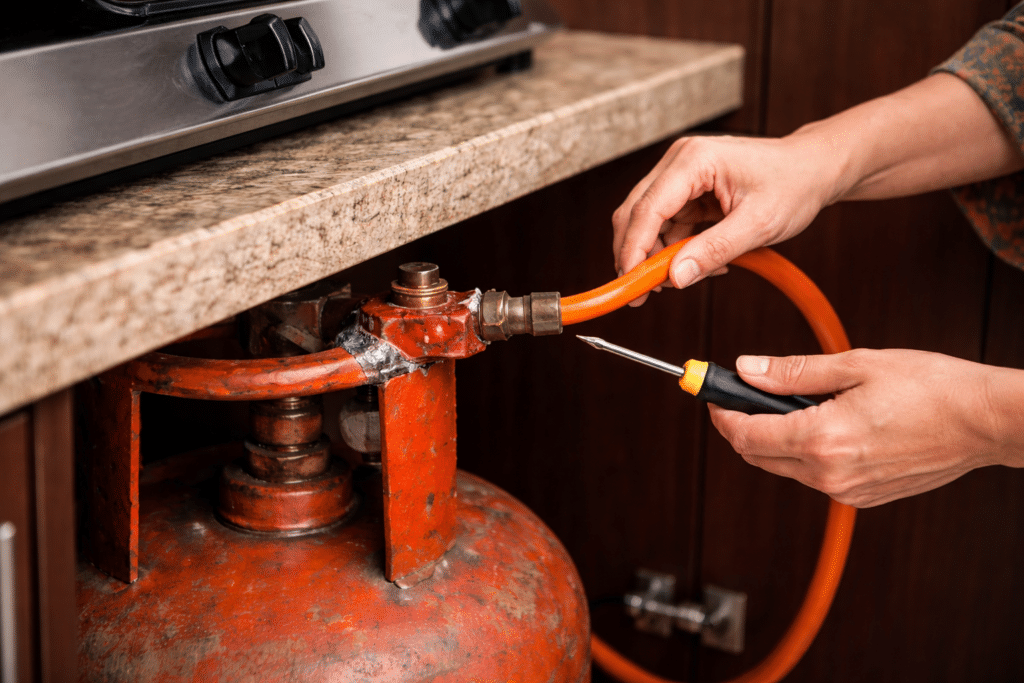
5. Never Treat Gas Equipment as a DIY Project
Gas appliances and cylinders can look simple, but safe installation involves important technical considerations.
Connections, regulators, hoses, ventilation, appliance compatibility, and other components all need to be suitable for the installation.
A mistake can create a serious safety risk.
For that reason, installation, modification, repair, and inspection of gas systems should be handled by appropriately qualified professionals.
This is particularly important for commercial buildings, restaurants, apartments, and other properties where gas systems may be more complex.
LPG Decanting Is a Serious Safety Concern
People may sometimes encounter unsafe or unauthorized practices involving LPG transfer.
OGRA’s LPG policy states that decanting LPG from one cylinder to another is prohibited, subject to the regulatory framework described by OGRA.
Families should not attempt to transfer LPG between cylinders.
This is not a suitable household activity and can create serious hazards.
If someone encounters suspicious or unauthorized LPG activity, it should be reported through appropriate authorities rather than investigated personally.
6. Keep Cylinders Out of Unsuitable Spaces
The location of an LPG cylinder matters.
OGRA’s guidance states that LPG cylinders should not be stored below ground level or in confined spaces.
This is an important principle because the surrounding environment can influence how a leak behaves.
Homeowners should follow the approved installation requirements for their particular appliance and property.
Avoid making improvised storage arrangements simply because a particular location seems convenient.
Safety should come before convenience.
7. Check the Surrounding Area
Gas-cylinder safety is not only about the cylinder itself.
The surrounding area should also be considered.
Ask whether:
– There is adequate ventilation.
– The equipment is exposed to unsuitable conditions.
– Combustible materials are unnecessarily nearby.
– There are inappropriate ignition sources.
– Children can easily access the equipment.
– The installation appears damaged or poorly maintained.
A simple visual safety check can help identify obvious concerns.
However, homeowners should not dismantle or repair gas equipment themselves.
If something appears unsafe, contact a qualified professional.
8. Do Not Ignore Damaged Hoses or Connections
Gas systems rely on multiple components rather than the cylinder alone.
Hoses, regulators, valves, connectors, and appliances all contribute to safe operation.
A damaged or poor-quality component can create an additional risk.
OGRA reported an inspection of multi-story buildings in Islamabad where LPG was being supplied through sub-standard rubber pipes with loose connections and poor quality. The authority described these conditions as potentially fatal and warned about illegal self-use of LPG.
This example shows why gas installations should not be improvised.
If a hose, connector, regulator, or other component appears damaged or unsuitable, stop using the affected equipment when it is safe to do so and seek qualified assistance.
9. Be Careful With LPG in Multi-Story Buildings
Gas safety can become more complicated in apartments and other multi-story buildings.
A problem involving LPG may affect more than one household.
OGRA has specifically highlighted concerns about commercial LPG cylinders being stored in basements of multi-story buildings and LPG being distributed through sub-standard connections.
Property owners and building managers should therefore make sure gas installations comply with applicable requirements.
Residents should also report obvious safety concerns to building management or the appropriate authority.
Never attempt to investigate a suspected gas leak in another apartment or shared utility area yourself.
10. Keep Children Away From Gas Equipment
Children should not play around gas cylinders, stoves, regulators, valves, hoses, or other gas equipment.
Parents and guardians can teach simple rules:
– Do not touch gas cylinders.
– Do not turn gas valves.
– Do not play with cooking appliances.
– Do not touch hoses or connections.
– Tell an adult if you smell gas.
– Move away from a suspected leak.
– Follow adult instructions during an emergency.
This education is particularly important because children may not understand the consequences of a gas leak.
The goal is awareness, not making children responsible for gas safety.
Gas Safety and Fire Alarm Systems
Gas-cylinder safety and fire detection are connected parts of a broader safety plan.
A gas leak can create a fire hazard, while a fire alarm can provide warning if a fire develops.
However, a standard fire alarm should not be considered a gas-leak detection system unless it is specifically designed and installed for that purpose.
Homeowners should understand the difference between:
Gas prevention: Reducing the chance of a leak or unsafe gas condition.
Gas detection: Using suitable equipment designed to detect gas where appropriate.
Fire detection: Detecting signs of an actual fire.
Emergency response: Getting people away from danger and contacting appropriate emergency services.
Each layer has a different purpose.
The Role of a Fire Alarm System in Pakistan
A fire alarm system in Pakistan can be an important component of a building’s overall fire-protection strategy.
Its purpose is to provide warning when a fire is detected.
The Pakistan Engineering Council’s Building Code of Pakistan – Fire Safety Provisions 2016 includes provisions concerning fire alarm systems where necessary and addresses wider fire-protection and life-safety measures.
For larger buildings, alarm design and installation should be based on the building’s characteristics, hazards, occupancy, and applicable requirements.
Professional installation and maintenance are particularly important for complex systems.
A fire alarm cannot eliminate gas-cylinder hazards, but it can add another layer of protection if a fire occurs.
Maintain Fire Detection Equipment
Installing a fire alarm is only the beginning.
Homeowners should follow the manufacturer’s instructions for:
– Testing
– Battery maintenance
– Cleaning
– Fault reporting
– Replacement
– Professional inspection where applicable
If an alarm repeatedly gives unwanted alerts, do not simply disable it.
The underlying cause should be identified and corrected.
For larger buildings, fire alarm systems may require professional inspection, testing, and maintenance.
A safety device is only useful when it remains operational.
Keep Emergency Exits Clear
Gas safety should be part of the same emergency plan as other fire hazards.
If a fire occurs, people need a safe route away from the building.
Keep doors, corridors, stairways, and other important escape routes accessible.
Do not allow gas cylinders, boxes, furniture, decorations, or other objects to obstruct important routes.
Families should know where they will go if they need to leave quickly.
A household meeting point outside the building can also help family members account for everyone after evacuation.
What To Do if You Suspect a Gas Leak
Suspected gas leaks should be treated as emergencies.
People should avoid actions that could create ignition and move away from the affected area.
OGRA’s public guidance specifically advises people who smell or detect LPG leakage to avoid using electrical switches and mobile phones in the affected area, evacuate, and report the emergency.
Children and teenagers should not attempt any of these emergency procedures themselves. They should move away from the suspected danger and immediately alert a responsible adult.
Do not attempt to repair, disconnect, transfer, or otherwise manipulate gas equipment during a suspected leak.
Qualified professionals or emergency personnel should handle the situation.
Gas Cylinder Safety During Power Outages
Power outages can change how households use energy.
Families may rely more heavily on LPG cooking equipment or other alternative energy sources.
This makes it especially important not to create improvised gas arrangements.
Do not make unauthorized modifications to gas appliances or installations simply because normal electricity is unavailable.
Use equipment only in the manner for which it is designed and follow manufacturer guidance.
If an installation needs modification, qualified professionals should handle it.
Gas Safety in Kitchens
The kitchen is often where LPG appliances are used, so it deserves particular attention.
Keep the area organized and make sure the appliance and gas installation are maintained appropriately.
Avoid storing unnecessary combustible materials close to cooking equipment.
Children should remain away from cooking appliances and gas equipment.
Adults should pay attention to unusual smells, sounds, visible damage, or other warning signs.
If there is a suspected gas problem, do not allow children to investigate.
Gas Safety for Restaurants and Businesses
Commercial kitchens and businesses can have significantly more complex gas systems than homes.
They may use multiple appliances, larger quantities of LPG, storage areas, ventilation systems, and more complicated piping arrangements.
Businesses should therefore have professional assessments and follow applicable licensing, building, fire, and gas-safety requirements.
OGRA’s requirements for authorized LPG distributor premises include ventilation, restrictions on ignition sources, appropriate fire extinguishers, and other safety measures.
Commercial operators should not assume that residential practices are automatically suitable for business premises.
Common Gas Cylinder Safety Mistakes
Several mistakes can increase risk.
Using damaged cylinders
A damaged cylinder or relief valve should not be treated as normal equipment.
Poor ventilation
Inadequate ventilation can make gas leaks more dangerous.
Unsafe storage
Cylinders should not be stored in unsuitable confined or below-ground spaces.
Improvised connections
Poor-quality hoses or loose connections can create serious hazards.
Unauthorized LPG transfer
Cylinder-to-cylinder LPG decanting is prohibited under OGRA’s stated regulatory framework.
Ignoring gas smells
A gas smell should always be treated seriously.
Letting children access gas equipment
Children should be kept away from cylinders, valves, hoses, and appliances.
Disabling fire alarms
Removing or disabling fire detection equipment reduces an important layer of protection.
A Simple Gas Safety Checklist
Families can use the following general checklist as a starting point:
– [ ] Cylinder is in suitable condition.
– [ ] Equipment is installed appropriately.
– [ ] The area has suitable ventilation.
– [ ] Gas equipment is away from inappropriate ignition sources.
– [ ] Children cannot access the cylinder or controls.
– [ ] Hoses and connections are not visibly damaged.
– [ ] The cylinder is not stored in an unsuitable confined or below-ground space.
– [ ] LPG is obtained through appropriate channels.
– [ ] No unauthorized cylinder-to-cylinder transfer is taking place.
– [ ] Fire detection equipment is maintained.
– [ ] Escape routes are clear.
– [ ] Family members know what to do during an emergency.
– [ ] Gas-system repairs are handled by qualified professionals.
This checklist is general information and does not replace professional assessment or applicable local requirements.
Why Gas Safety Should Be Part of Your Fire-Safety Plan
Fire safety is most effective when different protective measures work together.
Gas-cylinder safety reduces the chance of a dangerous gas-related incident.
Electrical safety reduces electrical hazards.
Good housekeeping reduces combustible materials.
Fire alarms provide early warning.
Clear escape routes support evacuation.
Emergency planning helps people respond without unnecessary confusion.
None of these measures is a complete solution by itself.
Together, they create multiple layers of protection.
Final Thoughts
Gas-cylinder safety is an important part of household fire safety in Pakistan.
LPG can be useful for cooking and other purposes, but it must be treated as a flammable fuel rather than ordinary household equipment. OGRA’s safety guidance emphasizes suitable cylinder condition, ventilation, safe storage, avoiding ignition sources, and appropriate action when a leak is suspected.
Families should avoid improvised gas installations, unauthorized LPG transfer, damaged equipment, and unsuitable storage.
Children and teenagers should never handle gas cylinders, investigate suspected leaks, or attempt repairs. Their role is to stay away from danger and immediately tell a responsible adult.
A fire alarm system in Pakistan can provide another important layer of protection by warning occupants when a fire is detected. But the strongest safety strategy combines prevention, professional maintenance, early detection, clear escape routes, and emergency preparedness.
Gas safety starts with responsible choices before an emergency happens.
FAQs
1. Why is gas cylinder safety important at home?
LPG is highly flammable, so a leak or unsafe installation can create a serious fire hazard. Proper equipment, suitable ventilation, safe storage, and professional maintenance can help reduce these risks.
2. Where should an LPG cylinder be stored?
OGRA advises that LPG cylinders should be kept in well-ventilated areas away from ignition sources and should not be stored below ground level or in confined spaces.
3. What should I do if I smell gas?
Treat the smell as a potential emergency. Move away from the suspected danger and alert a responsible adult. Avoid actions that could create ignition in the affected area. OGRA advises evacuation and reporting the emergency when LPG leakage is suspected.
4. Can children handle gas cylinders?
No. Children should not handle, move, repair, or investigate gas cylinders or gas connections. They should tell a responsible adult if they notice a gas smell or another safety concern.
5. Does a fire alarm detect a gas leak?
A standard fire alarm is designed primarily to detect signs of fire, not necessarily gas. Gas detection requires suitable equipment specifically designed for that purpose. A complete safety plan can include both appropriate gas-safety measures and fire detection.