Office fire safety is an important responsibility for every business, regardless of its size or the number of employees. Offices contain electrical equipment, computers, printers, kitchen appliances, paper documents, furniture, and other materials that can contribute to fire risks. Even a small incident can disrupt business operations, damage property, and put people’s lives at risk.
A safe office environment requires more than installing fire extinguishers or displaying emergency signs. Employees need to understand potential hazards, emergency procedures, evacuation routes, and the purpose of fire protection equipment. Management must also ensure that safety arrangements are maintained and reviewed regularly.
For businesses in Pakistan, office fire safety deserves particular attention because workplaces vary considerably in their layouts, building conditions, electrical installations, and emergency facilities. A practical checklist helps employers identify important safety measures and make sure nothing essential is overlooked.
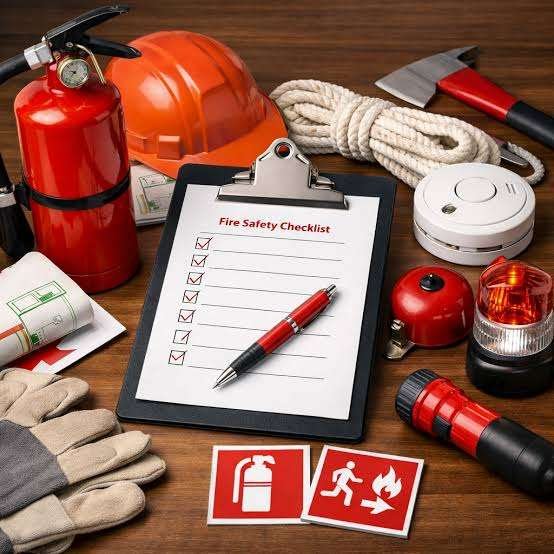
This beginner’s guide explains the key areas to consider when developing an office fire safety checklist, from everyday prevention to emergency preparedness.
### The Beginner’s Checklist for Office Fire Safety
### 1\. Identify Common Fire Hazards in the Office
The first step in improving office fire safety is recognising conditions that could contribute to a fire. Many workplace hazards develop gradually because people become accustomed to everyday routines.
Common office fire risks include:
* Damaged electrical cables and plugs.
* Overloaded electrical sockets.
* Poorly maintained office appliances.
* Paper, cardboard, and other combustible materials stored carelessly.
* Kitchen appliances left unattended.
* Blocked ventilation around electrical equipment.
* Waste materials accumulating in work areas.
* Smoking in areas where it is prohibited.
Office management should arrange regular inspections to identify these conditions. Employees should also know how to report damaged equipment, unusual smells, overheating appliances, or other potential hazards.
Beginner’s checklist:
* Common fire hazards have been identified.
* Damaged electrical equipment is reported.
* Electrical sockets and extension boards are used appropriately.
* Waste materials are removed regularly.
* Combustible materials are stored responsibly.
* Office kitchens and shared areas are kept organised.
### 2\. Check Electrical Safety
Electrical equipment is a major consideration in office fire prevention. Computers, printers, photocopiers, chargers, air conditioners, and other appliances are used throughout the working day.
Poor maintenance, damaged wiring, and unsuitable electrical connections can create serious hazards. Employees should avoid using visibly damaged cables or equipment and report electrical concerns to the responsible maintenance team.
Electrical installations should be inspected and maintained by qualified professionals. Office employees should not attempt repairs beyond their training.
Beginner’s checklist:
* Electrical installations receive appropriate professional inspections.
* Damaged cables and plugs are reported.
* Equipment is used according to manufacturer instructions.
* Electrical panels remain accessible.
* Unnecessary electrical equipment is switched off according to office procedures.
* Employees know whom to contact about electrical problems.
### 3\. Make Sure Fire Detection and Alarm Systems Are Suitable
A fire alarm system plays an important role in alerting people when a potential fire is detected. Early warning gives occupants an opportunity to follow the building’s emergency procedures.
Depending on the building’s design and requirements, a fire alarm arrangement may include smoke detectors, heat detectors, manual call points, control panels, sounders, and visual warning devices.
An office should have a suitable system designed for its occupancy, layout, and applicable requirements. Its components should be professionally installed, tested, and maintained.
Employees should also understand what the alarm sounds like and what action they must take when it activates.
Beginner’s checklist:
* Suitable fire detection and alarm arrangements are installed where required.
* Alarm devices are accessible and unobstructed.
* Employees know the building’s alarm signal.
* Testing and maintenance follow an approved schedule.
* Faults are reported promptly.
* Relevant inspection and maintenance records are retained.
For businesses reviewing a fire alarm system in Pakistan, the Building Code of Pakistan Fire Safety Provisions 2016 is an important reference. The precise requirements depend on building classification and the relevant authority’s jurisdiction. pec.org.pk +1
### 4\. Keep Fire Extinguishers Accessible
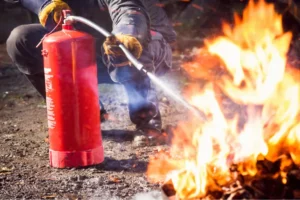
Fire extinguishers are an important part of many workplace fire protection arrangements. However, their presence alone does not guarantee safety. They must be appropriate for the potential fire risks, properly maintained, and accessible.
Different extinguishers are designed for different fire classifications. Office management should consult qualified fire safety professionals when selecting and positioning equipment.
Employees should receive suitable awareness training so they understand the purpose of the equipment and know that evacuation and personal safety must always come first. People should not attempt to tackle a fire if it is spreading, creating dangerous smoke, or blocking their escape.
Beginner’s checklist:
* Appropriate extinguishers are provided where required.
* Extinguishers are clearly visible and accessible.
* Inspection and maintenance are completed by competent personnel.
* Equipment is not blocked by furniture or stored materials.
* Employees know where the equipment is located.
* Staff understand when evacuation is the safer response.
### 5\. Keep Emergency Exits and Escape Routes Clear
Emergency exits are among the most important features of an office fire safety plan. During an emergency, people need clear and suitable routes to leave the building.
Corridors, staircases, doorways, and other designated escape routes should never be used as storage spaces. Furniture, delivery boxes, office supplies, and discarded equipment can obstruct movement and delay evacuation.
Employees should become familiar with the exits available on their floor. Where a building has more than one approved escape route, staff should understand the arrangements described in the emergency plan.
Beginner’s checklist:
* Emergency exits are clearly identified.
* Escape routes remain free from obstructions.
* Staircases are kept clear.
* Exit doors and access arrangements are maintained.
* Appropriate exit signs are displayed.
* Employees know the approved evacuation routes.
* Alternative routes are included in the emergency plan where applicable.
### 6\. Install and Maintain Emergency Lighting
An office may experience a power interruption during an emergency. If normal lighting becomes unavailable, occupants may have difficulty identifying exits, stairs, and changes in direction.
Emergency lighting helps make designated escape routes easier to recognise. Its suitability, coverage, testing, and maintenance should be considered as part of the building’s overall fire safety arrangements.
Management should arrange professional checks and keep records of relevant maintenance.
Beginner’s checklist:
* Emergency lighting is provided where required.
* Escape routes have suitable illumination.
* Exit signs remain visible.
* Emergency lighting is tested according to the maintenance schedule.
* Reported faults are addressed.
* Maintenance records are kept.
### 7\. Prepare a Clear Office Evacuation Plan
Every office should have an emergency evacuation plan that reflects its layout and occupancy. The plan should explain how people receive warnings, which routes they should follow, and where they should assemble after leaving the building.
Employees should not have to guess what to do during an emergency. Instructions should be easy to understand and communicated to staff members, contractors, and visitors where appropriate.
The plan should also explain how the organisation will account for occupants after evacuation.
Beginner’s checklist:
* A written emergency evacuation plan is available.
* Evacuation routes are identified on relevant floor plans.
* Assembly points are selected.
* Emergency responsibilities are assigned.
* Visitors and contractors are considered.
* Communication arrangements are explained.
* The plan is reviewed when office layouts or occupancy change.
### 8\. Train Employees in Fire Safety Awareness
Employees play an important role in maintaining a safe office. Even a well-equipped building can face problems when occupants do not understand the alarm, evacuation arrangements, or reporting procedures.
Basic fire safety awareness training should explain common hazards, emergency signals, exit routes, assembly points, and how to report a fire.
New employees should receive relevant safety information as part of their workplace introduction. Existing staff should also receive refresher information when procedures change or training needs are identified.
Beginner’s checklist:
* New employees receive fire safety information.
* Staff understand alarm signals.
* Employees know the approved evacuation routes.
* Emergency contacts are available.
* Relevant employees understand their assigned responsibilities.
* Training records are maintained.
### 9\. Arrange Regular Fire Drills
Fire drills allow employees to become familiar with the office evacuation plan. They also help management identify problems that may not be obvious during an ordinary inspection.
For example, a drill may reveal that employees do not know where to assemble or that visitors are not included in the organisation’s headcount arrangements.
Drills should be planned responsibly and follow the building’s approved emergency procedures. Their results should be reviewed so that weaknesses can be corrected.
Beginner’s checklist:
* Fire drills are planned according to applicable requirements.
* Employees receive suitable instructions.
* Visitors and contractors are considered.
* Assembly arrangements are reviewed.
* Problems identified during drills are recorded.
* Corrective actions are assigned and followed up.
The Pakistan Engineering Council’s fire safety provisions address evacuation drills and written drill records. Organisations should confirm the applicable requirements for their particular occupancy and building. pec.org.pk
### 10\. Pay Attention to Office Kitchens and Break Areas
Office kitchens are often overlooked when businesses prepare their fire safety checklists. Shared spaces may contain microwaves, kettles, refrigerators, cooking appliances, and electrical connections.
Employees should follow workplace rules for using kitchen equipment and keep the area clean and organised. Appliances should be maintained according to their instructions, and any visible damage should be reported.
Management should make sure that kitchen arrangements are included in the office’s fire risk assessment.
Beginner’s checklist:
* Kitchen appliances are maintained properly.
* Employees follow safe-use instructions.
* Combustible waste is removed regularly.
* Kitchen areas are kept clean.
* Electrical problems are reported.
* Emergency arrangements cover shared kitchen areas.
### 11\. Manage Office Storage and Housekeeping
Poor housekeeping can increase fire risks and make evacuation more difficult. Paper files, packaging, cardboard boxes, and other combustible materials should be stored responsibly.
Storage areas should not interfere with electrical equipment, emergency exits, firefighting equipment, or access routes. Office management should establish clear housekeeping responsibilities so that materials do not accumulate unnecessarily.
Beginner’s checklist:
* Storage areas are organised.
* Paper and packaging waste are removed.
* Combustible materials are stored appropriately.
* Electrical and utility areas remain accessible.
* Corridors are not used for storage.
* Housekeeping responsibilities are assigned.
### 12\. Consider Visitors, Contractors, and People Needing Assistance
Office fire safety arrangements should cover everyone who may be inside the building, not just permanent employees.
Visitors may be unfamiliar with the building’s layout. Contractors may work in areas with additional hazards. Some occupants may need assistance understanding warnings or reaching an approved evacuation route.
Management should consider these needs when preparing emergency procedures. Reception staff and other relevant employees should understand how visitors receive emergency information.
Beginner’s checklist:
* Visitor evacuation arrangements are established.
* Contractors receive relevant safety information.
* Reception staff understand emergency procedures.
* People needing assistance are considered in advance.
* Assembly and headcount arrangements include everyone.
### 13\. Maintain Fire Safety Records
Documentation helps an organisation understand whether its safety arrangements are being maintained. Records can also make it easier to review inspections, training sessions, equipment maintenance, and evacuation exercises.
An office fire safety file may include:
* Fire risk assessment reports.
* Fire alarm inspection and maintenance records.
* Fire extinguisher service records.
* Emergency lighting maintenance records.
* Employee training records.
* Fire drill reports.
* Evacuation plans.
* Corrective action records.
Records should be kept in an organised location and made available to authorised personnel when needed.
Beginner’s checklist:
* Fire safety documents are organised.
* Inspection reports are retained.
* Equipment maintenance is documented.
* Training sessions are recorded.
* Fire drill results are reviewed.
* Outstanding safety issues are tracked.
### 14\. Understand Fire Safety Requirements in Pakistan
Office fire safety requirements can vary according to building type, occupancy, location, and the relevant regulatory authority.
The Building Code of Pakistan Fire Safety Provisions 2016 provides a national framework covering fire prevention, detection, protection, and life safety. Provincial and local authorities may also have applicable rules and inspection procedures.
For example, Punjab Civil Defence identifies fire detection and alarm systems, firefighting arrangements, fire safety plans, emergency exits, and evacuation plans among the measures considered during inspections of certain commercial and other premises. pec.org.pk +1
Businesses should not assume that every office has identical requirements. They should consult the relevant building control authority, Civil Defence department, or qualified fire safety professional to establish which measures apply.
The Punjab Emergency Services Department also provides building safety information and related resources through its official website. Rescue Pakistan
### 15\. Review and Update the Checklist Regularly
An office fire safety checklist should be treated as an ongoing management tool rather than a document that is completed once and forgotten.
Office layouts can change when new furniture is installed, departments move, equipment is replaced, or additional employees join. These changes may affect escape routes, storage arrangements, and emergency responsibilities.
Management should review the checklist periodically and whenever significant changes occur.
A useful review process includes checking previous inspection findings, confirming that corrective actions have been completed, and updating emergency information where necessary.
### A Simple Office Fire Safety Checklist
The following summary can help beginners organise their first office review.
| Safety area | What to check |
| —————— | ———————————————— |
| Fire hazards | Identify and report potential risks |
| Electrical safety | Report damaged equipment and wiring concerns |
| Fire alarms | Confirm suitable systems and maintenance |
| Extinguishers | Check accessibility and professional servicing |
| Emergency exits | Keep approved routes unobstructed |
| Emergency lighting | Arrange appropriate inspection and maintenance |
| Evacuation plan | Communicate routes and assembly points |
| Staff training | Provide suitable awareness sessions |
| Fire drills | Conduct and review exercises as required |
| Housekeeping | Keep storage and shared areas organised |
| Visitors | Include visitors and contractors in arrangements |
| Documentation | Maintain inspection and training records |
### Conclusion
Office fire safety begins with understanding everyday hazards and creating a workplace where prevention and emergency preparedness are taken seriously. A practical checklist helps businesses review electrical safety, fire detection, firefighting equipment, emergency exits, employee awareness, and evacuation arrangements.
For offices in Pakistan, it is important to consider the Building Code of Pakistan Fire Safety Provisions 2016 alongside applicable provincial and local requirements. The right safety measures depend on the building’s characteristics and the relevant authority’s instructions.
A properly selected and maintained fire alarm system in Pakistan can support early warning, but employees must also know what to do when an alarm activates. Regular training, clear emergency procedures, professional equipment maintenance, and organised records all contribute to a safer office.
Fire safety is a shared responsibility. When management and employees work together, they can create a more prepared workplace and help protect people, property, and business operations.
### Frequently Asked Questions (FAQs)
### 1\. What should be included in a basic office fire safety checklist?
A basic checklist should cover fire hazards, electrical safety, alarm systems, extinguishers, emergency exits, emergency lighting, evacuation plans, staff training, fire drills, housekeeping, and maintenance records.
### 2\. Why is a fire alarm system important in an office?
A fire alarm system alerts occupants to a potential fire so they can follow the building’s emergency procedures. Its effectiveness depends on suitable installation, regular maintenance, and employees understanding the warning signals.
### 3\. How often should an office conduct fire drills?
The required frequency depends on the building’s occupancy, applicable regulations, and the approved emergency plan. Businesses should consult the relevant authority and maintain records of their drills.
### 4\. Who is responsible for office fire safety?
Responsibility is shared. Employers and building management should arrange suitable safety measures, maintenance, and training. Employees should follow safety procedures and report hazards promptly.
### 5\. Are fire safety requirements the same for every office in Pakistan?
No. Requirements may depend on building size, height, occupancy, location, and applicable local regulations. Businesses should confirm their obligations with the relevant authority or a qualified fire safety professional.