Burn injuries can happen unexpectedly at home, in kitchens, workplaces, schools, restaurants, and other environments. Hot liquids, cooking equipment, flames, electricity, chemicals, and hot surfaces can all cause burns. When an injury occurs, people often remember traditional home remedies or advice they have heard from family members and friends.
Unfortunately, some common burn-first-aid practices can make an injury worse or delay proper medical care.
Understanding what is fact and what is a myth is an important part of emergency preparedness. The World Health Organization (WHO) advises using appropriate first aid after a burn while emphasizing personal safety, cooling the burn with cool running water, and avoiding substances such as oil, paste, turmeric, and ice.
This guide looks at some of the biggest myths about burn first aid and explains safer principles to remember.
«Important: This article provides general educational information, not a diagnosis or substitute for professional medical care. Serious, extensive, electrical, chemical, facial, or otherwise concerning burns should receive urgent medical assessment.»
1. Myth: Ice Is the Best Treatment for a Burn
One of the most common misconceptions is that putting ice directly on a burn will cool it faster and therefore make the injury better.
This is not recommended.
The WHO advises against applying ice because it can deepen the injury.
For many thermal burns, established first-aid guidance recommends cool running water instead. The NHS advises cooling a burn under cool running water for around 20 minutes.
The important distinction is between cooling the injury safely and exposing damaged skin to extreme cold.
People should also avoid making the injured person excessively cold overall. Burn-care guidance emphasizes keeping the rest of the person warm while cooling the affected area.
2. Myth: Toothpaste Helps Heal Burns
Toothpaste is sometimes suggested as a home remedy for burns.
There is no good reason to use ordinary toothpaste as burn first aid.
Applying household products can interfere with assessment and may irritate injured skin. The NHS and specialist burn services advise against applying substances such as toothpaste, butter, creams, or oils to a fresh burn.
The safer principle is simple: use appropriate cooling and seek medical advice when necessary rather than experimenting with household remedies.
3. Myth: Butter or Oil Should Be Applied to a Burn
Another traditional remedy is butter, cooking oil, or another greasy substance.
This is not recommended.
The WHO specifically advises against applying paste, oil, turmeric, or raw cotton to burns.
Greasy substances do not provide the recommended method of cooling the injury and may make subsequent medical assessment more difficult.
This myth is particularly important in kitchens, where butter and cooking oils are readily available.
A kitchen should have a clear safety plan so that people know the appropriate response to an injury instead of relying on traditional remedies.
4. Myth: A Burn Should Always Be Covered Immediately With Any Material
Covering a burn can be useful, but the material and timing matter.
First, appropriate cooling should be carried out for a thermal burn. After cooling, specialist guidance commonly recommends loose coverage with cling film or an appropriate clean, non-fluffy covering for suitable burns.
However, cling film should not be tightly wrapped around a limb because swelling can occur. Specialist guidance also advises against applying it directly to the face.
The purpose of temporary covering is not to squeeze the injury or seal it tightly. It is to provide appropriate protection while medical assessment is arranged when necessary.
5. Myth: You Should Remove Clothing Even If It Is Stuck to the Burn
Clothing and jewellery near a burn may need attention because swelling can develop.
However, there is an important exception: material that is stuck or melted onto the injured skin should not be pulled away.
NHS guidance advises removing clothing or jewellery near the affected area but specifically says not to remove anything stuck to the burn.
Trying to pull adhered material away can cause additional injury.
When clothing is firmly attached to a burn, medical professionals should handle its removal.
6. Myth: Every Burn Can Be Treated at Home
Not every burn is a minor injury.
Some burns require urgent medical evaluation, including burns that are extensive, deep, involve sensitive areas, or result from particular causes such as electricity or chemicals.
For example, NHS guidance identifies burns involving the face, hands, feet, or other significant areas, as well as severe burns, as situations requiring medical attention.
Electrical and chemical burns also require particular care.
The correct response depends on the nature and extent of the injury, so people should not assume that every burn can be managed with home treatment.
7. Myth: Chemical Burns Should Be Treated Like Ordinary Burns
Chemical burns are different from ordinary thermal burns because the damaging substance may continue affecting tissue while it remains present.
The British Burn Association’s clinical guidance emphasizes removing the chemical agent and urgent irrigation, while also highlighting the importance of protecting the person providing assistance from exposure.
Chemical incidents can involve additional hazards, so people should follow appropriate emergency procedures and seek professional assistance.
The important lesson is not to assume that the same response applies to every type of burn.
8. Myth: Electrical Burns Are Only Skin Injuries
Electrical injuries can be deceptive.
The visible skin injury may not represent the full extent of the underlying injury. Electrical incidents can also involve serious internal effects.
Specialist burn guidance treats electrical burns as a distinct category and emphasizes controlling the electrical source before providing assistance.
For this reason, electrical burns should receive appropriate medical evaluation rather than being treated as ordinary minor burns.
Personal safety is also essential. Nobody should approach an electrical hazard while the source remains dangerous.
9. Myth: Blisters Should Always Be Popped
Blisters can form following burns.
A common mistake is to deliberately break them because they may appear uncomfortable or inconvenient.
Specialist guidance generally advises against deliberately opening burn blisters because doing so can increase the risk of infection.
If a blister is large, painful, damaged, or associated with a more serious burn, medical advice should be obtained.
The safest approach is to avoid unnecessary interference with the injured skin.
10. Myth: More Cooling Is Always Better
Cooling is an important part of first aid for many thermal burns, but that does not mean the entire body should be exposed to cold for an extended period.
Guidance commonly recommends around 20 minutes of cool running water for thermal burns.
At the same time, burn-care guidance emphasizes keeping the rest of the person warm because excessive cooling can contribute to hypothermia.
Therefore, the goal is controlled cooling of the affected area rather than making the injured person cold overall.
11. Myth: Home Remedies Are Always Safer Because They Are Natural
Natural does not automatically mean appropriate for an injury.
Substances such as turmeric, oil, butter, toothpaste, and other household products may be commonly recommended within families or communities, but that does not make them suitable burn treatments.
WHO specifically advises against several of these traditional remedies.
First aid should be based on reliable medical guidance rather than tradition alone.
12. Myth: If the Pain Goes Away, the Burn Is Fine
Pain level alone cannot determine the seriousness of a burn.
Different burns can affect tissue in different ways, and a person should not use pain as the only measure of whether professional assessment is necessary.
Other factors matter, including:
– Size of the injury
– Location
– Depth or appearance
– Cause of the burn
– Age of the injured person
– Other injuries
– Breathing difficulties
– Chemical or electrical involvement
When there is uncertainty, professional medical advice is appropriate.
13. Myth: Burn First Aid Starts With Finding Medicine
Many people immediately look for a cream, ointment, or household product.
For a thermal burn, the initial priority is generally to stop the burning process and cool the affected area appropriately.
The WHO lists stopping the burning process and cooling the burn among basic first-aid measures.
Medication or specialized wound treatment should be guided by appropriate medical advice.
This is especially important because different burns require different forms of treatment.
14. Myth: First Aid Is More Important Than Personal Safety
Helping an injured person is important, but the person providing assistance must not become another casualty.
The WHO specifically says not to begin first aid before ensuring your own safety.
For example, electrical, chemical, fire, or smoke-related situations may still contain hazards.
If the environment remains dangerous, the priority should be getting to a safe location and contacting appropriate emergency assistance.
This principle is particularly important during building fires.
15. Burn First Aid and Fire Safety Are Connected
Burn first aid is only one part of fire preparedness.
The best way to reduce burn injuries is to prevent fires and other hazardous incidents where possible.
A complete fire-safety programme can include:
– Fire prevention
– Safe cooking practices
– Electrical safety
– Appropriate fuel management
– Smoke and fire detection
– Alarm systems
– Emergency exits
– Evacuation planning
– Staff training
– Regular equipment maintenance
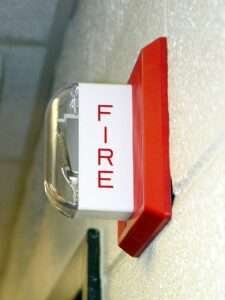
A Fire alarm system in Pakistan can provide an important layer of early warning in buildings where such systems are required by applicable regulations and fire-safety provisions.
The Building Code of Pakistan Fire Safety Provisions 2016 contains requirements related to fire detection and alarm systems, while the Building Code of Pakistan 2021 also addresses fire alarm systems and related life-safety provisions.
The purpose of an alarm is not to treat a burn. It is to help alert occupants to a potentially dangerous fire condition so they can follow the appropriate emergency procedure.
16. Why Early Warning Matters
A fire can produce smoke and heat before occupants realize that something is wrong.
Early notification can give people additional time to respond and evacuate.
The Building Code of Pakistan Fire Safety Provisions 2016 addresses automatic fire detection systems and alarm notification appliances in applicable buildings.
For homes and businesses, fire detection should therefore be considered together with:
– Clear exits
– Emergency lighting
– Evacuation procedures
– Fire-safety training
– Appropriate emergency equipment
No single system should be considered a complete substitute for overall fire safety.
17. Kitchens Are an Important Fire-Safety Area
Many burn injuries occur around everyday sources of heat.
Kitchens deserve particular attention because they may contain:
– Cooking appliances
– Hot liquids
– Hot surfaces
– Electrical equipment
– Fuel sources
– Oils and combustible materials
Preventive habits can reduce risks.
Cooking should not be left unattended, combustible materials should be kept away from heat, and electrical equipment should be maintained appropriately.
For businesses, commercial kitchens should have documented safety procedures and suitable fire-protection arrangements.
18. Children Need Special Burn-Safety Education
Children can be particularly vulnerable to burns.
They should be taught simple safety rules appropriate for their age.
For example:
– Stay away from hot cooking equipment.
– Do not touch electrical equipment without appropriate adult supervision.
– Do not approach a fire.
– Tell an adult immediately if something is burning or unusually hot.
– Follow evacuation instructions when an alarm sounds.
– Never experiment with household fire-safety equipment.
Children should not be expected to manage a serious burn or fire emergency themselves.
Adults should be responsible for contacting emergency services and arranging medical care when necessary.
19. When Professional Medical Help Is Important
Burn injuries should receive urgent professional assessment when they appear serious or involve higher-risk circumstances.
Examples can include:
– Large or deep burns
– Burns involving the face
– Burns involving major joints or other sensitive areas
– Electrical burns
– Chemical burns
– Burns associated with breathing difficulties or smoke exposure
– Burns in particularly vulnerable people
– Injuries where the seriousness is uncertain
Specialist guidance recommends seeking appropriate medical help for burns meeting relevant referral criteria.
When in doubt, contacting a qualified medical professional is safer than relying on a home remedy.
20. A Simple Myth-Busting Checklist
Remember these basic principles:
Do
– Prioritize personal safety.
– Stop the burning process when it is safe to do so.
– Cool suitable thermal burns with cool running water.
– Seek medical help when the injury is serious or uncertain.
– Keep the injured person appropriately warm overall.
– Follow professional medical advice.
Don’t
– Put ice directly on a burn.
– Apply butter or cooking oil.
– Apply toothpaste.
– Apply turmeric or other household pastes.
– Pull away clothing stuck to the burn.
– Deliberately burst blisters.
– Ignore serious burns.
– Enter a dangerous fire or electrical environment to provide assistance.
WHO guidance specifically advises against ice, oil, paste, turmeric, raw cotton, and other inappropriate materials on burns.
21. Preparing Homes and Businesses for Emergencies
Good emergency preparation can reduce confusion when an incident occurs.
Homes and workplaces can benefit from:
– Clearly understood emergency contacts
– Accessible emergency exits
– Functional smoke or fire detection where appropriate
– Properly maintained fire alarm systems
– Regular safety checks
– Basic first-aid supplies
– Staff or family awareness
– Evacuation planning
Businesses should also consider the needs of visitors, children, older people, and individuals who may require additional assistance during evacuation.
22. Why Fire Safety Equipment Requires Maintenance
Fire-safety equipment cannot be considered reliable simply because it was installed.
Alarm systems, detection devices, emergency lighting, fire doors, and other safety systems require appropriate inspection and maintenance.
A business considering a Fire alarm system in Pakistan should therefore look beyond installation and consider the complete lifecycle of the system, including commissioning, testing, maintenance, and professional support.
For information about fire-safety equipment and systems in Pakistan, businesses can also explore “Fire Safety Trading” (https://Firesafetytrading.com.pk).
23. Building a Better Emergency Culture
Fire and burn safety should become part of everyday awareness rather than something people think about only after an accident.
Schools, offices, restaurants, factories, hotels, and homes can encourage simple habits:
– Keep emergency routes clear.
– Report damaged electrical equipment.
– Do not ignore fire alarms.
– Keep children away from hazardous areas.
– Know the building’s evacuation route.
– Keep emergency contacts available.
– Review safety procedures regularly.
Education is especially valuable because people are more likely to respond appropriately when they have already learned what an alarm means and where they should go.
Final Thoughts
Burn first aid is surrounded by myths that have been passed down for generations. Ice, butter, toothpaste, oils, and household pastes are sometimes recommended, but established medical guidance advises against many of these practices. The WHO recommends stopping the burning process, cooling suitable burns with cool running water, and avoiding inappropriate substances such as ice, oil, paste, turmeric, and raw cotton.
For many thermal burns, cool running water for around 20 minutes is a key first-aid measure. However, serious, extensive, chemical, electrical, or otherwise concerning burns require appropriate professional medical assessment.
Burn first aid is also connected to wider fire prevention. Reducing fire hazards, maintaining appropriate detection and alarm systems, keeping emergency exits clear, and teaching occupants how to respond can all contribute to safer buildings.
A Fire alarm system in Pakistan can be an important component of an overall fire-safety strategy where required or appropriate, but it works best alongside prevention, evacuation planning, maintenance, and safety education.
The most useful lesson is simple: when a burn occurs, avoid unverified home remedies and rely on established first-aid principles and professional medical advice when needed.
Frequently Asked Questions
1. Is ice good for a burn?
No. The WHO advises against applying ice because it can deepen the injury. Cool running water is generally recommended for cooling suitable thermal burns.
2. Can toothpaste or butter be applied to a burn?
No. Toothpaste, butter, oil, and similar household substances are not recommended for fresh burns. They can interfere with appropriate treatment and do not replace proper cooling.
3. How long should a thermal burn be cooled?
For many thermal burns, established guidance recommends cooling with cool running water for about 20 minutes. The injured person should be kept appropriately warm overall.
4. Should burn blisters be popped?
No. Burn blisters should generally not be deliberately opened because this can increase the risk of infection.
5. How can fire alarms help prevent serious burn injuries?
A fire alarm system can provide an early warning when a fire condition is detected, allowing occupants to follow the building’s emergency and evacuation procedures. It does not treat burns, but it can form an important part of an overall fire-safety strategy.