
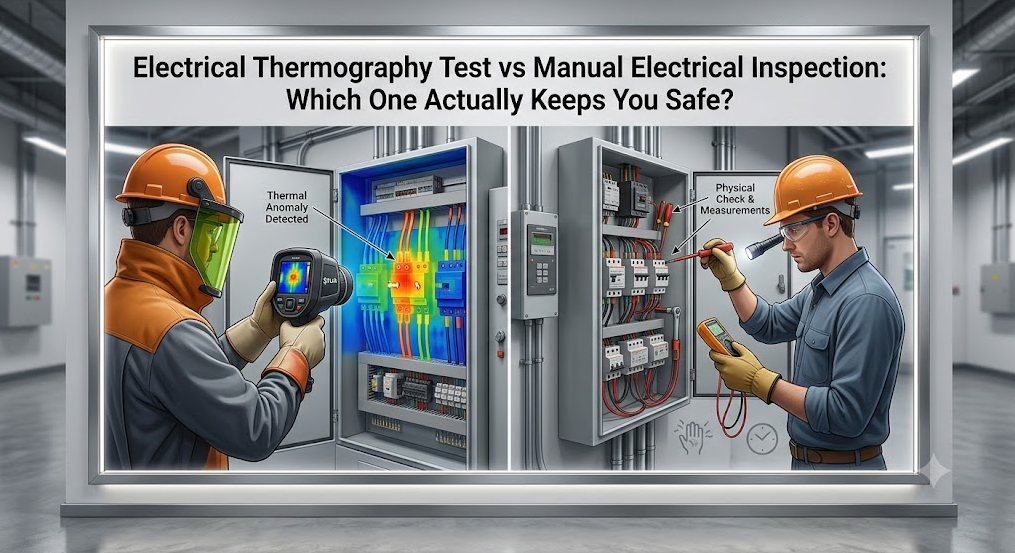
Every building owner in Pakistan, whether running a textile unit in Faisalabad, a shopping mall in Lahore, a hospital in Islamabad, or a warehouse in Karachi, eventually asks the same question: is a quick manual check of the electrical panel enough, or does the facility need a proper thermography test? The two methods sound similar on the surface, both are about catching electrical problems before they turn into fires, but they work in completely different ways and catch completely different types of faults.
This article breaks down exactly how a manual electrical inspection and an Electrical Thermography Test differ, what each one can and cannot detect, and why relying on manual checks alone leaves a dangerous gap in fire prevention for almost every commercial and industrial building in Pakistan.
What Is a Manual Electrical Inspection?
Fire Safety Trading (Pvt)
ToggleA manual electrical inspection is exactly what it sounds like: a technician opens panels, looks at wiring, checks connections by eye, and sometimes uses a screwdriver to test whether terminals feel loose. It typically includes checking for visible corrosion, burnt smell, discoloured insulation, exposed conductors, and obviously damaged components.
This kind of check has value. It catches problems that have already progressed far enough to be visible, a scorched terminal block, a cracked cable jacket, a panel door that will not close properly. But it depends entirely on what a human eye can see at that specific moment, in that specific lighting, without any way to measure what is actually happening inside a live connection under load.
What Is an Electrical Thermography Test?
An Electrical Thermography Test uses an infrared thermal imaging camera to scan electrical panels, breakers, busbars, cable joints, transformers, and connected equipment while the system is fully live and under normal operating load. The camera converts heat patterns into a colour-coded image, showing exactly where a connection or component is running hotter than it should compared to similar parts nearby.
Because electrical faults almost always generate excess heat long before they produce a visible spark, smell, or failure, thermography catches the problem at the earliest possible stage, often months before a manual inspection would find anything at all. You can read more about how this process works in our full guide to Electrical Thermography Test, which covers the equipment, process, and reporting involved.
The Core Difference: Seeing vs Measuring
The simplest way to understand the gap between the two methods is this: a manual inspection relies on what a person can see, while an Electrical Thermography Test relies on what a camera can measure. A loose connection inside a sealed panel, behind a busbar, or under a cable gland produces no visible sign at all until it has already overheated enough to melt insulation or discolour a surface. By that point, the fault has usually existed for weeks or months, quietly increasing resistance, generating heat, and moving closer to failure.
Thermography does not need the fault to become visible first. It measures the actual temperature of every connection point in the frame, compares it against the surrounding components and historical baselines, and flags anything abnormal immediately, regardless of whether anything looks wrong to the naked eye.
Comparison Table: Manual Inspection vs Thermography Test
| Factor | Manual Electrical Inspection | Electrical Thermography Test |
| What it detects | Only visible faults: loose covers, burnt smell, exposed wiring | Invisible heat build-up inside connections, breakers, and cables before any visible sign appears |
| Method | Visual check, sometimes with a screwdriver and torch | Infrared thermal imaging camera scans live equipment without contact |
| Requires shutdown? | Often yes, to open panels safely | No, performed on live, energised systems |
| Accuracy on hidden faults | Low, limited to what the eye can see | High, temperature differences reveal problems early |
| Typical use | Routine housekeeping check | Preventive maintenance and fire-risk assessment |
| Best suited for | Small, low-load domestic setups | Factories, offices, hospitals, malls, and any facility with heavy electrical load |
What Manual Inspection Misses That Thermography Catches
The list of faults that a purely visual, manual check simply cannot detect is longer than most facility managers realise:
- Loose connections inside sealed or enclosed panels that show no external sign
- Overloaded circuits that are running hot under real load but look normal when the load is off
- Uneven current distribution across the three phases of a supply, invisible without thermal comparison
- Deteriorating insulation resistance inside cable runs that are not physically accessible
- Early-stage corrosion inside a busbar joint, hidden behind a cover plate
- A failing capacitor or component inside a control panel that generates heat before it fails completely
Every one of these is a genuine fire risk. Every one of them can sit undetected through several manual inspections in a row simply because nothing looks wrong from the outside.
Why Manual Inspection Still Has a Place
None of this means manual inspection is pointless. A trained technician walking through a facility will still catch things a thermal camera alone might not flag as urgent: a physically damaged cable, an unsecured panel door, missing covers, signs of tampering, or a connection that has already progressed to visible burning. Manual checks are also useful for confirming labelling, verifying that breakers match load schedules, and general housekeeping around electrical rooms.
The point is not that one method replaces the other. It is that manual inspection alone, without thermography, leaves the most dangerous category of faults, the ones building up heat inside sealed connections, completely undetected until they are already close to failure.
Why This Matters More in Pakistan’s Operating Conditions
Pakistan’s electricity supply is far from stable in most cities. Voltage fluctuations, frequent load shedding followed by sudden reconnection, and inconsistent grid quality all put extra stress on connections, terminals, and breakers. Combined with high ambient temperatures for much of the year, especially across Punjab and Sindh, this means electrical joints in local factories, offices, and commercial buildings are working under tougher conditions than in more stable grid environments.
A connection that might slowly loosen over several years elsewhere in the world can reach a dangerous temperature in a fraction of that time here, simply because of repeated thermal cycling from voltage swings and heavy inrush currents every time power is restored. This makes routine thermal scanning far more valuable in Pakistan than in many other markets, and it is one of the main reasons fire audit teams and insurance surveyors increasingly ask for a documented Electrical Thermography Test rather than accepting a manual checklist alone.
Step by Step: How a Professional Thermography Scan Is Actually Performed
Understanding the process helps explain why thermography catches faults that a manual walkthrough cannot. A properly conducted scan generally follows these stages:
- Pre-scan review: the technician checks single-line diagrams and load schedules to know what equipment to expect and roughly how it should behave under normal load
- Load confirmation: the facility should be operating under a realistic load, ideally close to peak demand, since a lightly loaded system will not show the same heat signatures as one under full production
- Panel-by-panel scanning: every distribution board, breaker, busbar joint, and cable termination is imaged with the infrared camera, working systematically through the building rather than spot-checking a few panels
- Comparative analysis: each component is compared against similar components carrying a similar load nearby, since the goal is to spot abnormal temperature differences, not just measure absolute heat
- Severity classification: any hotspot found is graded, typically from minor and worth monitoring, to critical and requiring immediate shutdown and repair
- Reporting: the findings are compiled into a document with thermal images, temperature readings, severity ratings, and clear next-step recommendations for the facility’s maintenance team
None of these steps have an equivalent in a manual inspection, which is precisely why the two methods cannot be treated as interchangeable.
Signs Your Facility May Already Have a Hidden Problem
Some warning signs suggest a facility should schedule a thermography scan sooner rather than waiting for the next annual cycle, even if a recent manual inspection found nothing wrong:
- Breakers that trip occasionally without an obvious cause
- A faint burning or plastic smell near a panel that disappears before anyone can locate the source
- Recent addition of new heavy machinery or equipment on an existing circuit
- Lights that flicker or dim slightly when large equipment starts up
- A panel or wall near an electrical enclosure that feels noticeably warm to the touch
- Any recent history of voltage spikes, unstable grid supply, or frequent load shedding cycles in the area
Any of these on their own may seem minor, but together they are common early indicators of a connection under thermal stress, exactly the kind of fault a thermal camera is built to catch before it escalates.
Common Misconceptions About Electrical Safety Checks in Pakistan
A number of misunderstandings still lead facility owners to under-invest in proper thermal scanning:
- “If the electrician checked it last month, it must still be fine.” Heat-related faults can develop and worsen within weeks under heavy or fluctuating load, so a clean manual check does not guarantee the system is still safe months later
- “New wiring does not need to be scanned.” Poor termination quality during installation is actually one of the most common causes of early hotspots, making a baseline scan shortly after any new installation especially valuable
- “Thermography is only for large factories.” Offices, retail outlets, restaurants, and residential buildings all run electrical loads capable of generating dangerous heat at a loose connection, regardless of overall facility size
- “If nothing has failed yet, the system must be fine.” Electrical faults are progressive by nature; the absence of a failure so far is not evidence that a hotspot is not already forming somewhere in the system
Correcting these assumptions is often the first step toward building owners taking thermography seriously as a routine part of fire prevention rather than an optional extra.
Cost Comparison: Is Thermography Worth the Extra Expense?
Manual inspections are cheaper per visit because they require less specialised equipment and can be done quickly by general maintenance staff. A thermography scan costs more per session because it requires a calibrated infrared camera and a technician trained to interpret thermal images correctly. On paper, this makes manual inspection look like the more economical routine choice.
In practice, the comparison changes completely once you factor in what each method prevents. A single electrical fire caused by an undetected hot connection can destroy stock, machinery, and structure worth far more than years of thermography scans combined, not to mention the risk to life and the disruption to business operations during rebuilding and insurance claims. Thermography is best understood as a relatively small, predictable cost that protects against a much larger, unpredictable one.
Downtime and Disruption: A Practical Advantage of Thermography
One point that often surprises facility managers is that thermography testing does not require shutting anything down. The scan is performed while the system is live and under its normal operating load, which is actually necessary for the test to be meaningful, since a fault only generates excess heat when current is flowing through it. Manual inspections, by contrast, frequently require de-energising panels to safely open covers and physically check connections, which means scheduling downtime, coordinating with production or operations teams, and accepting some disruption.
For factories running continuous shifts or hospitals that cannot afford to lose power to critical circuits even briefly, this difference alone makes thermography the more practical routine option, with manual inspection reserved for scheduled shutdown periods.
How Often Should Each Be Done?
A reasonable maintenance schedule for most commercial and industrial buildings in Pakistan looks like this:
- Manual visual checks: monthly or quarterly, as part of routine housekeeping and general safety walkthroughs
- Full Electrical Thermography Test: at least once a year for standard commercial buildings, and every six months for factories, data centres, hospitals, and any facility with heavy or continuous electrical load
- Additional thermography scans after any major electrical upgrade, new equipment installation, or after periods of unusually heavy load such as summer peak season
Facilities that combine both, frequent manual walkthroughs alongside scheduled thermal scans, get the benefit of catching obvious physical issues quickly while still protecting against the hidden heat-based faults that only a camera can detect.
The Right Approach: Combining Both Methods
The strongest fire-prevention strategy does not choose one method over the other, it layers them. Manual inspection handles the day-to-day housekeeping: making sure panels are closed, labels are correct, and nothing is visibly damaged. Thermography handles the harder job of finding the faults that are invisible until they are already dangerous. Used together, they cover almost the entire range of electrical failure modes that lead to fires in commercial and industrial buildings.
This combined approach is exactly what fire safety audits, insurance surveys, and increasingly, local fire department recommendations across Pakistan are starting to expect from serious commercial operators, rather than accepting a manual checklist as sufficient evidence of electrical safety.
Thermography Demand Across Pakistan’s Industrial and Commercial Hubs
The need for proper thermal scanning is not limited to one city or region. Karachi’s dense mix of factories in SITE, Korangi, and Landhi carries constant heavy industrial load, while Lahore’s commercial towers, malls, and manufacturing units around Ferozepur Road and Kot Lakhpat face similar demands on ageing distribution boards. Faisalabad and Sialkot’s export-oriented textile and sporting goods factories run machinery for extended shifts, putting sustained stress on panel connections. Islamabad and Rawalpindi’s growing number of hospitals, hotels, and corporate offices increasingly require documented thermal scans as part of fire-safety compliance for occupancy and insurance. Gujranwala and Multan’s mix of light industry and commercial plazas add to the picture. In every one of these markets, the same underlying issue applies: unstable voltage and heavy, cyclical loading make hidden electrical faults a nationwide risk, not a regional one, which is why thermography services are increasingly requested across Pakistan rather than in any single city.
Which Facilities in Pakistan Should Prioritise Thermography Over Manual Checks Alone
While every facility benefits from thermal scanning, some environments carry higher risk and should treat it as a non-negotiable part of their maintenance routine rather than an occasional extra:
- Textile mills and garment factories with heavy machine loads and dense wiring
- Hospitals and clinics where continuous power and fire prevention are both critical
- Shopping malls and commercial plazas with high footfall and complex distribution panels
- Warehouses and cold storage facilities running compressors and refrigeration continuously
- Data centres and server rooms where even a small fire can cause massive data and financial loss
- Hotels and residential towers with shared electrical infrastructure serving many units
For all of these, a manual checklist alone is not a credible substitute for a documented thermal scan, and most professional fire audits will flag its absence.
What a Professional Thermography Report Looks Like
A proper thermography service does not simply hand over thermal photos. A useful report identifies each hotspot found, states the temperature difference against a normal reference point, classifies the severity of the fault, and gives a clear recommendation, whether that is immediate repair, scheduled maintenance, or simple monitoring at the next scan. This documentation also matters for insurance purposes and fire-safety compliance records, since it provides evidence that the electrical system has been proactively checked rather than left to a purely visual routine.
Insurance and Compliance Value of Thermography Records
Many commercial insurance policies in Pakistan now ask, directly or indirectly, whether a facility has a documented preventive maintenance programme for its electrical systems. A folder of thermography reports going back several years is far stronger evidence of due diligence than a handwritten manual inspection log, since it shows the system was actively measured rather than simply glanced at. In the event of an electrical fire, insurers and investigators will often ask when the last thermal scan was performed and what it found, making this documentation valuable well beyond day-to-day maintenance.
For facilities that host regular fire safety audits, whether internal, insurance-driven, or requested by a landlord or regulatory body, having thermography reports on file also speeds up the audit process considerably, since auditors can review objective data rather than relying on verbal assurances that everything was checked and found acceptable.
Choosing the Right Provider
Not every provider offering an Electrical Thermography Test in Pakistan uses properly calibrated equipment or technicians trained to interpret the results correctly. When selecting a provider, ask whether the camera is regularly calibrated, whether the technician can explain the severity classification used in the report, and whether the scan is performed under real operating load rather than with equipment idle. A test performed with the facility not under normal load will miss the exact faults that only show up when current is actually flowing.
Final Thoughts
Manual electrical inspection and Electrical Thermography Testing are not competing options, they are two different tools that answer two different questions. Manual checks answer, does anything look visibly wrong right now? Thermography answers, is anything quietly overheating before it becomes visible at all? For any facility in Pakistan dealing with unstable voltage, heavy seasonal loads, and ageing electrical infrastructure, relying on manual checks alone leaves the most dangerous category of faults completely unmonitored. A combined routine, regular visual housekeeping backed by scheduled thermal scanning, is the only approach that genuinely closes the gap between looking safe and actually being safe.
Frequently Asked Questions
1. What is the main difference between a manual electrical inspection and an Electrical Thermography Test?
A manual inspection relies on visible checks by a technician, while an Electrical Thermography Test uses an infrared camera to measure actual temperature at every connection point, catching hidden heat-related faults long before they become visible.
2. Can a manual inspection detect a loose connection inside a sealed panel?
Usually not. If the connection is inside an enclosed panel or behind a cover, a visual check will not reveal the problem until it has already caused visible damage such as discolouration or a burnt smell.
3. Does an Electrical Thermography Test require the power to be switched off?
No. The test is performed on live, energised equipment under normal operating load, since faults only generate the excess heat that reveals them when current is actually flowing.
4. How often should a facility in Pakistan get a thermography test done?
Most commercial buildings benefit from an annual scan, while factories, hospitals, and other high-load facilities should schedule one every six months due to heavier electrical demand and less stable grid conditions.
5. Is manual electrical inspection still necessary if thermography is being done?
Yes. Manual checks catch physically visible issues like damaged covers, exposed wiring, or missing labels, which complements thermography rather than replacing it.
6. Why is thermography considered more important in Pakistan specifically?
Frequent voltage fluctuations, load shedding, and high ambient temperatures put extra thermal stress on electrical connections, making hidden overheating faults develop faster than in more stable grid environments.
7. What kind of electrical faults does thermography typically find?
It commonly identifies loose or corroded connections, overloaded circuits, unbalanced phase loads, and failing components inside panels and breakers, all of which generate abnormal heat before failing.
8. Is an Electrical Thermography Test expensive compared to manual checks?
It costs more per visit due to the specialised camera and trained technician required, but the cost is minor compared to the potential damage, downtime, and safety risk from an undetected electrical fire.
9. Which types of buildings need thermography the most?
Factories, hospitals, shopping malls, warehouses, data centres, and multi-unit residential towers with heavy or continuous electrical loads benefit the most from regular thermal scanning.
10. What should be included in a proper thermography report?
A complete report lists each hotspot found, the temperature difference from a normal reference point, a severity classification, and a clear recommendation for repair, monitoring, or scheduled maintenance.