A fire extinguisher is only useful if it works the moment you need it. Many homes and businesses in Karachi assume that refilling an old cylinder is always the cheaper, smarter choice compared to replacing it. That is not always true. Some extinguishers reach a point where refilling them is actually dangerous, both for the person handling the cylinder and for anyone relying on it during a real fire. Knowing the warning signs can save you money, protect your property, and most importantly, protect lives.
In this guide, we break down exactly what makes a fire extinguisher unsafe to refill, why professional inspection matters, and how to make the right decision for your home, office, or commercial building in Karachi.
Why Fire Extinguisher Safety Cannot Be Ignored
Fire Safety Trading (Pvt)
ToggleA fire extinguisher cylinder is a pressurised container. When it works correctly, it releases its contents in a controlled burst that helps stop a fire from spreading. When it fails because of an unseen defect, it can leak, lose pressure silently, or in rare and extreme cases rupture. Refilling a cylinder that has structural or mechanical problems does not fix those problems. It simply repressurises a container that may not be able to hold that pressure safely.
This is why fire safety companies inspect the entire body of the extinguisher before agreeing to refill it, not just the pressure gauge or the amount of powder or gas left inside.
Signs a Fire Extinguisher Should Not Be Refilled
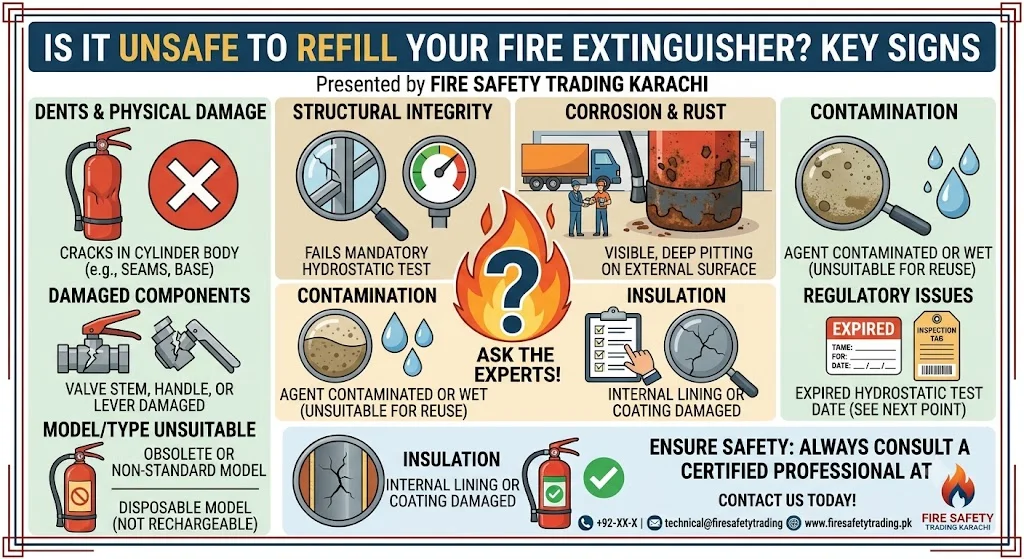
1. Visible Rust or Corrosion on the Cylinder
Rust is one of the clearest warning signs. Karachi’s humid, coastal climate speeds up corrosion, especially for extinguishers stored outdoors, in garages, or near kitchens with steam and moisture. Rust weakens the metal shell of the cylinder. Even if the rust looks minor on the surface, it can be a sign of deeper thinning of the metal walls, which makes the cylinder unable to safely hold pressure again.
2. Dents, Cracks, or Bulges in the Body
A dent might seem harmless, but it changes how stress is distributed across the cylinder wall. A dented or bulging cylinder is structurally compromised and should never be repressurised. Cracks, even hairline ones, are an automatic disqualifier for refilling.
3. Expired Hydrostatic Test Date
Every extinguisher cylinder has a hydrostatic test date stamped on its collar or body. This test checks whether the cylinder can still withstand high pressure safely. If this date has passed and the cylinder has not been retested, it should not be refilled until it passes a fresh hydrostatic test. Skipping this step is one of the most common and most dangerous shortcuts taken by unqualified refilling services.
4. Damaged Valve, Hose, or Nozzle
The valve assembly controls how the extinguishing agent is released. A cracked hose, a loose valve, or a nozzle blocked with old residue can cause the extinguisher to malfunction even if the cylinder itself is refilled correctly. If these parts show wear, they need to be replaced, not just reused after a refill.
5. A Pressure Gauge Stuck or Reading Incorrectly
If the gauge needle does not move, is stuck in the red zone, or behaves inconsistently during testing, the extinguisher has an internal fault that a simple refill will not solve. A faulty gauge means you cannot trust the extinguisher to tell you when it needs attention in the future either.
6. Signs the Extinguisher Was Exposed to Fire or Extreme Heat
Discoloured paint, warped plastic parts, or a scorched cylinder surface usually mean the extinguisher was exposed to high heat at some point. Heat exposure can weaken metal and seals in ways that are not always visible from the outside. These units should be retired, not refilled.
7. Missing or Broken Safety Pin and Tamper Seal
While this alone does not always mean the cylinder is unsafe to refill, it does mean the extinguisher’s history is unclear. Combined with any of the other warning signs above, a missing pin or broken seal is a reason to have the unit fully inspected before refilling.
8. Cylinder Age Beyond Its Service Life
Most fire extinguisher cylinders have a recommended service life, often around 10 to 15 years depending on the type and manufacturer. Once a cylinder passes this age, even if it looks fine on the outside, manufacturers generally recommend replacement over repeated refilling.
9. Improper Storage History
Extinguishers stored in extreme heat, direct sunlight, near chemicals, or in damp basements for long periods can suffer internal damage that is not visible without proper testing. If you are unsure how a second-hand or long-stored extinguisher was kept, it is safer to have it professionally checked before refilling.
10. Contaminated or Caked Extinguishing Agent
Sometimes the problem is not the cylinder itself but what is inside it. Moisture entering a dry powder extinguisher can cause the powder to cake and clump, which can block the nozzle during discharge. This is another reason a full inspection, not just a top-up, is necessary before refilling.
Why This Matters More in Karachi
Karachi’s mix of high humidity, coastal salt air, and dusty conditions is tougher on fire safety equipment than many other cities. Cylinders corrode faster, seals degrade sooner, and equipment stored in warehouses, shops, or industrial units is often exposed to heat and moisture for years without proper checks. This makes regular professional inspection even more important for homes, offices, factories, and commercial buildings across the city.
If you are looking for trusted, professional fire extinguisher refilling in Karachi, it is worth choosing a service that inspects the full unit rather than one that simply tops up the pressure and hands it back.
What Happens If an Unsafe Extinguisher Is Refilled Anyway
Refilling a compromised cylinder does not just risk a rare rupture. More commonly, it leads to extinguishers that fail quietly, leaking pressure over weeks or months without anyone noticing, or discharging weakly during an actual emergency when full pressure and a clear nozzle matter most. In a real fire, a few seconds of hesitation caused by faulty equipment can be the difference between a small, controllable incident and major damage.
How to Make the Right Decision
The safest approach is simple: never refill an extinguisher based on appearance alone. A professional technician should check the cylinder body, valve assembly, hose, pressure gauge, and hydrostatic test date every time, not just when something looks obviously wrong. If any of the issues covered above are present, replacement is usually safer and more cost-effective than refilling.
Regular annual inspection, even when an extinguisher has not been used, is the best way to catch these problems early before they become a safety risk.
Frequently Asked Questions
1. How do I know if my fire extinguisher is safe to refill?
Check for rust, dents, cracks, an expired hydrostatic test date, and a working pressure gauge. If any of these are present, have it inspected by a professional before refilling.
2. What is a hydrostatic test date and why does it matter?
It is the date stamped on the cylinder showing when it was last tested to withstand pressure safely. If this date has expired, the cylinder needs retesting before it can be refilled.
3. Can a rusted fire extinguisher still be refilled?
Light surface rust may be assessed by a technician, but visible corrosion often means the metal has weakened, making the cylinder unsafe to repressurise.
4. How often should fire extinguishers be inspected in Karachi?
Annual inspection is recommended for most homes and businesses, though commercial and industrial units may need more frequent checks due to Karachi’s humid, dusty environment.
5. Is it cheaper to refill or replace an old fire extinguisher?
It depends on the cylinder’s condition and age. If it has passed its service life or shows structural damage, replacement is usually the safer and more cost-effective option.
6. What happens if I use an expired fire extinguisher during a fire?
It may discharge weakly, leak pressure, or fail to work at all, leaving you without protection exactly when it is needed most.
7. Can a dented fire extinguisher explode?
A dent changes how pressure is distributed across the cylinder wall, which can increase the risk of failure. Dented cylinders should not be refilled or repressurised.
8. How long does a fire extinguisher cylinder last before it needs replacing?
Most cylinders have a recommended service life of around 10 to 15 years, depending on the type and manufacturer, after which replacement is generally advised.
9. Where can I get professional fire extinguisher refilling in Karachi?
Choose a service that inspects the full cylinder, valve, hose, and test date rather than one that only checks pressure levels before refilling.
10. Does caked or clumped powder inside an extinguisher matter?
Yes. Moisture can cause dry powder to clump, which can block the nozzle during discharge. This requires a full service, not just a refill.