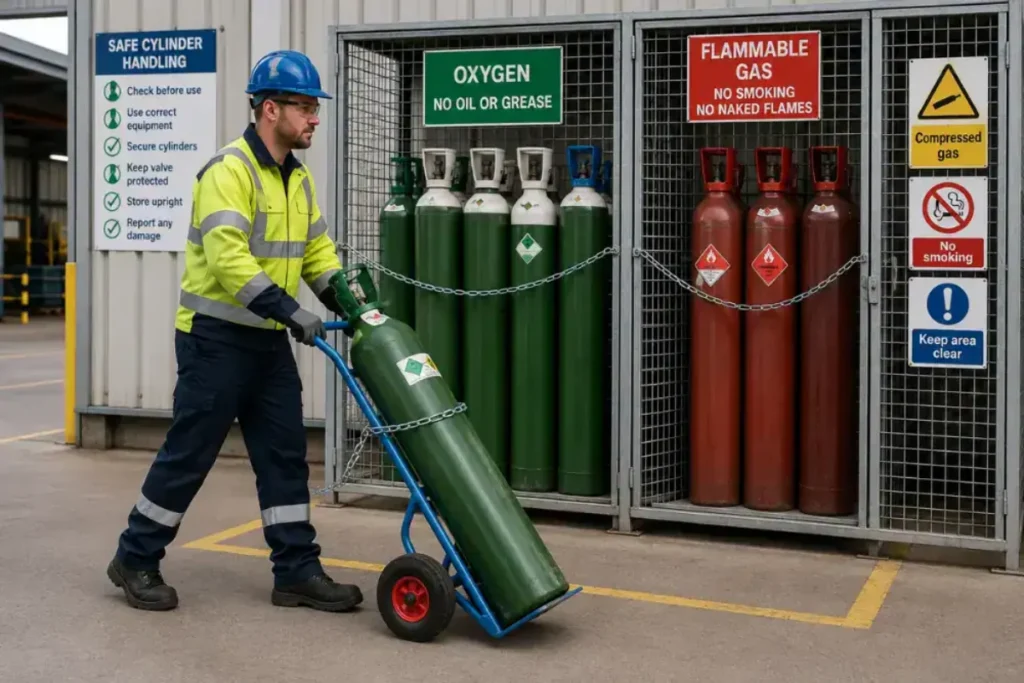
Gas cylinders are used in many homes, restaurants, shops, and workplaces across Pakistan. They provide fuel for cooking and other approved applications, making them useful in places where piped gas is unavailable or unreliable. However, gas cylinders and their connected equipment require careful handling, proper installation, suitable storage, and regular professional inspection.
Understanding gas cylinder safety does not require complicated technical knowledge. The most important principles are to use approved equipment, recognize possible hazards, keep cylinders in appropriate locations, and know how to respond safely if a problem occurs.
A gas leak can create a serious fire or explosion risk, particularly in an enclosed or poorly ventilated space. That is why prevention and early recognition are essential.
The Building Code of Pakistan Fire Safety Provisions 2016 addresses fire prevention, life safety, and the handling and storage of hazardous materials, including flammable gases, where applicable. <Cite refs={[“turn419973search24″,”turn419973search0”]}/> This guide explains the main gas cylinder safety principles in plain English, with a focus on homes and workplaces in Pakistan.
## 1. What Is Gas Cylinder Safety?
Gas cylinder safety means using and storing gas cylinders in a way that reduces the risk of leaks, fires, explosions, and other accidents.
A cylinder is only one part of a complete gas system. The regulator, hose, valves, connected appliance, surrounding environment, and ventilation all contribute to safety.
Good gas cylinder safety includes:
– Using suitable, approved equipment.
– Ensuring that cylinders are installed by qualified personnel.
– Keeping cylinders in an appropriate, well-ventilated location.
– Protecting cylinders from damage and excessive heat.
– Keeping ignition sources away from gas equipment.
– Arranging professional inspection and maintenance.
– Recognizing warning signs and following emergency procedures.
These precautions apply to homes, restaurants, hotels, offices, and other premises that use gas cylinders.
## 2. Why Gas Cylinder Safety Matters in Pakistan
Gas cylinders are used in different types of buildings throughout Pakistan, including residential properties, small businesses, commercial kitchens, and some industrial settings.
The risks vary according to the type of gas, the quantity stored, the building layout, the equipment used, and the quality of installation and maintenance.
A poorly maintained connection can create a hazard even when the cylinder itself appears to be in good condition. Similarly, storing a cylinder in an unsuitable location can increase the consequences of a leak.
For this reason, gas safety should be considered part of a property’s overall fire-prevention plan rather than an isolated responsibility.
The Building Code of Pakistan Fire Safety Provisions 2016 includes provisions concerning the handling and storage of flammable gases and other hazardous materials. The requirements that apply depend on the type of building and its use. <Cite refs={[“turn419973search24″,”turn419973search25”]}/>
## 3. Understand the Type of Gas Being Used
Liquefied petroleum gas, commonly called LPG, is widely used for cooking and other approved purposes. It is stored under pressure in specially designed cylinders.
LPG is highly flammable. If it escapes and accumulates in an unsuitable area, it can create a serious hazard when an ignition source is present.
The physical properties of the gas also matter. LPG vapour is generally heavier than air and can collect in low-lying areas, particularly where ventilation is poor.
This is why the location of a cylinder and the ventilation of the surrounding space are important safety considerations.
Never assume that an area is safe simply because a leak is not immediately obvious.
## 4. Choose Suitable, Approved Equipment
Gas cylinders and their associated equipment should be suitable for the intended application and supplied through legitimate, reliable channels.
The cylinder, regulator, hose, valves, and connected appliance should be compatible with one another.
Equipment should not be selected solely because it is inexpensive or looks similar to an approved product.
Important considerations include:
– The cylinder’s condition and suitability.
– Appropriate valves and regulators.
– Compatible connecting equipment.
– Clear product identification.
– Relevant safety markings and instructions.
– Professional installation and inspection.
If equipment appears damaged, heavily corroded, modified, or otherwise unsuitable, it should not be used until it has been assessed by qualified personnel.
## 5. Store Cylinders in an Appropriate Location
Storage arrangements have a major influence on gas cylinder safety.
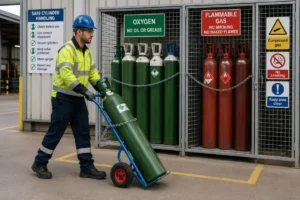
Cylinders should be kept in locations designed or approved for their use, with appropriate ventilation and protection from physical damage and excessive heat.
Avoid placing cylinders in unsuitable enclosed spaces, escape routes, basements, or areas where a gas leak could accumulate or interfere with evacuation. Specific restrictions depend on the building and applicable requirements.
Cylinders should also be protected against being knocked over or damaged, using suitable arrangements provided by qualified installers or responsible building management.
Do not improvise a storage enclosure or move cylinders into an unfamiliar location without checking that the arrangement is suitable.
## 6. Keep Cylinders Away From Excessive Heat
Gas cylinders should not be exposed to direct flames, excessive heat, or other inappropriate heat sources.
Heat can increase pressure inside a cylinder and make an already hazardous situation more serious.
Keep cylinders away from unsuitable cooking, heating, or industrial equipment, and follow the manufacturer’s instructions and applicable storage requirements.
If a cylinder is exposed to a fire or appears to be affected by unusual heat, do not approach it to investigate. Move away, warn others when safe, and contact emergency services.
## 7. Why Professional Installation Matters
Gas systems should not be installed or modified through guesswork.
An unsuitable connection, incompatible regulator, damaged hose, or poorly planned installation can create a leak or other hazard.
Qualified personnel can assess whether the equipment is appropriate, whether the installation meets applicable requirements, and whether ventilation and other safety measures are adequate.
Property owners and managers should also make sure that any maintenance or replacement work is completed by suitably qualified professionals.
Children and other untrained occupants should never be expected to repair gas equipment.
## 8. Recognize Possible Signs of a Gas Leak
Recognizing a possible leak is an important part of prevention.
Warning signs may include:
– An unusual gas smell.
– A suspected leak around gas equipment.
– Damaged or visibly deteriorated connecting components.
– Unusual behaviour from a connected appliance.
– A report of a possible leak from another occupant.
Odour alone is not a reliable way to establish whether an area is safe. Some circumstances may make a leak difficult to detect, so suspected gas problems should always be treated seriously.
**If you suspect a gas leak, prioritize leaving the affected area and alerting others. Do not operate electrical switches, use flames, smoke, or attempt to locate or repair the leak yourself.** Once safely away, contact the appropriate gas emergency service or local emergency responders and follow their instructions.
Do not return until the area has been declared safe by qualified personnel.
## 9. What to Do During a Gas-Related Emergency
A gas leak can become dangerous quickly, so people should understand the basic emergency response before an incident occurs.
If you suspect a leak:
1. Move away from the affected area and get others to safety if you can do so without risk.
2. Avoid flames, smoking, and operating electrical switches or equipment in the affected area.
3. Do not try to locate the leak, disconnect equipment, or repair the cylinder yourself.
4. From a safe location, contact the relevant emergency service or gas supplier.
5. Follow the instructions of emergency responders.
6. Do not re-enter the affected area until qualified personnel confirm it is safe.
If a fire has already started, do not approach the cylinder or attempt to manage the incident yourself. Evacuate and contact emergency services.
In Punjab, Rescue 1122 provides emergency response services, including fire and rescue assistance. <Cite refs={[“turn419973search24″,”turn419973search11”]}/> The appropriate emergency contact can vary by location and type of incident.
## 10. Never Ignore Damaged Equipment
Gas equipment can deteriorate through age, wear, physical damage, or unsuitable use.
Cylinders, valves, regulators, hoses, and connected appliances should receive appropriate professional inspection and maintenance.
If you notice damage or suspect a fault, stop using the equipment and keep people away from the affected area. Arrange assessment by qualified personnel.
Do not try to repair damaged components with household materials, improvised fittings, or unapproved replacement parts.
Professional inspection helps identify problems that may not be obvious to an ordinary occupant.
## 11. Good Ventilation Is Important
Ventilation helps reduce the risk of dangerous gas accumulation, but it does not make an unsuitable installation safe.
Gas equipment should be located and used according to its design, manufacturer instructions, and applicable building requirements.
Rooms containing gas equipment should not be assumed safe simply because a window is open. Ventilation arrangements must be suitable for the equipment and the space.
Building owners should obtain professional advice when planning a new installation, changing a room’s use, or modifying a gas system.
## 12. Gas Cylinder Safety in Homes
In residential properties, gas safety depends on both the equipment and the habits of the people using the building.
Households should make sure that:
– Gas equipment is installed appropriately.
– Cylinders are kept in a suitable location.
– Children cannot play with or interfere with gas equipment.
– Damaged equipment is reported promptly.
– Suspected leaks are treated as emergencies.
– Appliances are used according to their instructions.
– Maintenance is carried out by qualified personnel.
Family members should know how to recognize a possible gas emergency and where to go for safety.
Children should be taught to move away from a suspected leak and tell a trusted adult rather than attempting to investigate.
## 13. Gas Cylinder Safety in Restaurants and Commercial Kitchens
Restaurants and commercial kitchens may use gas equipment for extended periods and may have several appliances operating in the same area.
Their safety arrangements should be appropriate to the size and nature of the operation.
Important considerations include suitable cylinder storage, professional installation, ventilation, inspection, staff awareness, and clear emergency procedures.
Staff should know whom to notify if equipment appears damaged or a gas leak is suspected.
Cylinders and gas equipment should not obstruct escape routes or be stored in locations that conflict with applicable requirements.
Commercial operators should also ensure that their arrangements meet the requirements of the relevant building and local authorities.
## 14. The Connection Between Gas Safety and Fire Safety
Gas cylinder safety is closely connected to broader fire prevention.
A gas leak may create a flammable atmosphere, while an ignition source can turn a leak into a serious emergency. Preventing leaks, maintaining equipment, and responding quickly to suspected problems are therefore important fire-safety measures.
Other building safeguards can also contribute to overall protection.
Depending on the property and its applicable requirements, these may include:
– Fire detection and alarm systems.
– Appropriate ventilation arrangements.
– Clear evacuation routes.
– Emergency lighting and exit signs.
– Fire-protection equipment.
– Emergency response plans.
– Staff training and evacuation drills.
– Regular inspection and maintenance.
The Building Code of Pakistan Fire Safety Provisions 2016 addresses multiple elements of fire and life safety, including alarm systems and emergency egress where applicable. <Cite refs={[“turn419973search24″,”turn419973search25”]}/>
## 15. How a Fire Alarm System Supports Building Safety
A fire alarm system is designed to warn occupants when a fire or related emergency condition is detected. Depending on the building, the system may use automatic detectors, manual alarm points, audible notification, visual signals, and other components.
A properly designed **fire alarm system in Pakistan** can form an important part of a building’s overall safety arrangements where required.
However, a standard fire alarm system should not automatically be assumed to detect every type of gas leak. Gas detection is a separate function and may require purpose-designed detectors appropriate to the gas and installation.
Where gas detection is necessary, building owners should consult qualified professionals about the correct equipment, placement, integration, and maintenance.
An alarm is only one part of the safety plan. Occupants also need clear instructions and safe evacuation routes.
## 16. Fire Safety Training for Occupants
Training helps people understand how to respond without taking unnecessary risks.
For homes, families can discuss warning signs, safe exit routes, and how to contact emergency services.
For workplaces, managers can establish procedures for reporting damaged equipment, responding to suspected leaks, evacuating the affected area, and contacting emergency responders.
Training should emphasize that occupants must not attempt dangerous repairs or investigate a possible leak.
Rescue 1122’s community safety initiatives include fire-safety awareness and emergency preparedness activities. <Cite refs={[“turn419973search24″,”turn419973search11”]}/>
Regular awareness sessions can help turn safety principles into everyday habits.
## 17. Common Gas Cylinder Safety Mistakes
Some mistakes occur because people underestimate the risks or assume that familiar equipment does not require attention.
Common examples include:
– Ignoring the smell of gas.
– Using visibly damaged equipment.
– Allowing unqualified people to modify a gas installation.
– Storing cylinders in unsuitable areas.
– Exposing cylinders to excessive heat.
– Blocking ventilation or escape routes.
– Treating an alarm as unimportant.
– Attempting to repair a suspected leak.
– Returning to an affected area before it is declared safe.
Avoiding these mistakes requires awareness, professional maintenance, and clear emergency procedures.
## 18. The Role of Property Owners and Managers
Property owners and managers have an important role in keeping gas installations and fire-protection systems appropriate for their buildings.
Their responsibilities may include arranging professional installation and inspection, addressing reported hazards, maintaining required safety systems, and ensuring that occupants understand relevant emergency procedures.
The exact obligations depend on the property, the applicable regulations, and the authority responsible for enforcing them.
Tenants and employees should report problems promptly rather than assuming that someone else has already noticed them.
Safety is most effective when everyone understands their role and technical work is handled by qualified professionals.
## 19. A Simple Gas Cylinder Safety Checklist
The following checklist can help households and businesses review general safety arrangements.
– Is the cylinder suitable for the intended use?
– Is the equipment installed by qualified personnel?
– Is the storage location appropriate and adequately ventilated?
– Is the cylinder protected from physical damage and excessive heat?
– Are the regulator, valves, and connecting equipment in suitable condition?
– Are inspections and maintenance handled professionally?
– Do occupants know how to report a suspected leak?
– Are emergency routes clear?
– Do occupants understand what to do during a suspected leak?
– Are required fire and gas detection systems maintained?
– Are emergency contact details available?
– Are children kept away from gas equipment?
This checklist is a starting point, not a replacement for professional inspection or applicable legal requirements.
## 20. Building a Stronger Gas-Safety Culture in Pakistan
Improving gas cylinder safety requires more than following a few rules when a cylinder is delivered or replaced.
Households, landlords, businesses, suppliers, installers, and building managers all contribute to safer conditions.
Reliable equipment, suitable installation, responsible storage, professional maintenance, and emergency awareness can reduce avoidable risks.
People should also rely on official guidance and qualified professionals instead of unverified advice from social media or informal sources.
Gas safety is especially important in shared buildings because a problem in one area can affect other occupants. Clear communication and responsible maintenance help protect everyone who uses the property.
## Conclusion
Gas cylinder safety is easier to understand when it is treated as a set of practical principles: use appropriate equipment, ensure professional installation, store cylinders in suitable locations, protect them from excessive heat and damage, and take suspected leaks seriously.
If a gas leak is suspected, leave the affected area, avoid ignition sources and electrical switches, and contact the appropriate emergency service from a safe location. Never attempt to locate or repair the leak yourself.
Fire safety also depends on the wider building environment. A properly designed fire alarm system in Pakistan can help warn occupants where required, while suitable gas detection may be needed for particular hazards. These systems should be selected and maintained professionally and supported by clear emergency procedures.
Ultimately, prevention, professional expertise, and early action are the foundations of safer gas use in Pakistani homes and workplaces.
## Frequently Asked Questions
### 1. Why is gas cylinder safety important?
Gas cylinder safety helps reduce the risk of leaks, fires, explosions, and equipment-related accidents. Suitable storage, professional installation, regular inspection, and awareness of emergency procedures are essential parts of prevention.
### 2. What should I do if I suspect a gas leak?
Leave the affected area, avoid flames and operating electrical switches, and do not attempt to find or repair the leak. Contact the appropriate emergency service or gas supplier from a safe location and follow their instructions.
### 3. Can a fire alarm system detect every gas leak?
No. A standard fire alarm system should not be assumed to detect every gas leak. Gas detection may require separate detectors designed for the particular gas and installation.
### 4. Where should gas cylinders be stored?
Cylinders should be kept in locations suitable for their type and intended use, with appropriate ventilation and protection from excessive heat and physical damage. The correct arrangement depends on the installation and applicable requirements, so professional advice is important.
### 5. Who should inspect and maintain gas cylinder equipment?
Qualified personnel should assess, install, repair, and maintain gas cylinders and their connected equipment. Suspected leaks and damaged components should be treated seriously rather than repaired through guesswork or im