Karachi is home to thousands of factories, warehouses, and industrial units, from textile mills to plastic manufacturing plants. With heavy machinery, flammable raw material, and long working hours, the risk of fire is always present. A fire extinguisher hanging on the wall is not enough on its own; it has to be checked, serviced, and refilled on a regular schedule to actually work when it is needed. This guide covers practical, easy-to-follow maintenance tips that factory owners and safety officers in Karachi can use to keep their fire equipment ready at all times.
Why Fire Extinguisher Maintenance Matters for Karachi Factories
Fire Safety Trading (Pvt)
ToggleKarachi’s climate is hot and humid for most of the year, and factory floors are often dusty, oily, or exposed to chemical fumes. These conditions speed up wear on extinguisher valves, hoses, and pressure gauges. A cylinder that looks fine from the outside can lose pressure or develop a clogged nozzle without anyone noticing until the moment it is actually needed. Regular maintenance closes this gap. It also keeps a factory compliant with fire safety regulations that insurance companies and labor inspectors expect to see followed.
Common Fire Hazards in Karachi’s Industrial Units
Before setting up a maintenance routine, it helps to know what you are protecting against. Karachi factories typically face a mix of the following hazards:
- Overloaded electrical wiring and old junction boxes
- Store fabric, cardboard, or packaging material near heat sources
- Flammable solvents, thinners, and lubricants in production areas
- Overheating machines that run for long shifts without breaks
- Poor ventilation that lets fumes and heat build up
Each of these hazard types calls for a specific class of extinguisher: ABC dry powder for general use, CO2 for electrical panels, and foam for flammable liquids. Matching the right extinguisher to the right hazard is the first step in real fire protection.
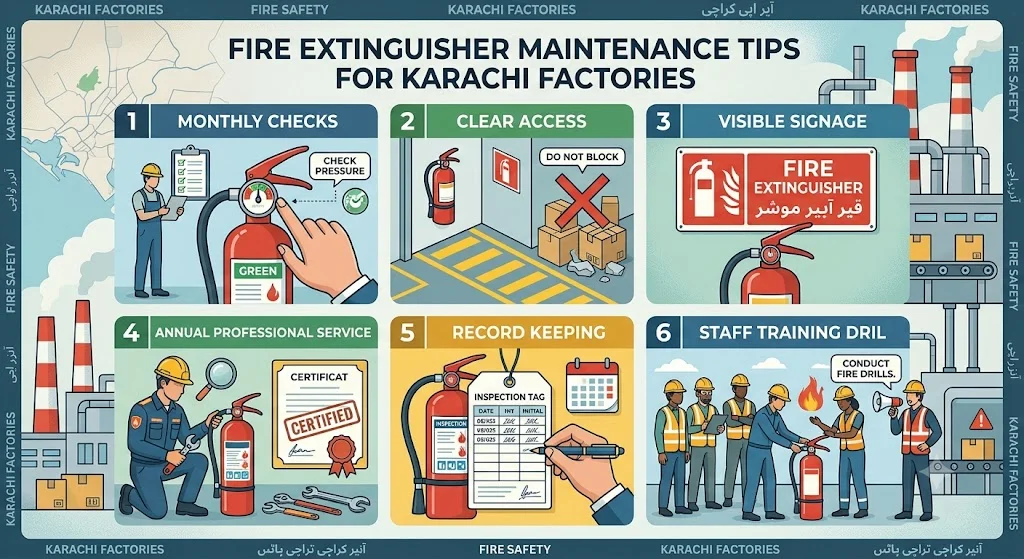
Monthly Visual Inspection Checklist
A full service is not needed every month, but a quick visual check should be part of every factory’s routine. Assign this task to a shift supervisor or safety officer and keep a simple log sheet near each unit.
- Confirm the pressure gauge needle sits in the green zone
- Check that the safety pin and tamper seal are intact
- Look for dents, rust, or corrosion on the cylinder body
- Make sure the hose and nozzle are free of cracks or blockages
- Verify the extinguisher is hanging in its designated, unobstructed spot
- Wipe off dust, oil, or grease that has built up on the cylinder
If any of these checks fail, the extinguisher should be tagged as out of service and sent for professional attention immediately rather than left in place “just in case.”
Understanding Fire Extinguisher Refilling in Karachi
Refilling is different from a simple inspection. It involves discharging any remaining agent, checking the internal condition of the cylinder, replacing the extinguishing agent, and re-pressurizing the unit to the correct level. Factories in Karachi generally need fire extinguisher refilling in Karachi once a year for standard units, or immediately after any partial or full discharge, even a test spray. Skipping this step is one of the most common reasons extinguishers fail during a real emergency.
A proper refill also includes replacing worn O-rings and seals, checking the internal walls for corrosion, and testing the pressure gauge for accuracy. This is not something that should be attempted in-house — it requires trained technicians and the correct filling equipment to be done safely.
Signs Your Fire Extinguisher Needs Refilling or Replacement
Watch for these warning signs between scheduled services:
- The pressure gauge needle has moved into the red zone
- The cylinder feels lighter than usual when lifted
- There is visible rust, denting, or a damaged base
- The service tag is missing, faded, or past its due date
- The extinguisher was used, even briefly, during a drill or minor incident
Any one of these signs is enough reason to pull the unit from service and arrange a refill or replacement the same week, not the same month.
Annual Professional Servicing Requirements
Beyond refilling, factories should schedule a complete annual service with a licensed fire safety provider. This typically includes hydrostatic testing every five years for most cylinder types, internal and external examination, weighing to confirm the agent level, and reissuing a fresh service tag with the technician’s details and the next due date. Keeping these records organized also makes it much easier to pass fire safety audits from SESSI, labor departments, or insurance surveyors.
Storage and Placement Best Practices for Factory Floors
Where an extinguisher is kept matters almost as much as its condition. In a Karachi factory setting, place units:
- At clearly marked, well-lit locations along main walkways
- Close to high-risk zones such as generators, boilers, and storage rooms
- At a height that workers can reach without climbing or stretching
- Away from direct sunlight, heat sources, and standing water
- With unobstructed access — never behind stacked goods or machinery
A good rule of thumb is that no point on the factory floor should be more than about 15 meters from a working extinguisher.
Staff Training and Fire Drill Tips
Even a perfectly maintained extinguisher is only useful if workers know how to use it. Run short refresher sessions covering the PASS method — Pull the pin, Aim at the base of the fire, Squeeze the handle, and Sweep side to side. Combine this with a fire drill at least twice a year so staff can practice locating the nearest extinguisher and using it under a bit of pressure, not just in theory.
Choosing a Reliable Fire Extinguisher Refilling Service in Karachi
When picking a service provider, look for a company that offers on-site pickup and delivery, uses genuine extinguishing agents, issues proper service tags and certificates, and can service the full range of extinguisher types your factory uses — powder, CO2, foam, and water-based units. A provider that also stocks spare parts and offers annual maintenance contracts saves time and keeps your equipment consistently compliant instead of being reactively fixed after a failed inspection.
Cost of Neglecting Fire Extinguisher Maintenance
Skipping regular servicing might save a small amount in the short term. Still, the real cost shows up later — failed safety audits, higher insurance premiums, production downtime after a fire, and, in the worst case, injury to workers. Compared to the actual damage a factory fire can cause, the cost of routine inspection and refilling is minor. Treating fire safety as an ongoing budget line rather than a one-time purchase is what keeps a factory genuinely protected.
Final Thoughts
Fire extinguisher maintenance is not a one-time task to check off a compliance list — it is an ongoing routine that protects workers, equipment, and the business itself. Monthly visual checks, timely refilling, annual professional servicing, and proper staff training together form a complete safety net. For Karachi factories operating in demanding industrial conditions, staying consistent with these steps is the difference between an extinguisher that works when it counts and one that looks good on the wall.
Frequently Asked Questions
1. How often should fire extinguishers be refilled in Karachi factories?
Most standard extinguishers should be refilled once a year, or immediately after any use, even a partial discharge.
2. What is the difference between an inspection and a refill?
An inspection is a quick visual and pressure check, while a refill involves discharging, cleaning, recharging, and re-pressurizing the cylinder with fresh agent.
3. How do I know if my fire extinguisher has lost pressure?
Check the pressure gauge — if the needle sits in the red zone instead of the green zone, the unit needs immediate attention.
4. Can an old fire extinguisher be refilled instead of replaced?
Yes, as long as the cylinder passes a hydrostatic test and shows no rust, dents, or structural damage; otherwise, replacement is safer.
5. How long does hydrostatic testing last?
Most steel cylinders require hydrostatic testing every five years, depending on the extinguisher type and manufacturer guidelines.
6. What type of fire extinguisher is best for a factory?
Most factories use a mix of ABC dry powder units for general fires and CO2 units near electrical panels and machinery.
7. Where should fire extinguishers be placed on a factory floor?
They should be placed near high-risk areas and along main walkways so no point on the floor is more than about 15 meters away.
8. Who is responsible for fire extinguisher maintenance in a factory?
The factory owner or safety officer is responsible for scheduling inspections and servicing, though a licensed technician should do the actual refilling.
9. What happens if a factory fails a fire safety inspection?
It can result in fines, insurance complications, and, in serious cases, a temporary shutdown until the equipment is brought up to standard.
10. How can I find a reliable fire extinguisher refilling service in Karachi?
Look for a provider with trained technicians, genuine agents, proper service documentation, and experience servicing industrial units — you can review the options available for fire extinguisher refilling in Karachi to compare services.