Fire is one of the most dangerous emergencies any institution can face. In Pakistan, schools and hospitals are often crowded, and many buildings are not designed with modern safety standards in mind. A small spark can turn into a major disaster within minutes. That is why strict Fire Safety Rules are not optional. They are essential for protecting children, patients, staff, and visitors.
Schools are responsible for the safety of students who may not know how to respond in an emergency. Hospitals care for sick and injured people who cannot move quickly. In both places, panic can increase the damage. Proper planning, equipment, training, and regular inspection can prevent loss of life and property.
This article explains in detail the Fire Safety Rules that every school and hospital in Pakistan should follow. It also highlights the importance of using quality fire safety equipment and reliable suppliers such as https://firesafetytrading.com.pk/fire-safety-equipment/ to ensure compliance with national and international standards.
Why Fire Safety Rules Are Critical in Pakistan
Pakistan faces several fire risks due to electrical overload, poor wiring, gas leaks, and lack of regular maintenance. In many cities including Karachi, Lahore, Islamabad, Rawalpindi, and Faisalabad, commercial and institutional buildings operate without proper fire audits.
Schools often use temporary wiring for fans, projectors, and computers. Hospitals use oxygen cylinders, medical gases, and heavy electrical equipment. These factors increase the risk of fire.
Strong Fire Safety Rules help institutions:
Reduce fire hazards
Ensure safe evacuation
Comply with local building regulations
Protect reputation and legal standing
Avoid financial losses
When management takes fire safety seriously, it builds trust among parents, patients, and the community.
Understanding Common Fire Hazards in Schools
Schools have unique fire risks that require special attention.
Electrical Overload
Classrooms often have multiple devices connected to a single socket. Overloaded circuits can overheat and cause sparks. Old wiring is a major cause of fire incidents in Pakistani schools.
Laboratory Chemicals
Science labs store flammable chemicals. Improper storage or mixing of chemicals can lead to explosions or fires.
Canteen Areas
Cooking oil, gas cylinders, and stoves in school canteens increase fire risk. Without proper ventilation and fire suppression systems, a kitchen fire can spread quickly.
Blocked Exits
Many schools use corridors and staircases for storage. During an emergency, blocked exits can trap students.
Understanding Common Fire Hazards in Hospitals
Hospitals face even greater risks because of sensitive equipment and vulnerable occupants.
Medical Gas Systems
Oxygen supports combustion. In areas like operation theatres and ICUs, even a small spark can become a serious fire hazard.
Electrical Equipment
Ventilators, monitors, MRI machines, and air conditioning systems consume high power. Faulty wiring or short circuits are common causes of hospital fires.
Pharmacy Storage
Some medicines and chemicals are flammable. Improper storage can increase danger.
Laundry and Kitchen Areas
Hospital kitchens and laundry rooms use heating equipment that can overheat if not maintained properly.
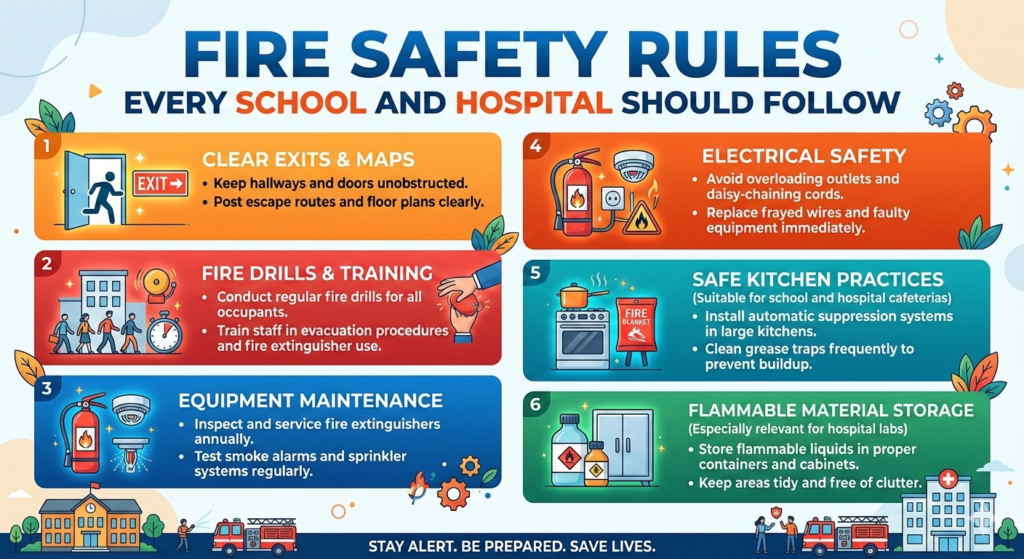
Core Fire Safety Rules Every School Must Follow
Installation of Fire Detection Systems
Every school should install smoke detectors and heat detectors in classrooms, laboratories, libraries, and corridors. Early detection saves lives. Alarm systems must be loud enough to be heard in every part of the building.
Regular Electrical Inspection
Electrical wiring should be inspected at least once a year by certified professionals. Loose connections, damaged wires, and overloaded circuits must be repaired immediately.
Fire Extinguishers in Accessible Locations
Portable fire extinguishers should be placed in every corridor, lab, and office. Staff must know how to use them. Different types of extinguishers are required for different types of fires, such as electrical fires or kitchen fires.
Clear Emergency Exits
Emergency exits must remain unlocked during school hours. Exit signs should be visible and illuminated. Staircases should never be used for storage.
Fire Drill Training
Students and teachers should participate in fire drills at least twice a year. Practice helps reduce panic and ensures smooth evacuation.
Safe Laboratory Practices
Chemicals must be stored in proper cabinets. Students should be supervised during experiments. Flammable materials should be kept away from heat sources.
Safe Canteen Operations
Gas cylinders should be placed in ventilated areas. Staff should check for leaks regularly. Fire blankets and Class K extinguishers should be available in kitchen areas.
Core Fire Safety Rules Every Hospital Must Follow
Comprehensive Fire Risk Assessment
Hospitals must conduct a detailed fire risk assessment. This identifies high risk areas such as operation theatres, generator rooms, and oxygen storage areas.
Advanced Fire Alarm Systems
Hospitals require addressable fire alarm systems that can pinpoint the exact location of a fire. This allows faster response.
Automatic Sprinkler Systems
Sprinkler systems are critical in hospitals because many patients cannot evacuate quickly. These systems control fire before it spreads.
Fire Compartmentalization
Hospitals should be divided into fire compartments. Fire resistant walls and doors help contain fire in one area and prevent it from spreading.
Emergency Lighting
In case of power failure, emergency lights must automatically turn on. Clear visibility is essential for safe evacuation.
Dedicated Fire Response Team
Hospitals should have trained fire wardens in every department. These individuals coordinate evacuation and assist patients.
Safe Oxygen Handling
Oxygen cylinders must be stored upright and away from heat sources. Smoking should be strictly prohibited near oxygen areas.
Importance of Quality Fire Safety Equipment
Following Fire Safety Rules is impossible without proper equipment. Low quality products may fail during emergencies. Schools and hospitals should only purchase certified fire safety equipment from trusted suppliers.
Essential equipment includes:
Fire extinguishers
Fire alarm panels
Smoke detectors
Heat detectors
Fire hoses and reels
Sprinkler systems
Fire blankets
Emergency exit lights
Institutions in Pakistan can find reliable fire safety products at https://firesafetytrading.com.pk/fire-safety-equipment/. Investing in quality equipment is not an expense. It is a long term safety investment.
Legal Requirements and Compliance in Pakistan
Different provinces in Pakistan have building codes that require fire safety measures. The Civil Defence Department and local development authorities conduct inspections. Non compliance can lead to fines, sealing of buildings, or legal action.
School and hospital management must:
Obtain fire safety certificates
Maintain updated inspection records
Ensure staff training documentation
Renew licenses as required
Compliance also improves chances of insurance approval and claim settlement in case of fire damage.
Training and Awareness Programs
Equipment alone is not enough. Human awareness plays a major role in preventing disasters.
Staff Training
Teachers, nurses, and administrative staff should know how to operate fire extinguishers and alarms. Training sessions should be conducted by certified fire safety professionals.
Student Education
Schools should include basic fire safety awareness in their curriculum. Students must understand emergency signals and evacuation routes.
Hospital Staff Drills
Hospital drills must include patient evacuation scenarios. Special attention should be given to ICU and neonatal units.
Proper Evacuation Planning
Evacuation plans should be displayed clearly on walls. Maps must show exit routes and assembly points.
Assembly Areas
Both schools and hospitals must have designated assembly areas outside the building. These areas should be at a safe distance from the structure.
Special Needs Consideration
Hospitals must plan evacuation for patients on ventilators or wheelchairs. Schools should have strategies for young children and students with disabilities.
Maintenance and Regular Inspection
Fire safety is not a one time setup. It requires continuous monitoring.
Monthly Inspection
Fire extinguishers should be checked monthly for pressure levels. Alarm systems should be tested regularly.
Annual Servicing
Professional servicing of sprinkler systems and fire pumps should be done annually.
Record Keeping
Maintain a logbook of inspections, maintenance activities, and fire drills. This record proves compliance during audits.
Fire Safety Culture in Institutions
True safety comes when fire prevention becomes part of the institution’s culture.
Management Commitment
Leadership must allocate budget for safety improvements. Cost cutting in fire safety can lead to heavy losses later.
Clear Communication
Emergency procedures should be communicated clearly to everyone. Posters and signs can reinforce awareness.
Encouraging Reporting
Staff and students should feel comfortable reporting faulty wiring or blocked exits without fear.
Modern Fire Safety Technologies
Technology is improving fire protection systems.
Smart Smoke Detectors
These devices send alerts to mobile phones and control rooms.
Integrated Building Management Systems
Large hospitals can integrate fire alarms with security and HVAC systems for automatic shutdown during emergencies.
Fire Resistant Materials
Using fire rated doors, cables, and panels can slow down fire spread.
Upgrading to modern systems enhances compliance with Fire Safety Rules and ensures better protection.
Role of Fire Safety Audits
A professional fire safety audit identifies weaknesses in the system.
Auditors check:
Equipment placement
Exit accessibility
Electrical safety
Staff training records
Risk areas
After the audit, management receives a report with recommendations. Implementing these recommendations reduces risk significantly.
Cost of Ignoring Fire Safety Rules
Ignoring Fire Safety Rules can result in:
Loss of precious lives
Severe injuries
Legal action
Closure of institution
Reputation damage
Financial losses
For schools, it can mean loss of parents’ trust. For hospitals, it can destroy public confidence.
Budget Planning for Fire Safety
Many institutions delay safety upgrades due to budget concerns. However, fire safety planning can be included in annual budgets.
Cost effective approach includes:
Phased equipment installation
Regular maintenance instead of replacement
Training internal staff
Reliable suppliers like https://firesafetytrading.com.pk/fire-safety-equipment/ provide a range of products suitable for different budget levels while maintaining quality.
Community Responsibility and Social Impact
Schools and hospitals are community pillars. Ensuring their safety protects the entire neighborhood. A fire in a hospital can spread to nearby buildings. A school fire can cause national outrage.
Strong Fire Safety Rules create a safer society. They show that management values human life above everything.
Conclusion
Fire safety in schools and hospitals is not just about installing extinguishers. It is about planning, training, inspection, compliance, and culture. In Pakistan, where infrastructure challenges exist, institutions must take extra responsibility.
By following strict Fire Safety Rules, conducting regular risk assessments, training staff, and investing in high quality equipment from trusted sources like https://firesafetytrading.com.pk/fire-safety-equipment/, schools and hospitals can significantly reduce fire risks.
Protecting children and patients should always be the top priority. A proactive approach today can prevent a tragedy tomorrow. Fire safety is not an option. It is a duty.