Fire Safety Rules Every School and Hospital Should Follow

Fire is one of the most dangerous emergencies any institution can face. In Pakistan, schools and hospitals are often crowded, and many buildings are not designed with modern safety standards in mind. A small spark can turn into a major disaster within minutes. That is why strict Fire Safety Rules are not optional. They are essential for protecting children, patients, staff, and visitors.
Schools are responsible for the safety of students who may not know how to respond in an emergency. Hospitals care for sick and injured people who cannot move quickly. In both places, panic can increase the damage. Proper planning, equipment, training, and regular inspection can prevent loss of life and property.

This article explains in detail the Fire Safety Rules that every school and hospital in Pakistan should follow. It also highlights the importance of using quality fire safety equipment and reliable suppliers such as https://firesafetytrading.com.pk/fire-safety-equipment/ to ensure compliance with national and international standards.

Why Fire Safety Rules Are Critical in Pakistan

Pakistan faces several fire risks due to electrical overload, poor wiring, gas leaks, and lack of regular maintenance. In many cities including Karachi, Lahore, Islamabad, Rawalpindi, and Faisalabad, commercial and institutional buildings operate without proper fire audits.

Schools often use temporary wiring for fans, projectors, and computers. Hospitals use oxygen cylinders, medical gases, and heavy electrical equipment. These factors increase the risk of fire.

Strong Fire Safety Rules help institutions:

Reduce fire hazards
Ensure safe evacuation
Comply with local building regulations
Protect reputation and legal standing
Avoid financial losses

When management takes fire safety seriously, it builds trust among parents, patients, and the community.

Understanding Common Fire Hazards in Schools

Schools have unique fire risks that require special attention.

Electrical Overload

Classrooms often have multiple devices connected to a single socket. Overloaded circuits can overheat and cause sparks. Old wiring is a major cause of fire incidents in Pakistani schools.

Laboratory Chemicals

Science labs store flammable chemicals. Improper storage or mixing of chemicals can lead to explosions or fires.

Canteen Areas

Cooking oil, gas cylinders, and stoves in school canteens increase fire risk. Without proper ventilation and fire suppression systems, a kitchen fire can spread quickly.

Blocked Exits

Many schools use corridors and staircases for storage. During an emergency, blocked exits can trap students.

Understanding Common Fire Hazards in Hospitals

Hospitals face even greater risks because of sensitive equipment and vulnerable occupants.

Medical Gas Systems

Oxygen supports combustion. In areas like operation theatres and ICUs, even a small spark can become a serious fire hazard.

Electrical Equipment

Ventilators, monitors, MRI machines, and air conditioning systems consume high power. Faulty wiring or short circuits are common causes of hospital fires.

Pharmacy Storage

Some medicines and chemicals are flammable. Improper storage can increase danger.

Laundry and Kitchen Areas

Hospital kitchens and laundry rooms use heating equipment that can overheat if not maintained properly.

Core Fire Safety Rules Every School Must Follow

Installation of Fire Detection Systems

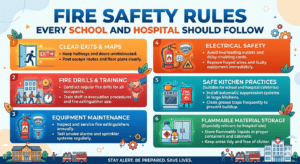
Every school should install smoke detectors and heat detectors in classrooms, laboratories, libraries, and corridors. Early detection saves lives. Alarm systems must be loud enough to be heard in every part of the building.

Regular Electrical Inspection

Electrical wiring should be inspected at least once a year by certified professionals. Loose connections, damaged wires, and overloaded circuits must be repaired immediately.

Fire Extinguishers in Accessible Locations

Portable fire extinguishers should be placed in every corridor, lab, and office. Staff must know how to use them. Different types of extinguishers are required for different types of fires, such as electrical fires or kitchen fires.

Clear Emergency Exits

Emergency exits must remain unlocked during school hours. Exit signs should be visible and illuminated. Staircases should never be used for storage.

Fire Drill Training

Students and teachers should participate in fire drills at least twice a year. Practice helps reduce panic and ensures smooth evacuation.

Safe Laboratory Practices

Chemicals must be stored in proper cabinets. Students should be supervised during experiments. Flammable materials should be kept away from heat sources.

Safe Canteen Operations

Gas cylinders should be placed in ventilated areas. Staff should check for leaks regularly. Fire blankets and Class K extinguishers should be available in kitchen areas.

Core Fire Safety Rules Every Hospital Must Follow

Comprehensive Fire Risk Assessment

Hospitals must conduct a detailed fire risk assessment. This identifies high risk areas such as operation theatres, generator rooms, and oxygen storage areas.

Advanced Fire Alarm Systems

Hospitals require addressable fire alarm systems that can pinpoint the exact location of a fire. This allows faster response.

Automatic Sprinkler Systems

Sprinkler systems are critical in hospitals because many patients cannot evacuate quickly. These systems control fire before it spreads.

Fire Compartmentalization

Hospitals should be divided into fire compartments. Fire resistant walls and doors help contain fire in one area and prevent it from spreading.

Emergency Lighting

In case of power failure, emergency lights must automatically turn on. Clear visibility is essential for safe evacuation.

Dedicated Fire Response Team

Hospitals should have trained fire wardens in every department. These individuals coordinate evacuation and assist patients.

Safe Oxygen Handling

Oxygen cylinders must be stored upright and away from heat sources. Smoking should be strictly prohibited near oxygen areas.

Importance of Quality Fire Safety Equipment

Following Fire Safety Rules is impossible without proper equipment. Low quality products may fail during emergencies. Schools and hospitals should only purchase certified fire safety equipment from trusted suppliers.

Essential equipment includes:

Fire extinguishers
Fire alarm panels
Smoke detectors
Heat detectors
Fire hoses and reels
Sprinkler systems
Fire blankets
Emergency exit lights

Institutions in Pakistan can find reliable fire safety products at https://firesafetytrading.com.pk/fire-safety-equipment/. Investing in quality equipment is not an expense. It is a long term safety investment.

Legal Requirements and Compliance in Pakistan

Different provinces in Pakistan have building codes that require fire safety measures. The Civil Defence Department and local development authorities conduct inspections. Non compliance can lead to fines, sealing of buildings, or legal action.

School and hospital management must:

Obtain fire safety certificates
Maintain updated inspection records
Ensure staff training documentation
Renew licenses as required

Compliance also improves chances of insurance approval and claim settlement in case of fire damage.

Training and Awareness Programs

Equipment alone is not enough. Human awareness plays a major role in preventing disasters.

Staff Training

Teachers, nurses, and administrative staff should know how to operate fire extinguishers and alarms. Training sessions should be conducted by certified fire safety professionals.

Student Education

Schools should include basic fire safety awareness in their curriculum. Students must understand emergency signals and evacuation routes.

Hospital Staff Drills

Hospital drills must include patient evacuation scenarios. Special attention should be given to ICU and neonatal units.

Proper Evacuation Planning

Evacuation plans should be displayed clearly on walls. Maps must show exit routes and assembly points.

Assembly Areas

Both schools and hospitals must have designated assembly areas outside the building. These areas should be at a safe distance from the structure.

Special Needs Consideration

Hospitals must plan evacuation for patients on ventilators or wheelchairs. Schools should have strategies for young children and students with disabilities.

Maintenance and Regular Inspection

Fire safety is not a one time setup. It requires continuous monitoring.

Monthly Inspection

Fire extinguishers should be checked monthly for pressure levels. Alarm systems should be tested regularly.

Annual Servicing

Professional servicing of sprinkler systems and fire pumps should be done annually.

Record Keeping

Maintain a logbook of inspections, maintenance activities, and fire drills. This record proves compliance during audits.

Fire Safety Culture in Institutions

True safety comes when fire prevention becomes part of the institution’s culture.

Management Commitment

Leadership must allocate budget for safety improvements. Cost cutting in fire safety can lead to heavy losses later.

Clear Communication

Emergency procedures should be communicated clearly to everyone. Posters and signs can reinforce awareness.

Encouraging Reporting

Staff and students should feel comfortable reporting faulty wiring or blocked exits without fear.

Modern Fire Safety Technologies

Technology is improving fire protection systems.

Smart Smoke Detectors

These devices send alerts to mobile phones and control rooms.

Integrated Building Management Systems

Large hospitals can integrate fire alarms with security and HVAC systems for automatic shutdown during emergencies.

Fire Resistant Materials

Using fire rated doors, cables, and panels can slow down fire spread.

Upgrading to modern systems enhances compliance with Fire Safety Rules and ensures better protection.

Role of Fire Safety Audits

A professional fire safety audit identifies weaknesses in the system.

Auditors check:

Equipment placement
Exit accessibility
Electrical safety
Staff training records
Risk areas

After the audit, management receives a report with recommendations. Implementing these recommendations reduces risk significantly.

Cost of Ignoring Fire Safety Rules

Ignoring Fire Safety Rules can result in:

Loss of precious lives
Severe injuries
Legal action
Closure of institution
Reputation damage
Financial losses

For schools, it can mean loss of parents’ trust. For hospitals, it can destroy public confidence.

Budget Planning for Fire Safety

Many institutions delay safety upgrades due to budget concerns. However, fire safety planning can be included in annual budgets.

Cost effective approach includes:

Phased equipment installation
Regular maintenance instead of replacement
Training internal staff

Reliable suppliers like https://firesafetytrading.com.pk/fire-safety-equipment/ provide a range of products suitable for different budget levels while maintaining quality.

Community Responsibility and Social Impact

Schools and hospitals are community pillars. Ensuring their safety protects the entire neighborhood. A fire in a hospital can spread to nearby buildings. A school fire can cause national outrage.

Strong Fire Safety Rules create a safer society. They show that management values human life above everything.

Conclusion

Fire safety in schools and hospitals is not just about installing extinguishers. It is about planning, training, inspection, compliance, and culture. In Pakistan, where infrastructure challenges exist, institutions must take extra responsibility.

By following strict Fire Safety Rules, conducting regular risk assessments, training staff, and investing in high quality equipment from trusted sources like https://firesafetytrading.com.pk/fire-safety-equipment/, schools and hospitals can significantly reduce fire risks.

Protecting children and patients should always be the top priority. A proactive approach today can prevent a tragedy tomorrow. Fire safety is not an option. It is a duty.

Fire Extinguisher Types and How to Use Them Properly

Fire safety is not a luxury. It is a basic need for homes, offices, factories, hospitals, shopping malls, and industrial sites. Every year, fire incidents cause heavy financial losses and serious injuries across Pakistan. Many of these losses could be reduced if the right fire extinguisher types were installed and used properly.
Understanding fire extinguisher types is important because not every fire can be controlled with the same equipment. Using the wrong extinguisher can make the situation worse. In this detailed guide, you will learn about different fire extinguisher types, their uses, and the correct way to operate them safely.

This article is specially written for Pakistani readers, business owners, safety officers, and homeowners who want practical and clear information about fire protection.

Why Understanding Fire Extinguisher Types Is Important

A fire extinguisher is usually the first line of defense in a fire emergency. It is designed to control small fires before they spread. However, different fires require different extinguishing agents.

For example, a water extinguisher works well on paper or wood fires, but if you use it on an electrical fire, it can cause electric shock. Similarly, using water on an oil fire can spread flames rapidly.

That is why knowing fire extinguisher types is not just technical knowledge. It is a matter of safety.

Classification of Fire Types

Before learning about fire extinguisher types, it is important to understand fire classes. Fires are classified based on the type of material that is burning.

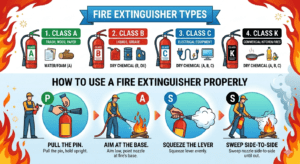
Class A fires involve ordinary combustible materials like wood, paper, cloth, and plastic.

Class B fires involve flammable liquids such as petrol, diesel, oil, and paint.

Class C fires involve gases like LPG and CNG.

Class D fires involve combustible metals such as magnesium and sodium.

Electrical fires involve energized electrical equipment such as wiring, panels, and machines.

Cooking oil fires are sometimes classified separately in commercial kitchens because they require special extinguishers.

Each class of fire requires a suitable extinguisher.

Main Fire Extinguisher Types Used in Pakistan

There are several fire extinguisher types available in the Pakistani market. The most commonly used ones are described below in detail.

Water Fire Extinguisher

Water extinguishers are one of the most basic and affordable options. They are mainly used for Class A fires involving wood, paper, and cloth.

How it works
Water cools the burning material and reduces the temperature below the ignition point. Once the heat is removed, the fire stops.

Where it is used
Schools, offices, homes, and places where flammable liquids are not present.

Where it should not be used
It must not be used on electrical fires or oil fires. Water conducts electricity and can cause severe injury. On oil fires, it can spread the flames.

Foam Fire Extinguisher

Foam extinguishers are suitable for Class A and Class B fires.

How it works
Foam forms a thick layer over burning liquid, cutting off oxygen supply and preventing re ignition. It also cools the surface.

Where it is used
Petrol pumps, workshops, warehouses, and industrial facilities where flammable liquids are stored.

Limitations
Foam extinguishers should not be used on live electrical equipment unless they are specifically rated safe.

Dry Powder Fire Extinguisher

Dry powder is one of the most common fire extinguisher types in Pakistan because it is versatile.

How it works
Dry powder interrupts the chemical reaction of fire. It creates a barrier between fuel and oxygen.

Types of dry powder
There are general purpose powders for Class A, B, and C fires. There are also special powders for Class D metal fires.

Where it is used
Factories, gas stations, vehicles, commercial buildings, and industrial plants.

Advantages
It can be used on electrical fires. It works quickly.

Disadvantages
It leaves residue and can damage sensitive equipment. It reduces visibility when discharged.

Carbon Dioxide CO2 Fire Extinguisher

CO2 extinguishers are specially designed for electrical and Class B fires.

How it works
Carbon dioxide displaces oxygen and cools the fire. Since it is a gas, it does not leave residue.

Where it is used
Server rooms, laboratories, electrical panels, offices with computers, and control rooms.

Advantages
No residue. Safe for electronic equipment.

Limitations
It is less effective outdoors where gas can disperse quickly. It does not work well on deep seated Class A fires.

Wet Chemical Fire Extinguisher

Wet chemical extinguishers are specially designed for cooking oil fires.

How it works
It reacts with hot oil to form a soap like layer that seals the surface and prevents re ignition.

Where it is used
Hotels, restaurants, commercial kitchens, and food processing units.

Why it is important
Using water on cooking oil can cause a dangerous fire explosion. Wet chemical extinguishers are much safer in such environments.

Choosing the Right Fire Extinguisher for Your Property

Selecting the correct fire extinguisher types depends on risk assessment. You must consider:

The type of materials present
The size of the building
Electrical installations
Storage of fuel or chemicals
Local fire safety regulations

For example, a house may need a dry powder extinguisher for general use and a small CO2 extinguisher for electrical panels. A factory handling chemicals may require foam, powder, and CO2 extinguishers at different locations.

If you want professional guidance and certified products, you can explore reliable suppliers such as https://firesafetytrading.com.pk/fire-extinguishers-in-pakistan/ to understand available options and compliance standards.

How to Use a Fire Extinguisher Properly

Knowing fire extinguisher types is only half the job. You must also know how to use them correctly.

The most common method is remembered by the word PASS.

Pull the pin
This breaks the tamper seal and allows you to operate the extinguisher.

Aim at the base of the fire
Do not spray at the flames. Always target the base where the fuel is burning.

Squeeze the handle
This releases the extinguishing agent.

Sweep from side to side
Move the nozzle slowly across the base of the fire until it is fully out.

Always maintain a safe distance, usually about two to three meters from the fire. Move closer only if necessary.

Important Safety Precautions

Never attempt to fight a large fire. If the fire is spreading rapidly, evacuate immediately and call emergency services.

Always keep an exit route behind you while using an extinguisher.

Check pressure gauges regularly to ensure the extinguisher is charged.

Do not use expired or damaged extinguishers.

Training employees in fire extinguisher types and usage is essential in offices and factories.

Maintenance and Inspection of Fire Extinguishers

A fire extinguisher is useful only if it works during an emergency. Regular inspection is mandatory.

Monthly checks should include:

Ensuring the pressure gauge is in the green zone
Checking for visible damage
Making sure the pin and seal are intact
Confirming the extinguisher is easily accessible

Annual servicing should be carried out by certified professionals. In Pakistan, safety regulations often require documented maintenance records for commercial properties.

Refilling should be done immediately after use, even if the extinguisher was partially discharged.

Fire Extinguisher Placement Guidelines

Proper placement is as important as selecting the correct fire extinguisher types.

Extinguishers should be mounted on walls at visible and accessible points.

They should be placed near exits, kitchens, electrical panels, and high risk areas.

Do not block extinguishers with furniture or storage items.

Clear signage should be installed to indicate their location.

In multi story buildings, each floor should have appropriate fire extinguishers installed.

Fire Safety Laws and Compliance in Pakistan

Many commercial buildings, factories, and high rise structures are legally required to install fire extinguishers. Local building control authorities and civil defense departments conduct inspections.

Failure to comply can result in fines, closure notices, or legal action.

Insurance companies also check whether proper fire extinguisher types are installed before issuing coverage.

Investing in certified extinguishers is not just about safety. It is also about legal protection.

Common Mistakes People Make

One major mistake is buying the cheapest extinguisher without understanding fire risk.

Another mistake is ignoring maintenance. An expired extinguisher is as useless as having none.

Many people install only one type of extinguisher for all areas, which is risky.

Some people hesitate during fire emergencies because they are not trained.

Awareness and training solve most of these issues.

Fire Extinguishers for Homes in Pakistan

In Pakistani homes, common fire risks include gas leakage, electrical short circuits, and kitchen oil fires.

A small dry powder extinguisher of 2 kg or 4 kg is suitable for general household use.

A CO2 extinguisher is useful near inverter systems and electrical panels.

If you run a home based food business, a wet chemical extinguisher is strongly recommended.

Installing extinguishers near the kitchen and main entrance increases response time during emergencies.

Fire Extinguishers for Industries and Commercial Buildings

Industrial sites require detailed risk assessments.

Factories dealing with chemicals may need foam and dry powder units.

Data centers require CO2 extinguishers to protect sensitive electronics.

Petrol pumps must have foam and powder extinguishers strategically placed.

Shopping malls and offices require multiple units on every floor.

Professional consultation ensures that the correct fire extinguisher types are installed according to risk.

Importance of Fire Safety Training

Even the best equipment is useless without trained people.

Employees should receive training on:

Identifying fire classes
Selecting the right extinguisher
Using the PASS method
Evacuation procedures

Regular fire drills improve response time and reduce panic.

Training also builds confidence. When people know what to do, they act quickly and correctly.

The Cost of Ignoring Fire Safety

Fire damage is not limited to property loss. It can result in business closure, legal cases, injury, and even loss of life.

In many cases, small fires turn into major disasters because there was no proper extinguisher nearby.

Investing in the correct fire extinguisher types is a small cost compared to the potential losses.

Final Thoughts

Understanding fire extinguisher types and how to use them properly is essential for every home and business. Each type is designed for specific fire classes, and using the wrong one can be dangerous.

In Pakistan, where industrial growth and urban development are increasing, fire safety awareness must also grow. Whether you are a homeowner, factory owner, school administrator, or office manager, installing the correct fire extinguishers and training people to use them can save lives.

Do not wait for an emergency to realize the importance of fire safety. Evaluate your property, choose the right fire extinguisher types, maintain them regularly, and ensure everyone knows how to use them correctly.

Proper preparation today can prevent disaster tomorrow.

Why Fire Safety Training is Important for Offices and Factories

Fire is one of the most serious risks for any workplace. Whether it is a corporate office in a big city or a manufacturing unit in an industrial area, the danger of fire is always present. In Pakistan, where many buildings still lack proper safety systems, the importance of Fire Safety Training becomes even greater.
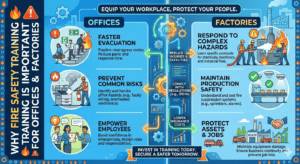
Many business owners invest in furniture, machinery, and technology, but they ignore the most important asset of their company, which is human life. A single fire incident can destroy property, stop business operations, and cause permanent damage to a company’s reputation. Proper Fire Safety Training ensures that employees know how to prevent fires, how to respond during emergencies, and how to protect themselves and others.

This article explains in detail why Fire Safety Training is essential for offices and factories, especially in the Pakistani business environment.

Understanding Fire Risks in Offices and Factories

Offices and factories have different types of fire risks, but both are equally dangerous.

In offices, common fire hazards include overloaded electrical sockets, faulty wiring, air conditioners, computers, printers, and kitchen areas. Paper files and wooden furniture can easily catch fire and help flames spread quickly.

Factories face even higher risks. There are heavy machines, chemical storage, gas cylinders, welding activities, flammable liquids, and high voltage equipment. A small spark in such an environment can turn into a massive fire within minutes.

Without Fire Safety Training, employees may not recognize these hazards. They may ignore warning signs such as burning smells, sparks, or overheating equipment. Training helps staff identify risks before they turn into disasters.

Protecting Human Lives

The first and most important reason for Fire Safety Training is to protect lives. In many fire incidents, people get injured not only because of flames but due to panic, smoke inhalation, and lack of knowledge.

When employees are trained, they know:

How to remain calm during an emergency
How to use fire extinguishers correctly
How to follow evacuation routes
How to assist others safely

Smoke spreads faster than fire and can cause suffocation within minutes. Training teaches employees the importance of staying low, covering their nose, and moving towards emergency exits quickly.

In factories, where the workforce is large, organized evacuation is critical. Without training, chaos can occur, leading to stampedes and serious injuries. Fire Safety Training creates discipline and structured response during emergencies.

Reducing Property Damage

Fire can destroy years of investment in a few hours. Offices lose important documents, IT equipment, and customer data. Factories lose raw materials, finished goods, and expensive machinery.

When employees are trained in Fire Safety Training programs, they can often control small fires before they become uncontrollable. Using the right type of fire extinguisher at the right time can save millions of rupees.

For example, using a water extinguisher on an electrical fire can make the situation worse. Training teaches the difference between Class A, B, C, and electrical fires and the correct extinguishing method for each type.

Businesses that invest in training often experience less severe damage because their staff acts quickly and effectively.

Ensuring Legal Compliance

Government authorities and local safety departments in Pakistan require businesses to follow fire safety standards. Many insurance companies also demand proof of Fire Safety Training before issuing policies.

If a fire occurs and it is found that the company did not provide proper training, legal action can be taken. The business owner may face fines, penalties, or even closure of operations.

Regular Fire Safety Training ensures compliance with local regulations and demonstrates that the company takes safety seriously. It also improves the company’s credibility when dealing with clients and international partners.

Improving Employee Confidence and Morale

Employees feel safer when they know their employer cares about their well being. Fire Safety Training builds confidence among staff members.

When workers understand emergency procedures, they feel prepared rather than helpless. This confidence improves overall morale and productivity.

In factories, especially where workers handle risky materials, training reduces fear and uncertainty. In offices, staff members feel secure knowing there are clear emergency plans in place.

A safe workplace creates a positive working environment and reduces employee turnover.

Preventing Business Interruptions

After a fire incident, businesses often remain closed for weeks or months. Production stops, customers shift to competitors, and financial losses increase.

Fire Safety Training reduces the chances of major incidents. Even if a fire occurs, trained employees can control it early and minimize downtime.

Continuity of operations is critical for factories that supply goods to local and international markets. Delays in production can lead to contract cancellations and loss of trust.

For offices providing services such as IT, banking, or consultancy, data loss due to fire can damage long term client relationships. Training, combined with proper safety equipment, ensures business continuity.

Creating a Culture of Safety

Fire Safety Training is not just a one time activity. It helps create a safety culture within the organization.

When management regularly conducts drills and refresher sessions, employees understand that safety is a priority. They become more alert and responsible.

In factories, workers start reporting faulty wiring, gas leaks, or blocked exits. In offices, employees avoid overloading sockets and follow safe electrical practices.

A strong safety culture reduces not only fire risks but also other workplace accidents.

The Role of Fire Drills

Theory alone is not enough. Practical fire drills are an important part of Fire Safety Training.

During drills, employees practice evacuation procedures in real time. They learn how long it takes to exit the building and identify possible obstacles.

Drills help management find weaknesses in emergency planning. For example, they may discover that some exits are blocked or alarm systems are not loud enough.

Regular drills ensure that everyone knows their role during an emergency, from security guards to department managers.

Importance of Proper Fire Safety Equipment

Training must be supported by the right equipment. Fire extinguishers, smoke detectors, fire alarms, hose reels, and emergency lights are essential in offices and factories.

Businesses should invest in high quality equipment and ensure regular maintenance. Reliable suppliers provide certified products that meet safety standards. Companies looking for complete solutions can explore professional fire protection systems and equipment from trusted providers such as https://firesafetytrading.com.pk/fire-safety-equipment/

Having equipment without training is useless. Employees must know how to operate fire extinguishers, where alarms are located, and how to shut down machinery safely.

Fire Risks in Pakistani Industrial Areas

Many industrial zones in Pakistan have closely built factories. A fire in one unit can quickly spread to neighboring buildings.

Poor wiring, illegal electrical connections, and lack of maintenance increase fire hazards. In some areas, fire brigade response time may be slow due to traffic or limited resources.

This makes Fire Safety Training even more critical. When employees can respond immediately, they reduce dependency on external help and prevent large scale disasters.

Special Considerations for Chemical and Textile Factories

Chemical factories handle flammable and hazardous substances. A small mistake can cause explosions and toxic smoke release.

Textile factories often store large quantities of fabric, which is highly flammable. Short circuits in sewing machines or boilers can ignite massive fires.

In such industries, Fire Safety Training must include:

Understanding chemical reactions
Safe storage of flammable materials
Proper ventilation systems
Emergency shutdown procedures

Training in these sectors should be detailed and industry specific.

Fire Safety in Corporate Offices

Corporate offices may look safer compared to factories, but they are not risk free.

Air conditioning systems, server rooms, and pantry areas are common sources of fire. Server rooms in particular require special fire suppression systems because water cannot be used on electrical equipment.

Fire Safety Training in offices should include:

Safe use of electrical devices
Emergency evacuation planning
Handling small kitchen fires
Protecting sensitive documents and data

Office staff should also know how to assist visitors during emergencies.

The Financial Benefits of Fire Safety Training

Some business owners see Fire Safety Training as an expense. In reality, it is a cost saving investment.

Insurance companies may offer lower premiums to businesses that demonstrate proper safety measures. Reduced accident rates also mean fewer compensation claims and medical expenses.

Preventing even one major fire incident can save millions in reconstruction costs, legal fees, and lost revenue.

Long term financial stability depends on risk management, and fire safety is a major part of that strategy.

Responsibility of Management

Top management must take responsibility for implementing Fire Safety Training. It should not be left only to the HR department.

Leaders must allocate budget, hire professional trainers, and ensure regular audits of safety systems.

When management actively participates in training sessions and drills, employees take the process seriously.

Safety policies should be clearly documented and communicated to all staff members.

Training for New Employees

Every new employee should receive Fire Safety Training as part of their orientation.

Many accidents happen because new workers are unaware of emergency procedures. Introducing safety training from the first day ensures that everyone follows the same standards.

Refresher courses should also be conducted annually to update employees about new risks and technologies.

The Role of Technology in Fire Safety

Modern fire safety systems include automatic alarms, heat sensors, and sprinkler systems. Smart monitoring tools can detect temperature changes and send alerts instantly.

However, technology alone cannot prevent disasters. Human response is always required.

Fire Safety Training ensures that employees understand how these systems work and what actions to take when alarms are triggered.

Integration of technology and training provides maximum protection.

Building Trust with Clients and Partners

Businesses that prioritize Fire Safety Training send a strong message to clients and investors.

International companies often conduct audits before partnering with local suppliers. They check safety standards and employee training records.

Having proper training programs increases chances of securing large contracts, especially in export industries.

It also enhances brand reputation in the competitive market.

Conclusion

Fire incidents can destroy lives, property, and business reputation within minutes. Offices and factories in Pakistan face unique challenges due to infrastructure issues and high industrial density.

Fire Safety Training is not optional. It is a necessity for every organization, regardless of size or industry.

By investing in proper training, conducting regular drills, installing quality equipment, and creating a culture of safety, businesses can protect their employees and secure their future.

A safe workplace is a productive workplace. Companies that take fire safety seriously not only save money but also demonstrate responsibility towards their workers and society.

In today’s competitive environment, no organization can afford to ignore Fire Safety Training. It is a powerful step towards sustainable growth, operational stability, and long term success.

Also Read: