Construction sites are busy environments where workers, contractors, engineers, visitors, and machinery operate together. Activities such as welding, electrical installation, material storage, cutting, and temporary power distribution can create fire hazards if they are not properly managed. A small safety oversight can affect workers, damage equipment, delay construction, and put nearby properties at risk.
Fire safety should therefore be an essential part of every construction project’s planning and daily operations. It should not be treated as a task that begins only after a building is completed. Temporary structures, unfinished electrical systems, combustible materials, and changing work areas all require careful attention throughout the construction process.
In Pakistan, construction projects range from small residential developments to large commercial buildings, factories, roads, and infrastructure projects. Each site has different fire risks depending on its size, design, activities, and materials. A practical fire safety checklist helps site managers identify hazards, assign responsibilities, and maintain safer working conditions.
This beginner’s guide explains the essential fire safety measures for construction sites, including hazard identification, equipment maintenance, worker training, emergency planning, and the importance of suitable fire alarm systems.
Why Fire Safety Is Important on Construction Sites
Construction sites often contain several fire hazards at the same time. Workers may use electrical tools, temporary wiring, generators, welding equipment, paints, solvents, packaging materials, and other combustible products.
Unlike completed buildings, construction sites may not yet have permanent fire protection systems or fully developed escape routes. Their layouts also change as work progresses.
A suitable fire safety plan helps address these challenges and provides clear procedures for preventing emergencies and protecting people.
The main benefits of construction site fire safety include:
– Protecting workers, contractors, and visitors.
– Reducing the likelihood of accidental fires.
– Protecting construction materials and machinery.
– Supporting business continuity.
– Reducing avoidable project delays.
– Improving workplace awareness.
– Helping maintain compliance with applicable safety requirements.
Fire prevention is a shared responsibility. Site managers, contractors, supervisors, and workers all have important roles in maintaining a safe environment.
Understanding Common Fire Hazards on Construction Sites
Before creating a checklist, it is important to understand where fire risks may arise.
1. Hot Work Activities
Welding, cutting, grinding, and other activities that produce heat or sparks can create ignition hazards.
These tasks require suitable planning, authorization, supervision, and precautions. A hot work permit system can help ensure that hazards are assessed before work begins.
Only appropriately trained and authorized personnel should perform these activities.
2. Temporary Electrical Installations
Construction sites often depend on temporary electrical supplies to operate lighting, tools, machinery, and other equipment.
Damaged cables, unsuitable connections, overloaded circuits, and poorly maintained electrical equipment can increase fire risks.
Temporary electrical systems should be installed and inspected by qualified professionals.
3. Flammable Materials
Paints, solvents, adhesives, fuels, and certain construction chemicals may be flammable.
Improper storage or careless handling can increase the possibility of fire.
These materials should be stored according to their safety information and applicable requirements.
4. Combustible Construction Materials
Wood, cardboard, plastic packaging, insulation products, and other combustible materials may accumulate during construction.
Poor housekeeping can allow unnecessary materials to collect near work areas and potential ignition sources.
Regular waste removal and suitable material storage help reduce this risk.
5. Generators and Fuel Storage
Generators may be used when permanent electrical supplies are unavailable.
Their placement, operation, maintenance, and fuel arrangements should be managed according to manufacturer instructions and relevant safety requirements.
Fuel should be stored in approved containers and designated areas away from unsuitable ignition sources.
6. Temporary Buildings and Site Offices
Construction sites may include temporary offices, worker facilities, storage containers, and other structures.
These areas may contain electrical equipment, furniture, documents, and combustible materials.
They should have appropriate safety arrangements, clear exits, and suitable fire protection measures.
The Beginner’s Construction Site Fire Safety Checklist
A checklist helps site managers organize fire prevention responsibilities and identify areas requiring attention.
The following sections provide a practical starting point for construction projects.
1. Conduct a Fire Risk Assessment
<AsyncImage query=”construction site safety manager conducting workplace inspection with clipboard hard hat” aspectRatio=”16:9″ width=”100%”/>A fire risk assessment should be completed before construction activities begin and reviewed whenever site conditions change.
The assessment should identify potential ignition sources, combustible materials, people who may be affected, and existing fire protection arrangements.
Important considerations include:
– Types of construction activities taking place.
– Materials used and stored on site.
– Temporary electrical installations.
– Hot work locations.
– Fuel and chemical storage.
– Worker accommodation and temporary offices.
– Emergency exits and access routes.
– Nearby buildings and public areas.
The assessment should also identify who is responsible for managing each hazard.
A documented assessment makes it easier to track safety improvements and communicate responsibilities to contractors and workers.
2. Establish Clear Fire Safety Responsibilities
Every construction project should have clearly defined safety responsibilities.
Site managers should ensure that suitable fire safety arrangements are established, communicated, and reviewed.
Responsibilities may include:
– Conducting and updating fire risk assessments.
– Arranging equipment inspections.
– Managing hot work authorization.
– Monitoring housekeeping.
– Providing worker training.
– Maintaining emergency contact information.
– Coordinating evacuation procedures.
– Reporting and investigating fire-related incidents.
Supervisors should communicate relevant safety requirements before work begins.
Workers should understand how to report hazards and who to contact when they identify unsafe conditions.
3. Manage Hot Work Safely
<AsyncImage query=”professional construction workers welding metal at industrial construction site with protective screens” aspectRatio=”16:9″ width=”100%”/>Hot work is a significant fire hazard on many construction sites.
Welding, cutting, and grinding should only be performed by trained and authorized personnel under appropriate supervision.
A hot work permit system helps ensure that relevant safety checks are completed before the activity starts.
The process should consider:
– Whether the work can be completed without generating sparks or heat.
– Nearby combustible materials.
– Suitable protection for surrounding areas.
– Availability of appropriate emergency equipment.
– Required supervision.
– Post-work monitoring as specified by the site’s safety procedures.
Workers should stop the activity and notify a supervisor if conditions become unsafe.
Hot work should never be carried out casually or without the required authorization.
4. Maintain Electrical Safety
Temporary electrical systems require regular attention because construction activities can expose cables and equipment to damage.
Electrical safety arrangements should include:
– Professional installation of temporary electrical supplies.
– Inspection of cables, plugs, and electrical equipment.
– Suitable protection against electrical faults.
– Avoidance of overloaded circuits.
– Protection of cables from physical damage.
– Safe placement of distribution equipment.
– Prompt reporting of damaged electrical accessories.
Workers should not attempt unauthorized electrical repairs.
If equipment repeatedly trips a protective device or shows signs of damage, it should be taken out of service until a qualified professional has assessed it.
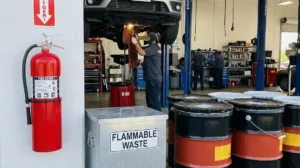
5. Store Flammable Materials Properly
<AsyncImage query=”construction site designated chemical storage cabinet flammable liquid safety labels” aspectRatio=”16:9″ width=”100%”/>Construction materials such as paints, solvents, adhesives, and fuels should be managed carefully.
A suitable storage plan should identify:
– Which materials are flammable.
– Where they are permitted to be stored.
– Required ventilation and environmental conditions.
– Suitable containers and labels.
– Access restrictions.
– Separation from incompatible materials.
– Procedures for handling damaged containers.
Safety data sheets should be available for relevant hazardous products.
Only authorized workers should handle materials that require special precautions.
Unnecessary quantities of flammable materials should not be kept in active work areas.
6. Maintain Good Housekeeping
Good housekeeping is one of the simplest ways to improve construction site fire safety.
Waste packaging, cardboard, wood scraps, and other combustible materials should be removed regularly.
Site managers should ensure that:
– Waste is collected in designated areas.
– Corridors and exits remain clear.
– Combustible materials are stored appropriately.
– Work areas are kept organized.
– Electrical equipment is not surrounded by unnecessary waste.
– Fuel and chemical storage areas remain orderly.
Housekeeping should be included in daily site inspections rather than left until the end of a project.
7. Provide Suitable Firefighting Equipment
<AsyncImage query=”red portable fire extinguishers mounted on construction site safety station” aspectRatio=”16:9″ width=”100%”/>Construction sites should have appropriate firefighting equipment based on their hazards, layout, and activities.
Portable fire extinguishers may be provided in designated locations, while other equipment may be necessary for larger or more complex projects.
The equipment selection should be based on a professional assessment.
Important checklist points include:
– Suitable equipment is available for identified hazards.
– Equipment is easy to locate.
– Access is not blocked.
– Inspection and maintenance are recorded.
– Workers know where equipment is located.
– Only trained and authorized people are expected to use it.
Workers should never attempt to control a spreading fire or put themselves at risk. Evacuation and raising the alarm must take priority.
8. Install Suitable Fire Detection and Alarm Arrangements
<AsyncImage query=”temporary fire alarm system construction site manual call point alarm sounder installation” aspectRatio=”16:9″ width=”100%”/>Fire detection and alarm arrangements help warn workers when a possible fire is identified.
The appropriate system depends on the construction stage, site layout, building design, and identified hazards.
A system may include:
– Smoke detectors.
– Heat detectors.
– Manual call points.
– Alarm sounders.
– Visual warning devices.
– A central control panel.
Temporary alarm arrangements may be necessary before permanent building systems become operational.
A suitable fire alarm system in Pakistan can support fire protection in construction projects, commercial buildings, offices, and industrial facilities.
However, the alarm arrangement must be appropriate for the actual site conditions. Equipment should be installed, tested, and maintained by qualified professionals.
Construction managers should also ensure that alarms can be heard or otherwise recognized in noisy work areas.
9. Keep Emergency Exits and Access Routes Clear
<AsyncImage query=”construction site clearly marked emergency exit route green safety signage” aspectRatio=”16:9″ width=”100%”/>Workers need clear routes to leave the site during an emergency.
Construction projects often change as walls, temporary partitions, scaffolding, and equipment are added or removed. Escape routes must therefore be reviewed regularly.
The site should provide:
– Clearly identified escape routes.
– Accessible emergency exits.
– Suitable directional signs.
– Appropriate emergency lighting where required.
– Clear access to stairways and passageways.
– A designated assembly point.
Temporary storage, tools, machinery, and construction waste should never obstruct escape routes.
If the building layout changes, evacuation arrangements and signs should be updated accordingly.
10. Display Clear Fire Safety Signage
Fire safety signs communicate important information to workers, contractors, and visitors.
Construction sites should use suitable signs to identify emergency exits, alarm points, firefighting equipment, restricted areas, and assembly points.
Signs should be:
– Easy to understand.
– Visible from relevant locations.
– Suitable for the site environment.
– Maintained in good condition.
– Consistent with the emergency plan.
Workers should receive an explanation of important signs during site induction.
11. Train Workers and Contractors
<AsyncImage query=”construction site workers attending safety training toolbox talk wearing hard hats” aspectRatio=”16:9″ width=”100%”/>Training helps workers understand their responsibilities and respond appropriately when a fire hazard is identified.
Fire safety information should be included in the induction process for new employees and contractors.
Training topics may include:
– Common construction site fire hazards.
– Safe handling of flammable materials.
– Electrical safety awareness.
– Hot work procedures.
– Alarm recognition.
– Emergency reporting.
– Evacuation routes.
– Assembly point arrangements.
Short toolbox talks can reinforce these lessons throughout the project.
Training should use simple language that workers can understand. Where necessary, instructions should be provided in relevant local languages.
12. Plan and Practice Emergency Evacuation
A construction site should have a documented emergency plan that explains how occupants will be warned and evacuated.
The plan should identify responsible personnel, escape routes, assembly points, and arrangements for contacting emergency services.
Regular drills help workers become familiar with the procedures.
During an evacuation, workers should:
1. Stop work when the emergency warning is given.
2. Follow the designated escape route.
3. Avoid elevators and restricted areas.
4. Proceed to the assembly point.
5. Report to the responsible supervisor.
6. Wait for further instructions.
No one should re-enter the affected area until emergency personnel or authorized site management confirm that it is safe.
13. Maintain Generators and Fuel Arrangements
Generators and fuel supplies require careful management on construction sites.
Generator installations should follow manufacturer instructions and applicable safety requirements.
Fuel should be stored in appropriate containers and designated locations.
Site managers should ensure that:
– Generators receive scheduled maintenance.
– Fuel storage is properly managed.
– Equipment is protected from unauthorized access.
– Ventilation requirements are considered.
– Combustible materials are kept away from unsuitable heat sources.
– Only authorized personnel handle fuel and generator equipment.
Workers should report unusual equipment conditions rather than attempting unauthorized repairs.
14. Inspect Temporary Buildings and Worker Facilities
Temporary site offices, accommodation areas, and storage structures should receive the same attention to fire safety as other occupied spaces.
These areas may contain electrical appliances, heating equipment, furniture, and combustible materials.
Managers should check that:
– Electrical installations are suitable.
– Exit routes are accessible.
– Fire safety signs are visible.
– Suitable detection and warning arrangements are provided.
– Combustible materials are stored appropriately.
– Occupants understand emergency procedures.
Where workers live on or near a construction site, evacuation planning should consider their accommodation arrangements as well.
15. Keep Fire Safety Records Updated
Documentation helps site managers demonstrate that safety responsibilities are being managed.
Important records may include:
– Fire risk assessments.
– Equipment inspection reports.
– Maintenance records.
– Hot work permits.
– Worker training records.
– Emergency drill reports.
– Hazard reports.
– Corrective action records.
Records should be updated when site conditions change.
They also help managers identify recurring problems and improve safety arrangements over time.
Special Fire Safety Considerations for Construction Sites in Pakistan
Construction projects in Pakistan operate under different environmental and operational conditions.
Hot weather, dust, temporary electrical supplies, heavy machinery, and varying project sizes can affect fire safety arrangements.
Site managers should consider the following factors.
Hot Weather
High temperatures can affect equipment, materials, and working conditions.
Storage arrangements should follow manufacturer guidance, and materials should be protected from unsuitable heat exposure.
Electrical Supply Conditions
Construction sites may use temporary power arrangements and backup generators.
These installations should be designed and maintained by qualified professionals.
Worker Awareness
Workers may have different levels of experience and familiarity with formal safety procedures.
Clear instructions, practical demonstrations, and regular toolbox talks can help improve understanding.
Nearby Properties
Construction sites in populated areas may be close to homes, shops, offices, and public roads.
Fire safety planning should consider people outside the site boundary as well as workers inside it.
Applicable Requirements
Project managers should identify the building, workplace, fire safety, and local authority requirements that apply to their project.
Professional guidance can help ensure that safety arrangements are appropriate for the project’s location, size, and activities.
Daily Construction Site Fire Safety Checklist
A daily inspection can help supervisors identify problems before work begins.
<PRIVATE_PERSON> The following checklist provides a practical starting point for routine site reviews.
Before work begins:
– Confirm that escape routes are clear.
– Check that emergency exits are accessible.
– Ensure fire safety signs are visible.
– Review the condition of relevant fire safety equipment.
– Confirm that temporary electrical equipment is in suitable condition.
– Check that flammable materials are stored appropriately.
– Review hot work permits where applicable.
– Ensure that workers know how to raise an alarm.
– Confirm that emergency contact information is available.
– Check that waste and combustible materials are managed properly.