Fire safety is an important part of protecting homes, offices, schools, shops, factories, and other buildings. Many people understand that fire extinguishers are useful, but fewer people know that extinguishers are designed for different types of fires.
Choosing the right type of extinguisher matters because different fires involve different materials. An extinguisher suitable for an ordinary combustible-material fire may not be appropriate for a fire involving energized electrical equipment or cooking oils.
This is why understanding extinguisher types should be part of a complete fire-safety plan.
In Pakistan, fire-safety requirements can vary according to the type, size, occupancy, and use of a building. The Building Code of Pakistan Fire Safety Provisions 2016 addresses fire protection, fire extinguishers, alarm and detection systems, emergency response plans, and fire drills.
At the same time, Rescue 1122 promotes fire prevention, community preparedness, safety education, and emergency evacuation training.
For people researching a fire alarm system in Pakistan, it is useful to understand that alarms and extinguishers serve different purposes. An alarm helps provide warning, while an extinguisher is one part of a broader fire-protection strategy.
What Is a Fire Extinguisher?
A fire extinguisher is a portable fire-protection device designed to discharge an extinguishing agent onto a fire.
Different extinguishers contain different agents because fires can involve different materials.
Common extinguishing agents include:
– Water
– Foam
– Dry chemical powder
– Carbon dioxide
– Wet chemical agents
– Other specialized agents
The appropriate choice depends on the type of fire, the environment, the equipment involved, and applicable safety requirements.
A fire extinguisher should never be considered a replacement for fire prevention, detection, evacuation planning, or professional emergency response.
If a fire is growing, producing heavy smoke, blocking an exit, or otherwise creating an unsafe situation, occupants should prioritize getting to safety and contacting emergency services rather than attempting to deal with the fire themselves.
Why Are There Different Types of Fire Extinguishers?
Not every fire behaves in the same way.
For example, a fire involving paper or wood is different from one involving electrical equipment. A commercial kitchen may also present different hazards because of cooking oils and fats.
Using an unsuitable extinguishing agent can be ineffective and may create additional hazards.
Understanding fire classifications helps property owners and safety professionals determine what type of equipment may be appropriate.
The most common categories discussed in fire-safety education include fires involving ordinary combustible materials, flammable liquids, gases, metals, and cooking oils or fats. Classification terminology can vary between standards and jurisdictions, so local requirements and product labeling should always be followed.
1. Water Fire Extinguishers
Water extinguishers are traditionally associated with fires involving ordinary combustible materials such as:
– Wood
– Paper
– Cardboard
– Cloth
– Some types of furniture
These materials can burn and leave glowing or smoldering areas, making cooling an important part of extinguishing the fire.
Water-based extinguishers are therefore commonly associated with ordinary combustible-material fires.
However, water is not suitable for every type of fire.
It should not automatically be used on electrical equipment or fires involving materials where water could create an additional hazard.
This is one reason people should not assume that every extinguisher works for every emergency.
Where Water Extinguishers May Be Relevant
Depending on the building and its risk assessment, water-based equipment may be considered for areas containing ordinary combustible materials.
The correct equipment should be selected by considering the building’s hazards and applicable fire-safety requirements.
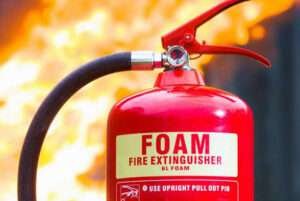
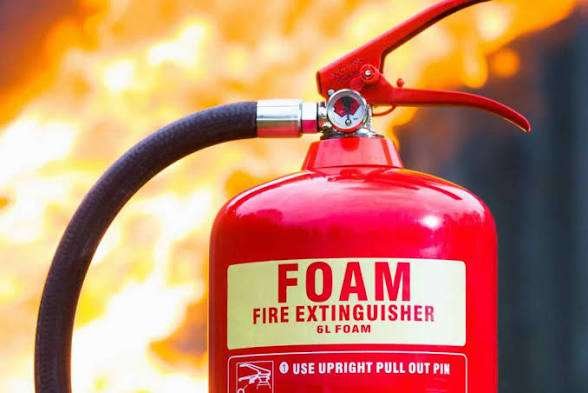
2. Foam Fire Extinguishers
Foam extinguishers are commonly associated with certain fires involving ordinary combustibles and flammable liquids.
The foam creates a layer over the burning material, helping separate it from the surrounding environment.
They may therefore be considered in locations where both ordinary combustible materials and certain flammable liquids are potential hazards.
However, the suitability of any extinguisher depends on its specific rating and manufacturer instructions.
Property owners should check the extinguisher’s labeling rather than relying only on its general type.
Why Foam Extinguishers Need Careful Selection
A foam extinguisher that is appropriate for one hazard may not be appropriate for another.
Electrical risks are particularly important to consider.
If electrical equipment is involved, people should follow the appropriate emergency procedure and avoid using an extinguisher unless the equipment is specifically rated for that application and the person using it is trained and authorized to do so.
For children, the safest approach is to alert an adult and move away from the danger.
3. Dry Chemical Powder Extinguishers
Dry chemical powder extinguishers are widely used for certain fire classes and can be suitable for several hazards depending on their specific rating.
Some powder extinguishers are designed for fires involving:
– Flammable liquids
– Flammable gases
– Ordinary combustible materials
– Certain electrical equipment
However, not every dry powder extinguisher has the same rating.
This distinction is important.
When selecting an extinguisher, property owners should examine the fire classifications shown on the product label and consider the hazards present at the property.
Advantages and Considerations
Dry chemical powder can be versatile, but using it can also leave powder residue.
In areas containing sensitive equipment, the consequences of residue may need to be considered when selecting fire-protection equipment.
Professional advice can be useful for workplaces, commercial buildings, industrial facilities, and other properties with specialized equipment.
4. Carbon Dioxide Fire Extinguishers
Carbon dioxide, commonly called CO₂, is another extinguishing agent used for particular applications.
CO₂ extinguishers are often associated with certain electrical equipment and flammable-liquid hazards.
One reason they can be useful around electrical equipment is that CO₂ does not leave the same type of dry powder residue associated with many powder extinguishers.
However, CO₂ extinguishers are not a universal solution.
Their suitability depends on the fire classification, environment, equipment, and product rating.
Because CO₂ systems have specific safety considerations, they should be selected and maintained appropriately.
CO₂ and Electrical Equipment
Electrical equipment can present a special fire-safety challenge.
People should not assume that a general-purpose extinguisher is suitable simply because an electrical appliance is nearby.
The equipment’s rating and manufacturer instructions should be checked.
More importantly, occupants should never place themselves at risk attempting to deal with an electrical fire.
Professional emergency responders should handle serious fire situations.
5. Wet Chemical Fire Extinguishers
Wet chemical extinguishers are especially associated with cooking-oil and fat fires.
They are commonly found in commercial kitchen environments where deep-fat cooking and similar activities create specialized fire hazards.
The extinguishing agent is designed for this particular type of fire and can help reduce the possibility of the fire reigniting when used as intended.
Why Cooking Fires Are Different
Cooking oils and fats can behave differently from ordinary combustible materials.
This means a household or commercial kitchen should not simply rely on whichever extinguisher happens to be available.
Commercial kitchens may require specifically designed fire-protection arrangements based on their equipment and cooking processes.
Homeowners should follow manufacturer instructions and seek professional advice where appropriate.
6. Class D Extinguishers for Combustible Metals
Certain industrial environments may involve combustible metals.
These can include metals such as magnesium, titanium, sodium, potassium, or other materials depending on the industrial process.
Such fires require specialized fire-protection arrangements.
Class D extinguishing agents are designed for particular combustible-metal hazards.
These extinguishers are generally not part of an ordinary household fire-safety setup.
Their selection requires an understanding of the specific metals and processes present at the facility.
Industrial operators should obtain professional fire-safety advice when combustible metals are involved.
Understanding Fire Classes
A useful way to understand extinguisher selection is to start with fire classification.
Common fire categories include:
Fire category| Typical materials involved
Ordinary combustibles| Wood, paper, cardboard, cloth
Flammable liquids| Certain fuels, solvents, paints
Flammable gases| Certain combustible gases
Combustible metals| Specialized industrial metals
Cooking oils and fats| Commercial cooking applications
Electrical equipment| Energized electrical equipment may require specifically suitable equipment
Classification systems can vary depending on the standard being used.
For this reason, extinguisher labels, local regulations, professional assessments, and manufacturer instructions should always be considered together.
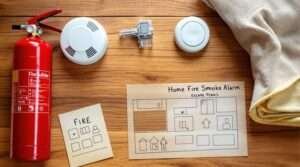
Fire Extinguishers and Fire Alarm Systems Serve Different Purposes
A common misunderstanding is that buying extinguishers eliminates the need for a fire alarm system.
It does not.
Fire extinguishers and alarm systems have different roles.
A fire alarm or smoke detection system is primarily concerned with detecting and warning.
An extinguisher is designed to provide a means of controlling a suitable small fire under appropriate circumstances.
A complete fire-safety strategy may therefore involve:
– Fire prevention
– Fire detection
– Alarm and notification
– Fire extinguishers
– Safe exits
– Emergency lighting where required
– Evacuation plans
– Fire drills
– Professional inspection and maintenance
The Building Code of Pakistan specifically recognizes fire alarm and detection systems, fire extinguishers, emergency response plans, and fire drills as elements of minimum fire protection in applicable circumstances.
Why a Fire Alarm System in Pakistan Is Important
When considering a fire alarm system in Pakistan, it is important to understand the difference between standalone smoke alarms and larger building-wide systems.
A simple residence may use appropriate smoke alarms, while a commercial or institutional building may require a more comprehensive system.
Depending on the property, a system can include:
– Automatic detectors
– Manual alarm points
– Audible notification
– Visual notification
– Control panels
– Backup power
– Monitoring arrangements
– Connections with other fire-protection systems
The appropriate design depends on the property’s size, occupancy, layout, and applicable requirements.
The Building Code of Pakistan Fire Safety Provisions 2016 contains provisions addressing fire alarm systems, including testing, servicing, maintenance, and impairment.
Pakistan Engineering Council also recognizes installation, commissioning, and maintenance of fire detection, alarm, and suppression systems as a specialized engineering area.
Choosing the Right Extinguisher
Selecting an extinguisher should begin with identifying the hazards present.
Consider:
1. What materials are present?
Look at the building’s normal activities.
A home kitchen, office, workshop, restaurant, warehouse, and factory can have very different risks.
2. What fire classes are possible?
Identify the types of materials or equipment that could potentially be involved.
3. What does the product label say?
Never rely solely on an extinguisher’s color or general appearance.
The label should identify its intended applications and ratings.
4. Is professional advice necessary?
For workplaces, commercial properties, industrial facilities, and larger buildings, professional fire-safety assessment may be appropriate.
5. Is the equipment maintained?
An extinguisher that has not been properly inspected or maintained may not provide reliable protection.
Fire Extinguisher Placement Matters
Having the right extinguisher is not enough if people cannot access it safely.
The Punjab Community Safety Buildings Regulations 2022 include specific provisions concerning extinguisher placement, including travel distance in certain hazardous areas and mounting heights based on extinguisher weight.
These requirements demonstrate why extinguisher placement should be based on the building’s use and applicable regulations rather than simply putting an extinguisher wherever convenient.
Extinguishers should be accessible without being hidden behind stored goods or unnecessary obstacles.
For commercial and regulated buildings, installation should follow applicable requirements and professional recommendations.
Inspection and Maintenance Are Essential
Fire extinguishers require appropriate inspection and maintenance.
Property owners should not assume that an extinguisher remains reliable simply because it is hanging in the correct location.
Depending on the type of extinguisher and applicable requirements, maintenance may involve checking its condition, pressure, seals, hose or nozzle, mounting, labeling, and service status.
Specialized servicing should be performed by appropriately qualified personnel.
The same principle applies to fire alarm systems.
A fire alarm system that is not tested or maintained properly may not provide the expected protection.
Keep Fire Safety Equipment Accessible
Do not allow furniture, boxes, merchandise, or other stored materials to block fire-safety equipment.
Employees and occupants should be able to identify where safety equipment is located.
In workplaces, staff should receive appropriate fire-safety education and know the emergency procedures established for the building.
Rescue 1122’s Community Safety Program includes citizen training, school safety, fire safety, emergency evacuation drills, and collaboration with organizations on fire and workplace safety.
Fire Safety in Pakistani Homes
Households in Pakistan may have several different potential fire hazards.
These can include:
– Cooking appliances
– Gas appliances
– Electrical equipment
– UPS systems
– Generators
– Charging devices
– Heating equipment
– Stored combustible materials
A household fire-safety plan should focus primarily on prevention and early warning.
Families should maintain electrical and gas equipment appropriately, keep exits clear, and ensure suitable smoke detection is available.
Children should be taught basic fire-safety behavior but should not be expected to operate extinguishers or approach a fire.
Fire Safety in Offices and Businesses
Businesses often have more complex fire risks because of the number of occupants, equipment, storage materials, and operating processes.
An office may contain computers, electrical equipment, paper, furniture, and backup power systems.
A workshop may contain machinery and specialized materials.
A restaurant may have cooking equipment and oils.
A warehouse may contain large quantities of combustible goods.
Each environment therefore requires a risk-appropriate approach.
The Building Code’s fire-safety provisions apply to hazards associated with the storage, handling, or use of materials and devices, as well as other conditions that can affect life, property, or public welfare.
Fire Drills and Emergency Planning
A fire extinguisher is only one part of emergency preparedness.
People should know what to do when an alarm sounds.
An emergency plan can identify:
– Exit routes
– Assembly areas
– Emergency contacts
– Responsibilities of designated staff
– Assistance procedures
– Evacuation arrangements
Regular drills can help occupants become familiar with the plan.
Rescue 1122’s safety programs include emergency evacuation drills and fire-safety education for students and communities.
When Should You Evacuate?
People should never feel obligated to fight a fire.
If a fire is spreading, producing substantial smoke, blocking an exit, or otherwise creating danger, evacuation should take priority.
Children should always leave the area and alert a responsible adult rather than attempting to use firefighting equipment.
Even adults should only consider using fire-extinguishing equipment where the situation is appropriate, the person is properly trained, an unobstructed escape route is available, and the building’s emergency procedures allow it.
If there is any doubt, leaving the area and contacting emergency services is the safer choice.
Fire Safety Maintenance Checklist
A basic property review can include:
Fire Detection
– Are suitable smoke alarms installed?
– Are alarms tested according to manufacturer instructions?
– Are larger systems professionally maintained where required?
Fire Extinguishers
– Are appropriate types available for the identified hazards?
– Are they accessible?
– Are they properly mounted where required?
– Are they within their required service period?
– Are they visibly damaged?
Escape Routes
– Are exits clear?
– Are doors and pathways accessible?
– Are emergency routes appropriately identified?
Emergency Planning
– Does everyone know the evacuation procedure?
– Is there a designated assembly point?
– Are emergency contacts available?
– Are evacuation drills conducted where applicable?
Common Mistakes to Avoid
Several mistakes can weaken a fire-safety plan.
Choosing an Extinguisher Only by Price
The cheapest option is not necessarily the correct option.
Assuming One Extinguisher Works Everywhere
Different fire hazards require different extinguishing agents.
Ignoring Maintenance
An extinguisher or alarm system needs appropriate inspection and servicing.
Blocking Fire Equipment
Safety equipment should remain accessible.
Forgetting About Detection
Extinguishers do not replace smoke alarms or fire alarm systems.
Failing to Plan Evacuation
People need to know how to leave safely, not simply where the extinguisher is located.
The Bigger Picture of Fire Safety
A strong fire-safety plan is built from several layers.
Prevention helps reduce the chance of a fire starting.
Detection helps identify a fire or smoke condition.
Alarm systems notify occupants.
Extinguishers may provide an appropriate means of controlling certain small fires under suitable conditions.
Escape routes help people leave.
Emergency plans provide structure during an emergency.
Professional responders handle situations beyond the capabilities of occupants.
Rescue 1122 describes its community-safety approach around emergency preparedness, response, and prevention, with fire safety and evacuation training included in its programs.
This layered approach is much more effective than relying on a single piece of equipment.
Final Thoughts
Understanding the different types of fire extinguishers is an important part of fire-safety awareness. Water, foam, dry chemical powder, carbon dioxide, wet chemical, and specialized extinguishing agents each have different applications.
The correct choice depends on the hazards present, the extinguisher’s rating, the building’s use, and applicable safety requirements.
However, extinguishers should never be viewed as the entire safety plan.
A safer property combines prevention, appropriate detection, reliable alarms, suitable fire-protection equipment, cle