
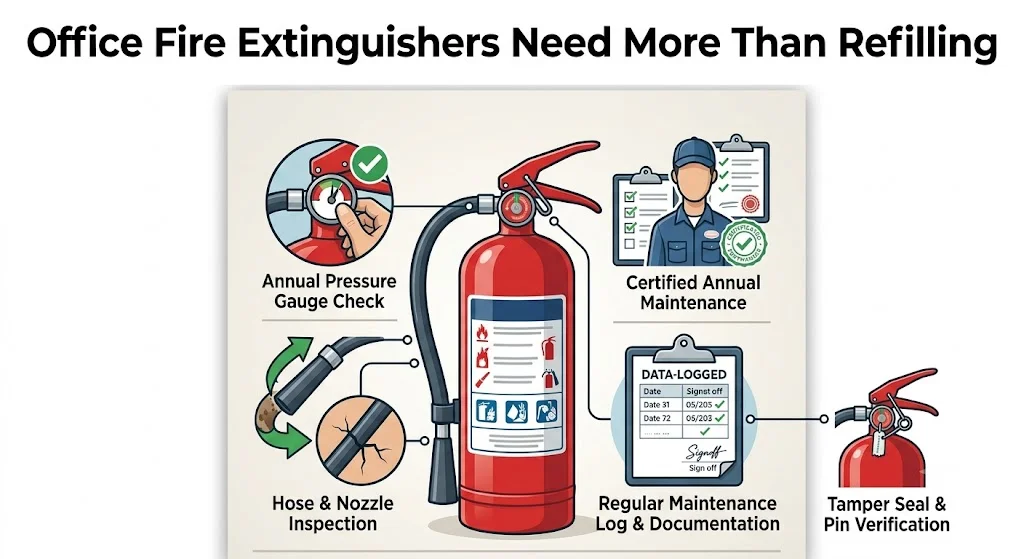
Walk into almost any office in Karachi, and you will find a fire extinguisher mounted near the exit, the pantry, or the server room. Most facility managers treat these cylinders as a one-time purchase — install it, forget it, and refill it whenever the annual audit reminds them. That approach feels responsible, but it is only half the job. A fire extinguisher that has been refilled is not the same as a fire extinguisher that is actually ready to work when a fire starts.
Refilling replaces the extinguishing agent, but it does nothing for the internal pressure gauge, the hose, the valve assembly, or the metal body of the cylinder itself. Offices that rely only on refilling are often surprised to learn, during a real emergency or a fire audit, that their equipment looks fine on the outside but fails the moment someone tries to use it.
The Real Lifecycle of an Office Fire Extinguisher
Fire Safety Trading (Pvt)
ToggleA fire extinguisher is not a static object sitting quietly on a wall bracket. It is a pressurised device with moving parts, rubber seals, and a chemical or gas agent that behaves differently depending on temperature, humidity, and how long it has been sitting unused. Karachi’s coastal humidity and dusty office environments speed up wear on seals, hoses, and pressure gauges compared to drier climates.
Over months of use — real or accidental, like someone bumping the pin or leaning equipment against it — small issues build up. A slightly loose hose connection, a hairline crack in the discharge nozzle, or a gauge that has drifted out of the green zone are all things a simple top-up refill will not catch, because refilling only addresses the agent level, not the mechanical condition of the unit.
Why Refilling Alone Isn’t Enough
Think of refilling as changing the oil in a car without ever checking the brakes, tyres, or engine belts. The oil might be fresh, but the car still isn’t safe to drive if other components are worn out. The same logic applies to office fire safety equipment.
A cylinder can be topped up with the correct amount of powder, foam, or CO2 and still fail during an actual fire if:
- The pressure gauge is inaccurate and shows ‘full’ when the unit is actually under-pressurised
- The hose has internal cracking that restricts flow under pressure
- The safety pin or tamper seal has been replaced incorrectly and jams during activation
- Corrosion inside the cylinder body has weakened the metal, especially in humid storage areas
- The nozzle is partially blocked by dried powder residue from a previous partial discharge
None of these problems shows up in a quick visual check or a basic refill. They only surface during a full inspection, pressure test, and hydrostatic check performed by a trained technician.
What a Complete Fire Extinguisher Service Includes
A proper service visit goes well beyond opening the cylinder and pouring in new agent. A qualified technician typically checks the external body for dents, rust, or corrosion, tests the pressure gauge against a calibrated reference, inspects the hose and nozzle for cracks or blockages, verifies the safety pin and tamper seal are intact, weighs the cylinder to confirm the agent level is accurate, and records the service date and next due date on the inspection tag.
For older cylinders, a hydrostatic test may be required every few years to confirm the metal body can still safely hold pressure. This step is often skipped entirely by businesses that only ask for a refill, which is exactly how older, weakened cylinders stay in circulation in office buildings across the city.
Signs Your Office Extinguishers Need Attention Now
Facility managers don’t need to wait for the annual service date to check on their equipment. A few warning signs are visible without any special tools:
- The pressure gauge needle sits outside the green zone
- Visible rust spots or dents on the cylinder body
- The inspection tag is missing, faded, or shows a date more than a year old
- Powder residue or clumping is visible around the nozzle
- The mounting bracket is loose, or the extinguisher has been moved from its designated spot
If any of these apply to extinguishers in your Karachi office, it is worth arranging a professional inspection rather than assuming a refill alone will fix the underlying issue.
How Often Should Karachi Offices Service Their Extinguishers
Most fire safety guidelines recommend a full inspection every month by in-house staff — checking the gauge, seal, and mounting position — combined with a professional service and refill at least once a year. Cylinders that have been discharged, even partially, should be serviced immediately rather than waiting for the scheduled date.
Offices in high-humidity or high-dust areas of Karachi, such as spaces near industrial zones or older commercial buildings, often benefit from a six-month inspection cycle instead of a full year, since environmental wear happens faster in those conditions.
Choosing the Right Fire Extinguisher Refilling Service in Karachi
Not every vendor offering a quick refill will check the mechanical condition of your equipment. When comparing providers for fire extinguisher refilling in Karachi, look for a company that inspects the full unit rather than just topping up the agent, uses calibrated equipment to test pressure accurately, provides a proper service tag and documentation, and can service multiple extinguisher types — powder, CO2, and foam — in one visit.
A trustworthy provider will also flag cylinders that are beyond safe repair and recommend replacement instead of pushing another refill on equipment that has reached the end of its usable life.
The Cost of Neglecting Proper Servicing
Skipping a full inspection in favour of a cheap refill might save a small amount upfront, but the real cost shows up during a fire, a safety audit, or an insurance claim. Insurance providers and building safety inspectors in Karachi increasingly ask for service records, not just a full cylinder. An extinguisher with an expired or incomplete service history can also become a liability during workplace safety audits, potentially leading to fines or compliance issues for the business.
More importantly, a poorly maintained extinguisher that fails during an actual office fire puts staff and property directly at risk — a risk that is entirely avoidable with proper, complete servicing rather than a refill-only approach.
Frequently Asked Questions
1. Is refilling a fire extinguisher the same as servicing it?
No. Refilling only replaces the extinguishing agent inside the cylinder. Servicing includes checking the pressure gauge, hose, nozzle, safety pin, and cylinder body for damage or wear.
2. How often should office fire extinguishers be refilled in Karachi?
Most offices should have their extinguishers professionally serviced and refilled once a year, though high-humidity or high-dust environments may need a check every six months.
3. Can a fire extinguisher be refilled multiple times?
Yes, as long as the cylinder passes its inspection and hydrostatic testing. Once the metal body shows corrosion or structural weakness, replacement is safer than another refill.
4. What happens if an office extinguisher is never serviced?
Over time, the pressure can drop, seals can degrade, and the nozzle can become blocked, which means the extinguisher may fail to discharge properly during an actual fire.
5. How do I know if my extinguisher needs a refill right now?
Check the pressure gauge — if the needle is outside the green zone, or the inspection tag is missing or outdated, it likely needs immediate attention.
6. Does every type of extinguisher need the same servicing?
No. Powder, CO2, and foam extinguishers each have different internal components and maintenance requirements, so a single technician visit should cover the specific type installed in your office.
7. Is a hydrostatic test necessary for office extinguishers?
For older cylinders, yes. A hydrostatic test checks whether the cylinder body can still safely hold pressure, which a standard refill does not test.
8. Why do offices in Karachi need more frequent checks than other cities?
Karachi’s coastal humidity and dust levels can accelerate wear on hoses, seals, and metal cylinder bodies compared to drier inland cities, making more frequent inspection worthwhile.
9. Can a partially discharged extinguisher be reused without servicing?
No. Any extinguisher that has been partially or fully discharged should be serviced and refilled immediately, since it is no longer at full operational pressure.
10. Who should I contact for professional fire extinguisher refilling in Karachi?
It’s best to work with a fire safety company that inspects the entire unit, not just the agent level. You can learn more about proper fire extinguisher refilling in Karachi and what a complete service visit should include.
Office fire extinguishers are only as reliable as their last full inspection. A refill keeps the agent level topped up, but it takes a complete service — covering the gauge, hose, seal, and cylinder body — to make sure the equipment will actually work when it matters most.n