
Apartment buildings in Karachi house dozens, sometimes hundreds, of families under one roof, which makes fire safety a shared responsibility rather than a one-person job. A fire extinguisher tucked away in a stairwell or corridor is only useful if it actually works when someone reaches for it. That is why property managers and building societies across the city rely on fire extinguisher refilling in Karachi services to keep every unit charged, pressurised, and ready. Servicing is not a single event, it is a recurring schedule that protects residents from the moment a building opens its doors.
Why Servicing Schedules Matter in Residential Buildings
Fire Safety Trading (Pvt)
ToggleAn apartment building is different from a single shop or office. Extinguishers are often mounted in common areas, hallways, parking basements, and near lift lobbies, where they are exposed to dust, temperature swings, and constant foot traffic. Over months, the pressure inside a cylinder can drop even without anyone touching it, and the powder or gas inside can settle or lose effectiveness. A missed service means that in the middle of an emergency, dozens of residents could be depending on equipment that simply does not discharge. Setting a clear servicing schedule removes the guesswork and makes sure every extinguisher in the building is accounted for.
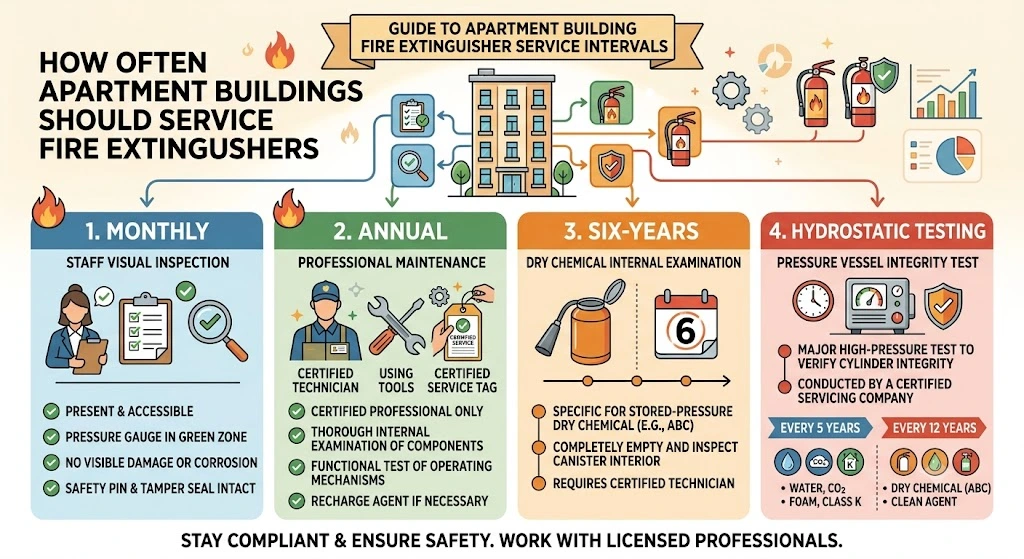
How Often Should Fire Extinguishers Be Serviced?
Monthly Visual Inspections
A quick monthly check by building staff or the facilities team catches obvious problems early. This means looking at the pressure gauge, confirming the pin and tamper seal are in place, checking for dents or rust, and making sure the extinguisher has not been moved, blocked, or tampered with. These checks take only a few minutes per unit but prevent small issues from turning into bigger ones.
Annual Professional Servicing
Once a year, every extinguisher in the building should go through a full professional service. A trained technician opens the cylinder, checks the internal condition, verifies the weight or pressure of the extinguishing agent, replaces worn seals, and refills or tops up the unit as needed. This annual visit is the core of a compliant fire safety programme and should be documented with a dated service tag on each cylinder.
Hydrostatic Testing Every 5 to 12 Years
Beyond the yearly refill, extinguisher cylinders themselves need periodic pressure testing to confirm the metal body is still safe to hold pressure. Depending on the type of extinguisher, this hydrostatic test is typically required somewhere between five and twelve years from the manufacture date. Buildings with older extinguisher stock should ask their servicing provider to flag units approaching this milestone, since a cylinder that fails testing needs to be replaced rather than refilled.
Signs an Apartment Building’s Extinguishers Need Attention
A few warning signs tell a facilities manager that a refill or service is overdue. A pressure gauge needle sitting outside the green zone is the clearest signal, whether it has dropped too low or climbed too high. Visible rust, dents, or corrosion around the valve point to moisture damage that can weaken the cylinder over time. A missing or faded service tag, or one showing a date older than twelve months, means the unit has likely gone past its scheduled check. Any extinguisher that has been discharged, even partially, needs to be refilled immediately rather than left on the wall as a placeholder.
Who Is Responsible for Fire Extinguisher Maintenance in Apartment Buildings?
In most residential buildings, the responsibility falls on the building management, the owners’ association, or the appointed facilities company rather than individual residents. This group is expected to budget for annual servicing, keep records of every inspection, and act as the point of contact when a refilling provider visits the property. Clear ownership matters because fire safety equipment that nobody is directly responsible for tends to get overlooked until it is too late. Many well-run buildings assign one staff member to track service dates and maintain a simple logbook or spreadsheet for every extinguisher on the property.
Why Professional Servicing Beats a DIY Approach
Refilling a fire extinguisher is not something building staff can safely handle without training. It involves depressurising the cylinder, inspecting it for internal wear, adding the correct weight of extinguishing agent, and re-pressurising it to an exact specification before testing the valve. Getting any of these steps wrong can leave a unit that looks fine on the outside but fails to discharge properly, or in rare cases becomes unsafe to handle. Working with a certified provider for fire extinguisher refilling in Karachi ensures every cylinder in the building meets the same standard, with proper documentation left behind for each visit.
Building a Practical Servicing Plan
A workable plan for an apartment building usually combines a few simple habits. Staff carry out a monthly walk-through of every common-area extinguisher and note anything unusual. A professional provider is booked once a year for a full inspection and refill across the entire property, ideally on the same visit to keep costs and downtime manageable. Older cylinders are flagged ahead of their hydrostatic testing window so replacements can be planned rather than rushed. Finally, all service tags, invoices, and inspection notes are kept together, since these records are often requested during insurance renewals or municipal safety checks.
Fire Safety Compliance for Apartment Buildings in Karachi
Residential buildings are generally expected to keep working fire safety equipment in shared spaces as part of basic building management practice. Insurance providers frequently ask for proof of recent extinguisher servicing when underwriting or renewing a policy for a residential property, and municipal or fire department inspections can request the same records. Beyond ticking a compliance box, an up-to-date servicing schedule is also a practical way to reassure residents that the building takes their safety seriously, which matters for reputation as much as for regulation.
Frequently Asked Questions
1. How often should apartment buildings service fire extinguishers?
Extinguishers in apartment buildings should be visually checked every month and given a full professional service once a year. Cylinders also need hydrostatic pressure testing roughly every five to twelve years depending on the type.
2. Who pays for fire extinguisher servicing in an apartment building?
This cost is usually covered by the building management, owners’ association, or facilities budget rather than individual residents, since the extinguishers protect shared common areas.
3. What happens if an apartment building skips annual servicing?
A skipped service means pressure loss or degraded powder can go unnoticed, so an extinguisher may fail to discharge properly during an actual fire, putting residents at serious risk.
4. How can I tell if a hallway fire extinguisher needs a refill?
Check the pressure gauge for a reading outside the green zone, look for rust or dents, and check the service tag date. Any of these signs means the unit needs attention.
5. Can apartment building staff refill fire extinguishers themselves?
No, refilling requires specialised equipment and training to depressurise, inspect, and re-pressurise a cylinder correctly, so it should always be handled by a certified technician.
6. How long does it take to service all extinguishers in a large building?
A professional provider can usually service a full building in a single visit or over one to two days, depending on how many units are installed across the property.
7. Do basement and parking area extinguishers need more frequent checks?
Yes, extinguishers in basements, parking areas, or near generators are exposed to more heat, dust, and moisture, so many buildings schedule these for more frequent visual checks.
8. What records should a building keep for fire extinguisher servicing?
Buildings should keep dated service tags on every unit along with invoices or inspection reports from the servicing provider, since these are often needed for insurance or safety inspections.
9. When does a fire extinguisher need to be replaced instead of refilled?
A cylinder that fails hydrostatic pressure testing, shows significant corrosion, or is structurally damaged should be replaced rather than refilled, since refilling a damaged cylinder is not safe.
10. Where can building managers arrange fire extinguisher refilling in Karachi?
Building managers and owners’ associations can arrange professional fire extinguisher refilling in Karachi through certified fire safety providers that handle inspection, refilling, and record-keeping for residential properties.
Final Thoughts
Fire extinguisher servicing in an apartment building is a small recurring task compared to the scale of what it protects. A monthly glance at the gauge, a yearly professional refill, and attention to hydrostatic testing deadlines are enough to keep every unit in the building genuinely ready rather than just present on the wall. For property managers in Karachi, building this rhythm into routine maintenance is one of the simplest ways to protect residents, meet compliance expectations, and avoid the far higher cost of a fire that a working extinguisher could have contained.