Fire safety is not based on one piece of equipment. A safe building usually needs a combination of prevention measures, early warning systems, emergency exits, fire-protection equipment, trained personnel, and a clear emergency plan.
Among these measures, fire hose reels can play an important role in suitable buildings. They provide a fixed source of water that can support firefighting arrangements when properly designed, installed, maintained, and used by appropriately trained personnel.
For offices, commercial buildings, factories, warehouses, schools, hospitals, hotels, shopping centers, and other facilities, understanding the purpose of fire hose reels can help building owners and managers make better fire-safety decisions.
The Building Code of Pakistan Fire Safety Provisions 2016 contains provisions for hose stations and states that, where hose stations are provided, they should conform to NFPA 14 or another approved code or standard. The code also discusses the relationship between hose stations and portable fire extinguishers.
At the same time, a hose reel should never be viewed as a substitute for the complete fire-safety system. Fire detection, occupant warning, evacuation routes, maintenance, training, and professional emergency response remain important.
Here are five reasons fire hose reels matter more than many people realize.
1. Fire Hose Reels Can Provide a Ready Water Supply
One major advantage of a fixed hose reel or hose station is that it can provide access to a water supply at a designated location.
Portable extinguishers are valuable for appropriate types of fires, but their capacity is limited. A fixed hose arrangement can provide a different type of firefighting resource when included in the building’s approved fire-protection design.
This does not mean every building needs the same equipment. Fire-protection requirements depend on factors such as:
– Building size
– Occupancy
– Fire hazards
– Floor layout
– Building height
– Available water supply
– Applicable codes and standards
– Local authority requirements
The Building Code of Pakistan Fire Safety Provisions 2016 specifically includes requirements for hose stations where they are provided.
This makes professional design particularly important.
A hose reel that is incorrectly located, poorly maintained, or connected to an unsuitable water supply may not provide the protection expected from it.
What Is a Fire Hose Reel?
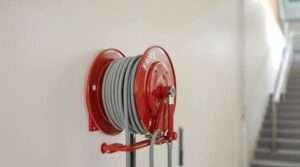
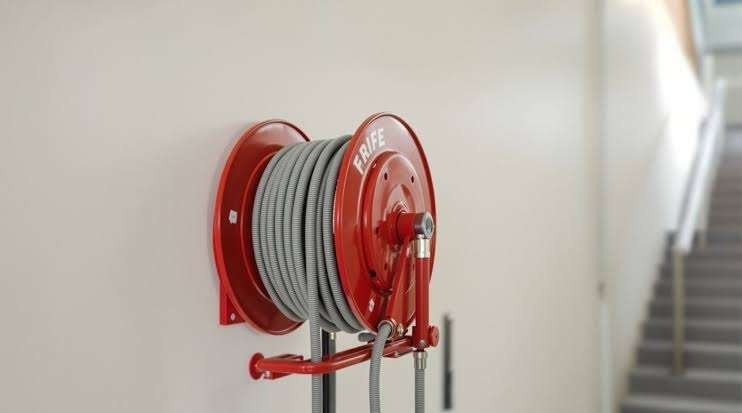
A fire hose reel is a fixed fire-protection device designed to provide a controlled water supply through a hose.
Depending on the system, the hose is stored on a reel or within a designated hose station, allowing it to be deployed when required.
The complete arrangement can involve components such as:
– Hose
– Reel or storage arrangement
– Nozzle
– Valve
– Pipework
– Water supply
– Supporting equipment
The exact design should be determined according to the building’s fire-protection requirements and applicable standards.
Because these systems involve water supply, pressure, pipework, and building design, installation and technical maintenance should be handled by appropriately qualified professionals.
Pakistan Engineering Council identifies installation, commissioning, and maintenance of fire detection, alarm, and suppression systems as a specialized engineering area under ME02.
2. Hose Reels Can Support a Wider Fire-Protection Strategy
A hose reel is most useful when it is treated as part of a larger fire-protection strategy.
A building may contain several layers of protection.
These can include:
– Fire prevention measures
– Smoke or fire detection
– Fire alarm systems
– Emergency lighting
– Fire extinguishers
– Hose stations
– Hydrant systems
– Automatic suppression systems where required
– Fire-resistant construction
– Emergency exits
– Evacuation procedures
– Staff training
– Professional inspection and maintenance
Each layer serves a different purpose.
For example, a detection system can help identify a fire condition. An alarm can warn occupants. Emergency exits can provide a route toward safety. Fire-protection equipment can form part of the building’s response arrangements.
The Building Code addresses several of these elements, including fire alarms, means of egress, fire-protection systems, and maintenance.
This is why simply installing a hose reel does not make a building fire-safe.
The Connection With Fire Alarm Systems
Early warning is an important part of fire protection.
The Building Code of Pakistan Fire Safety Provisions 2016 provides for fire alarm systems where necessary when the fire itself may not provide adequate warning to occupants.
A properly designed fire alarm system in Pakistan can therefore work alongside other fire-protection measures.
The roles are different:
Fire alarm system: Provides warning and occupant notification where required.
Fire hose reel or hose station: Provides a water-based firefighting resource as part of an approved system.
Emergency exits: Provide a means for occupants to move toward safety.
Fire extinguishers: Provide portable firefighting equipment for appropriate hazards.
Training: Helps people understand the emergency plan and their responsibilities.
Together, these measures can provide a more comprehensive approach than relying on a single device.
3. Hose Reels Can Be Useful in Larger or Higher-Risk Buildings
The need for fire-protection equipment changes according to the characteristics of a building.
A small low-risk area may have different requirements from a large factory, warehouse, hotel, shopping center, hospital, or industrial facility.
Large buildings can contain:
– More occupants
– Larger floor areas
– Multiple rooms
– Storage areas
– Electrical equipment
– Machinery
– Cooking facilities
– Combustible materials
– Multiple floors
These factors can make comprehensive fire-protection planning especially important.
A properly designed hose system can form part of that planning.
However, the decision about whether a particular building requires hose stations or another type of fire-protection system should be based on the applicable code, risk assessment, building design, and requirements of the relevant authority.
It is not appropriate to assume that the same arrangement is suitable for every property.
Why Location Matters
Fire-protection equipment needs to be accessible.
A hose station hidden behind stored materials or blocked by furniture cannot provide the same practical benefit as equipment that is clearly identified and accessible.
During building planning, the location of hose stations should therefore be considered carefully.
Relevant considerations can include:
– Accessibility
– Floor layout
– Travel distances
– Occupancy
– Fire hazards
– Water supply
– Emergency access
– Visibility
– Interaction with other fire-protection equipment
The Building Code includes specific provisions concerning the location of hose stations and their relationship with portable fire extinguishers.
The system should be designed by professionals rather than positioned simply because a particular wall appears convenient.
Keep Access Clear
One simple but important maintenance principle is keeping fire-protection equipment accessible.
Hose stations should not become storage areas.
Boxes, furniture, cartons, decorations, machinery, or other objects should not be placed in front of emergency equipment.
Building managers can include hose stations in routine safety inspections.
A basic inspection can ask:
– Is the hose station visible?
– Is access clear?
– Is the equipment physically damaged?
– Are valves and associated components accessible?
– Are maintenance requirements up to date?
– Has any leakage or other problem been reported?
Technical inspections should be completed by qualified personnel.
4. Regular Maintenance Makes a Difference
Installing a hose reel is only the beginning.
Fire-protection equipment can deteriorate if it is neglected.
Possible issues may include:
– Damaged hoses
– Corrosion
– Leaks
– Blocked access
– Faulty valves
– Problems with water supply
– Physical damage
– Poor storage conditions
Regular inspection and maintenance can help identify such problems before the equipment is needed.
The Building Code of Pakistan Fire Safety Provisions 2016 includes provisions related to inspection, testing, and maintenance of fire-protection systems.
This principle applies to the entire fire-protection system, not only hose stations.
A building’s alarm, detection equipment, emergency lighting, extinguishers, hydrants, and other systems also require appropriate inspection and maintenance according to their design and applicable requirements.
Maintenance Should Be Professional
Fire-protection equipment should not be modified casually.
Water pressure, pipework, valves, pumps, storage tanks, and other technical components need to work together.
A change to one part of the system can affect other components.
For this reason, technical inspection, servicing, testing, and repairs should be performed by appropriately qualified professionals.
Pakistan Engineering Council classifies fire detection, alarm, and suppression system installation, commissioning, and maintenance under specialized engineering services.
Building owners should also maintain appropriate records of inspections and servicing.
5. Fire Hose Reels Support Preparedness and Safety Culture
Fire safety is not only about equipment.
People also need to understand what the equipment is for and how it fits into the building’s emergency plan.
Rescue 1122’s Community Safety Program emphasizes emergency preparedness, prevention, fire safety education, and training citizens in life-saving and emergency-management skills. It also includes school safety and emergency evacuation training.
This reflects an important principle: equipment works best when it is supported by awareness and planning.
Employees should know:
– Where emergency exits are located
– What the fire alarm sounds like
– Where fire-protection equipment is located
– How to report hazards
– Where to assemble after evacuation
– Who has emergency responsibilities
Not everyone should be expected to operate firefighting equipment.
Untrained people should not place themselves in danger to fight a fire. If an emergency develops, occupants should follow the building’s emergency procedures and evacuate when instructed.
Professional emergency responders should handle serious fire incidents.
Fire Hose Reels in Offices
Office buildings may contain computers, electrical equipment, paper, furniture, kitchens, and other materials.
A comprehensive office fire-safety plan can include:
– Fire detection
– Alarm systems
– Portable extinguishers
– Suitable fixed fire-protection systems
– Emergency exits
– Emergency lighting
– Staff training
– Evacuation drills
– Regular maintenance
Where hose stations are part of the building’s approved fire-protection design, staff should know their locations and understand their purpose.
Fire Hose Reels in Factories
Factories can have more complex hazards.
Production machinery, electrical systems, combustible materials, storage areas, chemicals, and industrial processes can all affect the fire-risk assessment.
Fire-protection systems should therefore be selected according to the actual hazards.
A factory may require multiple forms of protection rather than relying on hose stations alone.
Professional fire-safety planning can help determine the appropriate combination of detection, alarm, suppression, evacuation, and emergency-response measures.
Fire Hose Reels in Warehouses
Warehouses can contain large quantities of stored materials.
Storage arrangements can affect fire risk and emergency access.
Fire-protection planning should consider:
– Type of stored materials
– Storage height
– Building size
– Aisle arrangements
– Fire detection
– Water supply
– Emergency exits
– Fire-protection equipment
– Access for emergency responders
A hose station should remain accessible and should not be surrounded by stored goods.
Fire Hose Reels in Hospitals
Hospitals require particularly careful fire planning because patients may not be able to evacuate independently.
A hospital fire-safety program may include:
– Detection systems
– Alarm systems
– Emergency communication
– Fire-protection equipment
– Staff training
– Evacuation planning
– Maintenance
– Assistance procedures for vulnerable patients
Hose stations, where required, should be integrated into the hospital’s overall fire-protection strategy.
Staff should understand their assigned responsibilities rather than attempting actions outside their training.
Fire Hose Reels in Schools
Schools have unique safety requirements because children may need guidance during an emergency.
Rescue 1122’s Community Safety Program includes school safety activities, fire-safety awareness, and emergency evacuation drills.
Schools can teach students basic safety awareness, such as:
– Recognizing an alarm
– Following teacher instructions
– Moving toward designated exits
– Going to the assembly area
– Avoiding interference with emergency equipment
Technical firefighting equipment should remain under the control of appropriately trained and authorized personnel.
Fire Hose Reels and Emergency Exits
Fire-protection equipment and evacuation arrangements should work together.
A building may have excellent equipment, but blocked exits can still create serious safety problems.
The Building Code addresses means of egress and requires appropriate arrangements and marking so that occupants can identify routes toward a place of safety.
For building managers, this means fire-safety inspections should consider both equipment and evacuation routes.
Check that:
– Exits remain accessible
– Exit signs are visible
– Emergency lighting is maintained where required
– Corridors are not unnecessarily obstructed
– Fire equipment remains accessible
– Occupants know the emergency procedures
Fire Hose Reels and Fire Extinguishers Are Not the Same
It is useful to understand the difference between these systems.
Fire extinguishers
Portable extinguishers are designed for specific types and sizes of fires and can be positioned around a building according to applicable requirements.
Fire hose reels or hose stations
These are fixed systems connected to a water supply and designed as part of the building’s fire-protection arrangements.
The Building Code discusses both hose stations and portable extinguishers and specifies that hose stations, where provided, should conform to NFPA 14 or an approved code or standard.
Neither system should automatically be treated as a replacement for the other.
The appropriate combination depends on the building’s hazards and applicable requirements.
Common Problems With Fire Hose Reels
Several basic issues can reduce the usefulness of a hose station.
Blocked access
Stored materials can make equipment difficult to reach.
Poor maintenance
Damaged or neglected components may not function as intended.
Lack of inspection
Problems can remain unnoticed when equipment is not included in routine safety checks.
Untrained personnel
People may misunderstand the equipment or attempt actions beyond their training.
Poor system design
A system must be designed around the building and its hazards rather than installed as an afterthought.
Lack of documentation
Maintenance and inspection records are useful for tracking the condition of fire-protection systems.
A Simple Fire Hose Reel Inspection Checklist
Building managers can use a basic checklist as part of their wider fire-safety management program.
Visibility
– Is the hose station easy to identify?
– Is appropriate signage visible?
Accessibility
– Is the area around the equipment clear?
– Can authorized personnel access it without unnecessary obstacles?
Physical condition
– Is the hose visibly damaged?
– Are associated components in acceptable condition?
– Is there visible corrosion or leakage?
System condition
– Are required inspections current?
– Has the system received appropriate professional maintenance?
– Are records available?
Emergency planning
– Do relevant staff know the location?
– Is the equipment included in the building’s emergency plan?
– Are evacuation procedures clearly understood?
This checklist does not replace a professional inspection or the requirements applicable to the building.
The Importance of Professional Design
Fire-protection systems should not be selected solely because a product looks suitable.
A professional assessment should consider the building’s:
– Occupancy
– Layout
– Size
– Fire hazards
– Water supply
– Applicable codes
– Local authority requirements
– Existing fire-protection systems
This is especially important when installing or modifying fixed fire-protection systems.
The Building Code states that fire-protection systems should be designed, installed, approved, and maintained according to applicable codes and standards.
The Bigger Picture of Fire Safety in Pakistan
Pakistan’s emergency services place significant emphasis on both response and prevention.
Rescue 1122 operates professional fire services in Punjab and identifies fire prevention, fire investigation, fire safety, and installation of fire hydrants in high-risk areas among its fire-service activities.
Its Community Safety Program also promotes prevention, preparedness, public education, and emergency response.
This broader approach shows why fire hose reels should not be considered in isolation.
A safer building combines suitable equipment with responsible management and informed occupants.
Final Thoughts
Fire hose reels may not receive as much attention as alarms or portable extinguishers, but they can form an important part of a building’s fire-protection strategy when required and properly designed.
Their value depends on more than simply having a reel installed on a wall.
The system needs an appropriate water supply, suitable design, correct placement, accessibility, professional installation, regular inspection, and proper maintenance.
It should also work alongside other safety measures.
A fire alarm system in Pakistan can provide early warning where required or appropriate, while emergency exits help occupants reach safety and fire-protection equipment supports the building’s emergency response arrangements.
The Building Code of Pakistan Fire Safety Provisions 2016 specifically addresses hose stations, fire extinguishers, fire alarms, means of egress, and maintenance of fire-protection systems.
Ultimately, good fire safety is about layers of protection. Prevention reduces hazards, alarms provide warning, evacuation plans guide occupants, and professionally maintained fire-protection systems provide additional support.
Fire hose reels matter because they can be one part of that larger system—and their effectiveness depends on making sure every part of the system is properly planned and maintained.
FAQs
1. What is a fire hose reel?
A fire hose reel is a fixed fire-protection device connected to a water supply. It provides a hose and associated equipment as part of an approved fire-protection system. The exact design and application depend on the building and applicable standards.
2. Are fire hose reels required in every building?
No. Fire-protection requirements vary according to factors such as building size, occupancy, hazards, design, applicable codes, and authority requirements. A qualified professional should determine the appropriate fire-protection arrangements.
3. How are fire hose reels different from fire extinguishers?
Fire extinguishers are portable devices designed for appropriate fire hazards. A hose reel or hose station is a fixed water-based fire-protection arrangement. The Building Code of Pakistan addresses both systems and specifies requi