


Fire safety is a critical requirement for modern buildings, especially where expensive equipment, sensitive data, or business operations are involved. Traditional fire extinguishing methods like water or foam are not always suitable because they can damage electronics and valuable assets. This is where the FM 200 fire suppression system becomes an ideal solution. Understanding the FM 200 system working principle helps building owners, engineers, and safety managers make informed decisions about fire protection.
FM 200 is widely used in Pakistan in data centers, server rooms, banks, hospitals, and industrial facilities. Its popularity is due to its fast action, clean agent properties, and high efficiency in controlling fires without causing secondary damage.
What Is an FM 200 Fire Suppression System
FM 200, also known by its chemical name Heptafluoropropane, is a clean agent fire suppression system designed to extinguish fires quickly and safely. It is a colorless, odorless gas stored in liquid form inside pressurized cylinders. When discharged, it turns into gas and spreads evenly throughout the protected area.
Unlike water-based systems, FM 200 does not leave residue, does not conduct electricity, and does not damage sensitive equipment. This makes it highly suitable for environments where downtime and asset protection are critical. Roman Urdu mein samjhein to yeh aik aisa fire system hai jo aag bujhata hai lekin machines ko kharab nahi karta.
Importance of Understanding the FM 200 System Working Principle
Knowing how the FM 200 system works is essential for proper system design, installation, and maintenance. Many people assume that FM 200 works by removing oxygen, but this is not entirely true. Its actual working principle is more scientific and advanced.
By understanding its working principle, facility managers can ensure correct room sealing, proper system sizing, and compliance with international fire safety standards such as NFPA 2001.
Basic Components of an FM 200 System
Before explaining the working principle, it is important to understand the main components involved. Each part plays a vital role in the successful operation of the system.
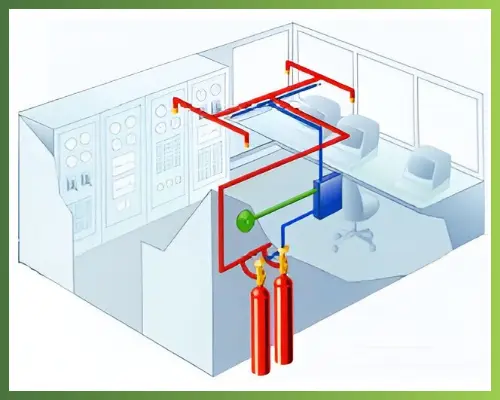
The FM 200 system includes storage cylinders, discharge nozzles, piping network, fire detection devices, control panel, and alarm systems. These components work together as an integrated fire protection solution.
The cylinders store FM 200 agent under pressure, while the piping and nozzles ensure even distribution. Smoke or heat detectors identify the fire, and the control panel processes the signal and activates the system.
FM 200 System Working Principle Step by Step
The FM 200 system working principle is based on rapid fire detection, quick agent discharge, and interruption of the fire’s chemical reaction. The entire process happens within seconds, minimizing fire damage and risk to life.
Fire Detection and Signal Initiation
The working process begins with fire detection. Smoke detectors, heat detectors, or multi-sensor detectors continuously monitor the protected area. When these detectors sense abnormal heat or smoke levels, they send a signal to the fire control panel.
The control panel is the brain of the system. It verifies the signal and activates alarms to warn occupants. In many installations, a short time delay is programmed to allow safe evacuation before agent discharge. Yeh delay logon ko bahar nikalne ka time deta hai.
Activation of the FM 200 Release Mechanism
Once the system confirms a fire condition, the control panel sends an electrical signal to the FM 200 cylinder valve. This signal activates the release mechanism, opening the valve and allowing the agent to flow into the piping network.
The system is designed to discharge the full agent quantity within ten seconds or less. This rapid discharge is critical to stopping the fire before it grows or spreads.
Distribution of FM 200 Agent
As the FM 200 agent travels through the piping, it reaches specially designed discharge nozzles. These nozzles ensure uniform distribution of the gas throughout the protected space.
Proper nozzle placement is essential for the working principle to be effective. The agent must reach all corners of the room to suppress the fire completely. Is liye system design bohat important hota hai.
Fire Suppression Through Chemical Interruption
The core FM 200 system working principle lies in how it suppresses fire. FM 200 does not primarily extinguish fire by removing oxygen. Instead, it interrupts the chemical chain reaction that sustains combustion.
Fire requires three elements: heat, fuel, and oxygen. FM 200 works by absorbing heat and breaking the free radicals produced during combustion. This stops the fire at a molecular level, causing it to extinguish rapidly.
Because oxygen levels remain safe for humans, FM 200 is considered safe for occupied spaces when used correctly.
How FM 200 Differs from CO2 Systems
Many people compare FM 200 with carbon dioxide fire suppression systems. While both are gaseous agents, their working principles and safety levels differ significantly.
CO2 systems extinguish fire by reducing oxygen levels, which can be dangerous for occupants. FM 200, on the other hand, works through chemical interruption and heat absorption, making it safer for human presence.
This difference makes FM 200 a preferred choice for offices, control rooms, and data centers in Pakistan where people may be present during system activation.
Role of Room Integrity in FM 200 System Working Principle
Room integrity plays a crucial role in the effectiveness of FM 200 systems. For the agent to remain at the required concentration long enough to suppress the fire, the protected area must be properly sealed.
Any leakage through doors, cable penetrations, or ventilation openings can reduce agent concentration. This is why room integrity testing, also known as door fan testing, is essential.
Roman Urdu mein kaha jaye to agar room leak ho to gas bahar nikal jati hai aur system ka effect kam ho jata hai.
Concentration Levels and Holding Time
The FM 200 system working principle also depends on maintaining the correct agent concentration for a specific holding time. The concentration is calculated based on room volume, temperature, and fire risk classification.
Typically, the agent must remain in the room for at least ten minutes to prevent re-ignition. Proper system design ensures that this holding time is achieved without compromising safety.
Safety Considerations of FM 200 Systems
FM 200 is classified as a clean agent and is safe for occupied spaces when designed according to standards. It does not leave residue, does not damage electronics, and has low toxicity.
However, safety alarms and warning systems are installed to alert occupants before discharge. Audible and visual alarms ensure that people can evacuate if needed.
Correct installation and regular maintenance are necessary to keep the system reliable and safe.
Environmental Impact and Regulations
FM 200 has zero ozone depletion potential, which makes it environmentally acceptable compared to older halon systems. However, it does have global warming potential, so its use is regulated under international environmental guidelines.
In Pakistan, FM 200 systems are widely accepted and used in compliance with NFPA standards and civil defense requirements.
Applications of FM 200 Based on Its Working Principle
Because of its fast action and clean nature, FM 200 is used in various applications. These include data centers, server rooms, telecommunication facilities, power control rooms, medical equipment rooms, and financial institutions.
Its working principle makes it ideal for protecting high-value assets where even small fire damage can cause major losses.
Maintenance and Testing for Reliable Performance
The FM 200 system working principle can only be effective if the system is well maintained. Regular inspection of cylinders, pressure levels, detectors, and control panels is essential.
Annual testing ensures that the system will operate correctly during an emergency. Leakage checks and room integrity tests help maintain the required agent concentration.
Maintenance is not just a legal requirement but a practical necessity for long-term safety.
Common Misunderstandings About FM 200 Working Principle
One common misconception is that FM 200 suffocates fire by removing oxygen. As explained earlier, its primary mechanism is chemical interruption.
Another misunderstanding is that FM 200 is harmful to humans. When installed correctly and used within recommended concentrations, it is safe for occupied areas.
Clear understanding helps users trust the system and use it correctly.
Why FM 200 Is a Reliable Fire Protection Solution
The reliability of FM 200 comes from its scientifically proven working principle, fast response time, and compatibility with modern infrastructure. It provides fire suppression without disrupting operations or damaging assets.
For businesses in Pakistan, where continuity and equipment protection are essential, FM 200 offers a balanced solution between safety and efficiency.
Conclusion
The FM 200 system working principle is based on rapid detection, quick agent discharge, and chemical interruption of fire. It does not rely on oxygen depletion, making it safer for occupied spaces and sensitive environments.
Its effectiveness depends on proper system design, correct agent concentration, good room integrity, and regular maintenance. When all these factors are combined, FM 200 becomes one of the most efficient and trusted fire suppression systems available today.
By understanding how the FM 200 system works, building owners and safety professionals can ensure better fire protection, reduced risk, and long-term asset safety. Fire safety sirf aik requirement nahi, balkay aik smart investment hai.
Also Read:


