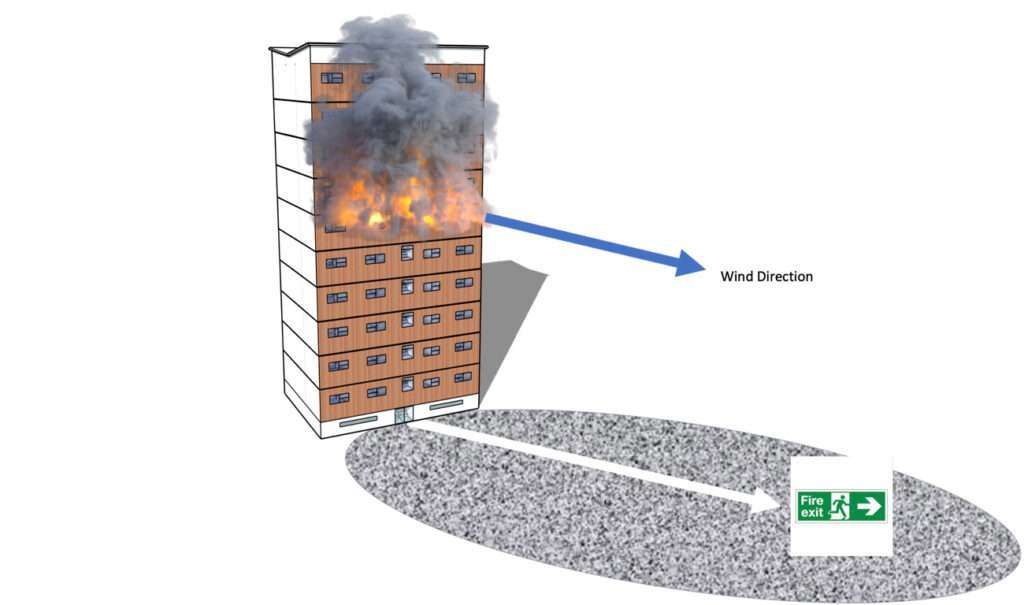
High-rise buildings are an important part of modern cities. Apartments, offices, hotels, hospitals, shopping centers, and commercial towers allow many people to live and work in limited urban space. However, protecting people from fire in a tall building requires careful planning because occupants may be located many floors above ground level.
Fire safety in high-rise buildings is not only about keeping fire extinguishers available. It involves prevention, early detection, alarm systems, protected escape routes, emergency planning, building design, regular inspections, and properly maintained fire-protection equipment.
In Pakistan, the Pakistan Engineering Council (PEC) publishes the Building Code of Pakistan Fire Safety Provisions 2016 and other building-related codes. The fire-safety provisions contain specific requirements for high-rise buildings, including escape routes, fire towers, fire lifts, refuge areas, and other protective measures.
This guide explains the main ideas in simple English.
What Is a High-Rise Building?
A high-rise building is a tall structure with multiple floors where occupants may be located significantly above ground level.
High-rise buildings can include:
– Apartment towers
– Office buildings
– Hotels
– Hospitals
– Shopping centers
– Educational buildings
– Mixed-use developments
– Commercial towers
– Residential complexes
The exact definition and requirements can vary according to the applicable building regulations and the characteristics of a particular structure.
The taller a building becomes, the more important it is to consider how people will be warned about a fire and how they can reach a safe location.
Why Fire Safety Is Especially Important in High-Rise Buildings
A fire in a high-rise building can create challenges that are different from those in a small single-story structure.
People may be spread across many floors. Some occupants may be unfamiliar with the building. Smoke can affect corridors and escape routes, while elevators may not be available for ordinary evacuation during a fire.
Emergency responders also need suitable access and reliable information about the building.
For these reasons, high-rise fire safety needs to be planned before an emergency happens.
Punjab Emergency Service Rescue 1122 has specifically highlighted the importance of fire-safety compliance and preparedness for complex and high-rise buildings.
1. Fire Prevention Comes First
The best fire is one that never starts.
High-rise buildings should have measures that reduce common fire risks. These can include proper electrical installation and maintenance, safe use of cooking equipment, appropriate storage of combustible materials, and regular inspection of building services.
Common sources of fire risk can include:
– Electrical faults
– Cooking equipment
– Heating equipment
– Poorly maintained machinery
– Improper storage
– Smoking materials
– Flammable materials
– Damaged electrical equipment
Building management should identify hazards and address them through an organized safety program.
Residents and employees also have a role. Unsafe electrical connections, blocked corridors, damaged equipment, or other hazards should be reported to responsible building management.
2. Early Detection Gives People a Warning
A fire can become dangerous when occupants do not know that it has started.
This is where fire detection becomes important.
Smoke detectors, heat detectors, manual alarm devices, and other initiating devices can form part of a building’s fire detection arrangement.
When an appropriate detector identifies a fire-related condition, the system can send information to the fire alarm control panel. The system can then activate notification devices according to its design.
The purpose is to provide people with an early warning so they can follow the building’s emergency procedures.
3. The Role of a Fire Alarm System in Pakistan
A Fire alarm system in Pakistan can be an important part of fire safety in high-rise buildings.
A typical system may contain:
– Fire alarm control panel
– Smoke detectors
– Heat detectors
– Manual call points
– Audible alarms
– Visual notification devices
– Emergency power supplies
– Monitoring equipment
– Associated wiring and communication equipment
The exact design depends on the building’s size, occupancy, layout, risks, and applicable requirements.
PEC’s professional engineering categories specifically recognize the installation, commissioning, and maintenance of fire detection, alarm, and suppression systems.
This is important because a fire alarm is not simply a collection of devices placed around a building. It should be properly designed, installed, commissioned, tested, and maintained.
4. Smoke Detectors and Heat Detectors
Different parts of a high-rise building may require different detection approaches.
Smoke Detectors
Smoke detectors are designed to respond to smoke associated with a developing fire.
They can be especially important in areas where early smoke detection is suitable.
Heat Detectors
Heat detectors respond to specified temperature conditions or changes.
They can be appropriate in locations where environmental conditions make other detection methods less suitable.
The selection and positioning of detectors should be based on the building’s design, environmental conditions, applicable requirements, and professional assessment.
5. Fire Alarm Control Panels
The fire alarm control panel acts as a central part of many fire alarm systems.
It can receive signals from different devices and display information about alarm or fault conditions.
In a large building, this information can help authorized personnel understand which area or zone has reported a problem.
Modern addressable systems can provide more specific device information than conventional zoned systems, depending on the equipment and system design.
The important point is that the system should provide useful information quickly enough to support the building’s emergency procedures.
6. Safe Escape Routes Are Essential
A fire alarm can warn people, but occupants still need a safe way to leave the building.
High-rise buildings therefore require carefully planned means of egress.
Escape routes should be:
– Clearly identified
– Kept accessible
– Protected according to the building design
– Free from unnecessary obstructions
– Connected to appropriate exits
The Building Code of Pakistan Fire Safety Provisions contains requirements for means of egress and fire towers in high-rise buildings. For buildings over 30 metres in height, the code states that at least one required means of egress should be a fire tower.
7. Why Fire Towers Matter
A fire tower is a specially protected escape route designed to provide a safer path out of a tall building.
According to the Pakistan Fire Safety Provisions, fire towers are considered a preferred type of escape route for storied buildings. The provisions specify fire-resistance requirements for fire-tower construction.
The purpose is to provide an escape route that is better protected from fire and smoke than an ordinary unprotected circulation area.
Building occupants should know the location of designated emergency exits and follow the building’s evacuation instructions.
8. Do Not Depend on Elevators During a Fire
One of the most important ideas in high-rise fire safety is understanding that ordinary elevators should not be treated as the normal evacuation route during a fire.
The Building Code separately addresses fire lifts and states that, in a fire, the fire lift is for operation by firefighters. Buildings 30 metres or more in height are addressed with requirements for fire lifts.
For ordinary occupants, evacuation should follow the building’s designated emergency procedures and protected escape routes.
People should never assume that an elevator will be safe simply because it is working normally.
9. Fire Lifts Support Emergency Response
High-rise buildings can be difficult for firefighters to navigate because of their height.
A fire lift is designed as part of the building’s emergency response infrastructure. The Pakistan Fire Safety Provisions specify requirements for fire lifts in buildings of 30 metres or more and include provisions concerning communication with the control room.
The exact design, number, and location of fire lifts depend on factors such as building population, floor area, compartmentation, and other characteristics.
10. Refuge Areas Can Provide Additional Protection
Some high-rise building designs include refuge areas.
These areas can provide a designated place associated with the building’s fire-safety strategy, particularly in taller structures where complete movement to ground level may be challenging.
The Pakistan Fire Safety Provisions contain requirements for refuge areas at specified building heights. For certain buildings, the provisions address refuge areas above 45 metres and at additional height intervals.
The requirements depend on the building type and design, so building owners should rely on applicable regulations and professional assessment.
11. Fire Doors Help Control Fire and Smoke
Fire doors are another important part of high-rise fire protection.
A properly designed fire door can help limit the spread of fire and smoke between protected areas for a specified period.
They are particularly important around protected escape routes, stairways, service areas, and other locations where fire separation is required.
Fire doors should not be propped open or obstructed because doing so can compromise the intended fire-safety arrangement.
12. Fire Compartmentation Limits Fire Spread
Compartmentation means dividing a building into sections designed to limit the movement of fire and smoke.
In a high-rise building, compartmentation can help prevent a fire from immediately affecting the entire structure.
Walls, floors, doors, shafts, and other building elements may form part of this strategy.
Penetrations for cables, pipes, ducts, and other services need to be properly addressed so that fire-resistant construction continues to perform as intended.
13. Emergency Lighting Is Important
Smoke, power interruptions, and confusion can make normal lighting unreliable during an emergency.
Emergency lighting and illuminated exit signs can help occupants identify escape routes when normal lighting is unavailable or inadequate.
Building management should ensure that emergency systems are maintained and tested according to applicable requirements.
14. Clear Exit Signs Help People Move Safely
In an emergency, people may become confused, particularly if they are visitors or unfamiliar with the building.
Clearly visible exit signs can help occupants identify the correct direction.
Signs should correspond with the building’s actual emergency routes and should remain visible.
Storage, decorations, advertisements, or other objects should not obstruct emergency signs.
15. Fire Extinguishers Are Only One Part of Fire Safety
Fire extinguishers are useful pieces of firefighting equipment, but they should not be considered the complete fire-safety solution.
Their suitability depends on the type of fire risk and the equipment selected.
In an emergency, occupants should prioritize personal safety and follow the building’s emergency procedures. Firefighting should only be attempted where it is safe, appropriate, and within the person’s training and responsibility.
For children and teenagers, the safest response to a building fire is to alert a responsible adult, follow the evacuation plan, and move to a safe location rather than attempting to fight the fire.
16. Regular Maintenance Keeps Systems Ready
A fire alarm system that has not been maintained may not provide the expected performance.
High-rise buildings contain many devices and systems, so regular professional inspection is important.
Maintenance programs may cover:
– Smoke detectors
– Heat detectors
– Manual alarm devices
– Control panels
– Notification devices
– Backup power
– Fire pumps
– Emergency lighting
– Fire doors
– Other fire-protection equipment
PEC recognizes installation, commissioning, and maintenance of fire detection, alarm, and suppression systems as professional engineering work.
17. False Alarms Should Not Be Ignored
Repeated false alarms can become a serious management problem.
If occupants hear alarms frequently without seeing a genuine emergency, they may eventually become less responsive to them.
However, alarms should never simply be ignored.
Repeated unwanted alarms should be investigated by qualified personnel to identify possible causes such as unsuitable detector placement, environmental conditions, equipment problems, or maintenance issues.
18. Fire Drills Build Familiarity
A written evacuation plan is useful, but people also need to understand what they are expected to do.
Appropriate fire drills can help residents, employees, students, and other occupants become familiar with:
– Alarm sounds
– Emergency exits
– Assembly areas
– Evacuation procedures
– Staff responsibilities
The exact frequency and format of drills should be appropriate for the building and its occupants.
19. Building Management Has an Important Role
High-rise fire safety is not only the responsibility of firefighters.
Building owners, managers, maintenance teams, security staff, employers, residents, and other occupants all have different responsibilities.
Management should maintain safety systems and address hazards.
Staff should understand emergency procedures.
Residents should avoid blocking escape routes and should report safety problems.
Visitors should follow instructions from building personnel during an emergency.
20. High-Rise Fire Safety in Pakistan
Pakistan’s cities are developing rapidly, and high-rise buildings are increasingly important in urban areas.
This makes proper building safety planning particularly relevant.
PEC maintains published building codes and standards, including the Building Code of Pakistan Fire Safety Provisions 2016.
In Punjab, Rescue 1122 also provides building-safety information and identifies the Punjab Community Safety Act 2021 and Punjab Community Safety Buildings Regulations 2022 as part of its building-safety framework.
Requirements can vary by jurisdiction and building type, so building owners should consult the applicable authorities and qualified professionals.
A Simple High-Rise Fire Safety Checklist
Building managers can use the following checklist as a general starting point:
– Fire detection systems are professionally designed.
– Fire alarms are regularly inspected and maintained.
– Emergency exits remain accessible.
– Stairways are not used for storage.
– Fire doors are kept in their intended condition.
– Exit signs remain visible.
– Emergency lighting is maintained.
– Firefighting equipment is properly maintained.
– Electrical systems receive appropriate professional inspection.
– Fire drills and emergency training are conducted where appropriate.
– Residents and employees know the emergency procedures.
– Changes to the building are reviewed for fire-safety implications.
This checklist does not replace a formal fire-safety inspection or applicable legal requirements.
What Should Occupants Do When an Alarm Sounds?
When a fire alarm sounds, occupants should take it seriously.
General safety priorities include:
1. Stay calm and follow the building’s emergency procedure.
2. Leave using the designated safe escape route.
3. Do not use ordinary elevators unless emergency personnel specifically direct otherwise.
4. Follow instructions from trained building staff or emergency responders.
5. Do not return to the building until authorized.
If smoke or fire is present, occupants should not place themselves in unnecessary danger by trying to investigate or fight the fire.
Final Thoughts
Fire safety in high-rise buildings is a combination of prevention, detection, warning, protected escape routes, emergency planning, professional maintenance, and responsible building management.
A Fire alarm system in Pakistan can play a central role by helping detect fire-related conditions and alert occupants. However, an alarm system works best when it is supported by appropriate building design, fire-resistant construction, emergency exits, fire towers, fire lifts, emergency lighting, fire doors, and regular maintenance.
The Pakistan Engineering Council’s Fire Safety Provisions contain specific requirements for high-rise buildings, including provisions concerning fire towers, fire lifts, refuge areas, and means of egress.
The goal of high-rise fire safety is simple: reduce the chance of fire, detect it early, warn people quickly, and provide safe ways for occupants and emergency responders to deal with the situation.
For information about fire-protection equipment and related services in Pakistan, building owners and managers should work with qualified professionals and ensure that their systems meet applicable requirements. Fire Safety Trading provides fire-safety products and related services for customers in Pakistan.
FAQs
1. Why is fire safety important in high-rise buildings?
High-rise buildings can contain many occupants across multiple floors. Evacuation and firefighting can be more complex than in smaller buildings, making early detection, warning, protected escape routes, and emergency planning especially important.
2. What is the role of a fire alarm system in a high-rise building?
A fire alarm system helps detect fire-related conditions and alert occupants and responsible personnel. It can include smoke detectors, heat detectors, manual alarm devices, control panels, and notification appliances.
3. Can people use elevators during a fire?
Ordinary elevators should not normally be relied upon for evacuation during a fire. Occupants should follow the building’s emergency procedures and use designated escape routes. Fire lifts have a separate emergency purpose and are intended for use by firefighters under the applicable building-safety arrangements.
4. What is a fire tower?
A fire tower is a specially protected escape route in a building. Pakistan’s Fire Safety Provisions identify fire towers as a preferred type of escape route for storied buildings and specify requirements for high-rise structures.
5. How can high-rise buildings improve fire safety?
Buildings can improve fire safety through proper fire prevention, professionally designed detection and alarm systems, protected escape routes, fire doors, emergency lighting, suitable firefighting equipment, staff training, evacuation planning, and regular professional inspection and maintenance.