Kitchen fires are one of the leading causes of property damage, business loss, and human casualties across Pakistan. Whether you run a commercial restaurant in Karachi, a hotel kitchen in Lahore, a fast-food chain in Islamabad, or a food-processing facility anywhere in the country, your kitchen hood is at the heart of your fire risk. Cooking oils, grease, open flames, and high-temperature equipment create a volatile environment where a fire can ignite in seconds — and spread in moments.
The good news is that modern kitchen hood fire suppression systems are specifically engineered to detect and extinguish kitchen fires almost instantly, before they spiral out of control. In this comprehensive guide, we cover everything you need to know about the best kitchen hood fire suppression systems available in Pakistan — how they work, what types are available, why they are mandatory for commercial kitchens, how to choose the right system, and where to buy and install them.
For businesses and building managers across Pakistan looking for reliable, certified fire suppression solutions, Fire Safety Trading (Pvt) Ltd is the country’s leading supplier and installer of kitchen and commercial fire suppression systems. Read on to find out everything you need to know.
What Is a Kitchen Hood Fire Suppression System?
Fire Safety Trading (Pvt)
ToggleA kitchen hood fire suppression system is an automatic fire protection system installed directly within or above the cooking hood of a commercial or industrial kitchen. Unlike general building fire suppression systems, kitchen hood systems are purpose-built to handle the specific and highly dangerous fires that occur in cooking environments — particularly grease fires (Class K fires in American standards / Class F fires in European and Pakistani standards).
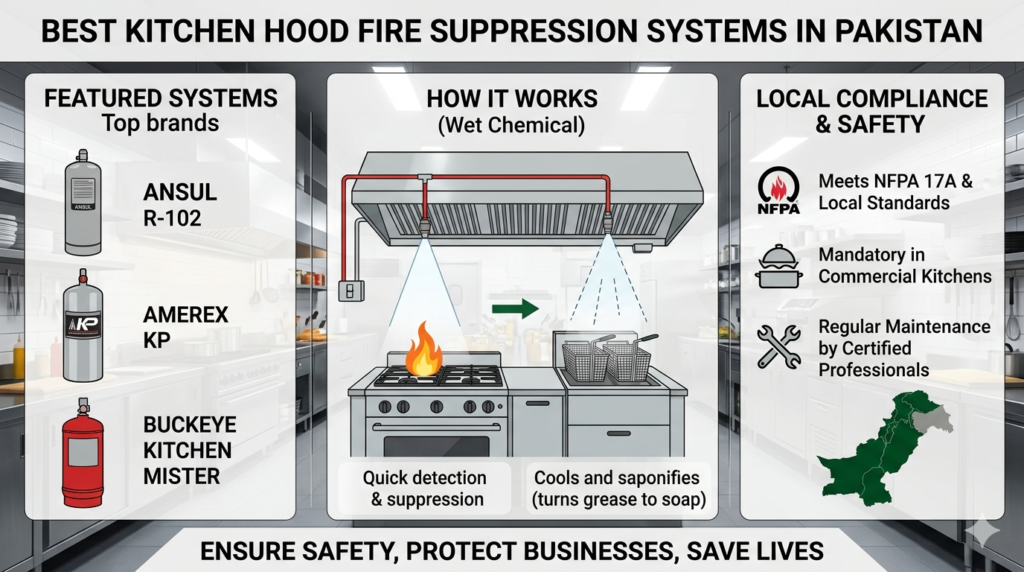
These systems work by detecting the sudden rise in temperature or the presence of flames at the cooking surface and immediately discharging a suppression agent — typically a wet chemical — directly onto the cooking equipment and into the grease trap. At the same time, the system automatically shuts off the gas and electrical supply to cooking appliances, removing the fuel source and cutting the fire off at its root.
In Pakistan, kitchen hood fire suppression systems are increasingly being made mandatory for commercial kitchens by local building authorities, fire departments, and insurance underwriters. High-profile restaurant fires in major Pakistani cities in recent years have accelerated the adoption of these systems, and the market for certified kitchen suppression solutions is growing rapidly.
Key Components of a Kitchen Hood Fire Suppression System
- Detection system: fusible links or thermal detectors positioned above the cooking surface
- Suppression agent cylinder: stores the wet chemical agent under pressure
- Nozzles: strategically positioned to direct agent onto the fire hazard zones
- Actuation mechanism: pneumatic or electrical trigger that releases the agent
- Fuel shut-off valve: automatically cuts gas or electricity to cooking appliances on activation
- Manual pull station: allows staff to manually trigger the system
- Control panel: monitors system status and triggers alarms
- Ansul pipe network: delivers the suppression agent from cylinder to nozzles
Why Are Kitchen Hood Fire Suppression Systems Critical in Pakistan?
Pakistan’s food service industry has grown enormously over the past decade. From Karachi’s coastal seafood restaurants to Lahore’s traditional dhabas, from Islamabad’s upscale dining establishments to fast-food franchises operating across every major city, commercial cooking is a significant economic activity. And with commercial cooking comes serious fire risk.
Grease fires are among the most dangerous types of fire in any built environment. They ignite rapidly, burn at extremely high temperatures, and cannot be extinguished with water — in fact, applying water to a grease fire causes a dramatic and dangerous flare-up. A standard fire extinguisher is often insufficient for a grease fire that has taken hold in a commercial kitchen hood.
The scale of the problem in Pakistan is illustrated by the frequency with which restaurant and kitchen fires appear in Pakistani news media. In Karachi alone, dozens of commercial kitchen fires are reported every year. Many of these could have been prevented or contained by a properly installed and maintained kitchen hood fire suppression system.
Consequences of Not Having a Kitchen Suppression System
- Complete destruction of kitchen equipment and the building itself
- Loss of inventory and perishable goods
- Staff injuries and fatalities
- Customer harm and associated legal liability
- Business closure and loss of operating licence
- Invalidation of fire insurance policies
- Criminal liability under the Pakistan Fire Safety Act and local building codes
For commercial kitchen operators in Pakistan, investing in a certified kitchen hood fire suppression system is not simply a regulatory box to tick — it is a fundamental business protection measure that protects lives, assets, and livelihoods.
How Kitchen Hood Fire Suppression Systems Work
Understanding how a kitchen hood fire suppression system works helps you appreciate both its effectiveness and the importance of proper installation and maintenance. Here is a step-by-step breakdown of the process:
- Detection: Fusible links or thermal detectors mounted above the cooking surface continuously monitor temperature. When the temperature exceeds the pre-set threshold — typically around 280°C for most cooking environments — the detection mechanism activates.
- Agent Release: The actuation mechanism opens the suppression cylinder valve, allowing the wet chemical agent to flow through the pipe network to the nozzles positioned above and around the cooking hazard areas.
- Suppression: The wet chemical agent is discharged in a fine mist directly onto the cooking surface, cooking appliances, and into the hood plenum. The chemical reacts with the burning cooking oil to form a soapy layer (saponification) that blankets the fire, cutting off its oxygen supply.
- Fuel Cutoff: Simultaneously with agent discharge, a mechanical or solenoid-operated valve shuts off the gas supply to all cooking appliances under the hood. Electrical power to cooking equipment is also isolated.
- Alarm Activation: The system triggers an audible and visual alarm, alerting kitchen staff and the broader building occupants to evacuate.
- Manual Override: Kitchen staff can also manually trigger the system using the pull station, enabling rapid response even before automatic detection.
The entire process from detection to full agent discharge typically takes less than 30 seconds — fast enough to contain most kitchen fires before they spread beyond the hood area. This speed is what makes properly installed and maintained kitchen hood fire suppression systems so effective at saving lives and preventing property loss.
Types of Kitchen Hood Fire Suppression Systems Available in Pakistan
There are several types of kitchen hood fire suppression systems available to buyers in Pakistan, each suited to different kitchen sizes, cooking types, and risk levels. Here is a breakdown of the main categories:
1. Wet Chemical Fire Suppression Systems
Wet chemical systems are the gold standard for commercial kitchen fire suppression, and they are the most widely specified system for kitchen hoods worldwide and in Pakistan. The wet chemical agent typically a potassium-based solution is specifically formulated to combat Class F/K fires involving cooking oils and fats.
When discharged, the agent reacts chemically with the burning fat or oil in a process called saponification, forming a thick foam layer that blankets the fire and prevents re-ignition. It also has a rapid cooling effect on the cooking surface, reducing the risk of the fire reigniting once the system has been triggered.
Wet chemical systems are available from leading brands supplied by Fire Safety Trading (Pvt) Ltd, including NAFFCO, Ansul, and Akronex — all of which are certified and tested to international fire safety standards.
2. Dry Chemical Fire Suppression Systems
Dry chemical suppression systems use a powdered agent typically sodium bicarbonate or monoammonium phosphate to extinguish fires. While effective for a range of fire classes, dry chemical systems are generally considered less ideal for kitchen hood applications compared to wet chemical systems, because they do not provide the same cooling and re-ignition prevention effect and can leave significant residue that contaminates food preparation surfaces.
However, dry chemical systems are sometimes used in smaller or lower-risk kitchen environments, or in situations where the lower cost of the system is a primary consideration.
3. CO2 Fire Suppression Systems
CO2 (carbon dioxide) suppression systems work by displacing oxygen in the protected area, effectively starving the fire of the oxidiser it needs to continue burning. CO2 systems are clean — they leave no residue — and are effective on a range of fire types.
However, CO2 systems are generally not recommended as the primary suppression system for occupied kitchen environments because the displacement of oxygen poses a significant risk to anyone present when the system discharges. They are more commonly used in unoccupied ancillary areas adjacent to kitchens, such as electrical rooms or extract duct systems.
4. Water Mist Fire Suppression Systems
Water mist systems use ultra-fine water droplets discharged at high pressure to suppress fires. They work by cooling the fire and the surrounding environment, displacing oxygen, and forming a vapour barrier around the fire source. Water mist systems have the advantage of using significantly less water than conventional sprinkler systems, reducing the risk of water damage to kitchen equipment and food.
While not as common as wet chemical systems for direct-coverage kitchen hood applications, water mist systems are increasingly being used in kitchen environments in Pakistan, particularly in larger commercial kitchens where a combined approach is appropriate.
5. Automatic Kitchen Fire Suppression Systems
All modern kitchen hood fire suppression systems are designed to be fully automatic — they require no human intervention to activate and will discharge the suppression agent the moment the detection system identifies a fire. This is critical in a busy commercial kitchen environment where staff may not be immediately aware of a fire starting in the hood or duct system.
Fire Safety Trading (Pvt) Ltd supplies and installs automatic kitchen fire suppression systems from globally recognised brands across Pakistan, including in Karachi, Lahore, Islamabad, Rawalpindi, Faisalabad, Multan, Peshawar, and Quetta. To find out more about the kitchen fire suppression systems available, contact the team today.
Best Kitchen Hood Fire Suppression System Brands Available in Pakistan
Choosing a recognised, certified brand is essential when selecting a kitchen hood fire suppression system for your restaurant, hotel, or food-processing facility in Pakistan. Here are the leading brands available through Fire Safety Trading:
NAFFCO (UAE)
NAFFCO is one of the world’s largest and most respected fire protection companies, headquartered in Dubai, UAE. NAFFCO kitchen suppression systems are designed to international standards and have been installed in commercial kitchens across the Middle East, South Asia, and beyond. Their systems are known for reliability, longevity, and ease of maintenance. Fire Safety Trading is an authorised distributor of NAFFCO products in Pakistan.
Ansul (USA)
Ansul is the market-leading brand for kitchen hood fire suppression systems globally. The Ansul R-102 Restaurant Fire Suppression System is the benchmark product for the industry and is found in commercial kitchens in fast-food chains, hotels, and restaurants around the world. Ansul systems use a specially formulated wet chemical agent that is exceptionally effective against cooking oil fires.
Akronex
Akronex provides a range of fire suppression solutions that are popular in Pakistan’s commercial and industrial sectors. Their kitchen suppression systems offer a cost-effective alternative to premium Western brands while maintaining strong performance standards. Fire Safety Trading supplies and installs Akronex systems across Pakistan.
Hygood and Tyco
Hygood and Tyco are both internationally respected fire suppression brands whose systems are available in Pakistan through Fire Safety Trading. Both brands offer robust, certified kitchen suppression solutions that meet international safety standards.
China-Origin Systems
For buyers working within tighter budgets, Fire Safety Trading also supplies certified kitchen fire suppression systems from Chinese manufacturers. These systems offer competitive pricing while still meeting the technical performance requirements for commercial kitchen applications. They are particularly popular among smaller restaurant owners and food court operators in Pakistan.
Choosing the Right Kitchen Hood Fire Suppression System in Pakistan
Selecting the correct kitchen hood fire suppression system for your specific application requires careful consideration of several factors. Here is what to think about:
1. Size and Configuration of the Kitchen Hood
The dimensions of your kitchen hood and the cooking equipment beneath it directly determine the number and positioning of suppression nozzles required, and therefore the size and capacity of the suppression cylinder. A professional fire safety engineer from Fire Safety Trading will conduct a site survey to calculate the exact system specification required.
2. Type of Cooking Equipment
Different cooking methods produce different fire risks. Deep fat fryers and woks cooking at very high temperatures with large quantities of oil present a higher risk than grills or ovens. The suppression system must be engineered to cover all hazard zones identified in the kitchen.
3. Certification and Standards Compliance
In Pakistan, kitchen fire suppression systems should comply with internationally recognised standards such as NFPA 96 (Standard for Ventilation Control and Fire Protection of Commercial Cooking Operations), UL 300 (for wet chemical systems), and local building code requirements. Always ensure the system and its components are certified.
4. Automatic vs. Manual Operation
All commercial kitchen hood suppression systems should include fully automatic detection and activation. Manual pull stations should be provided as a supplementary means of activation, not as the primary trigger.
5. Maintenance and Servicing Requirements
Kitchen suppression systems require regular inspection and maintenance typically every six months to ensure all components remain in working order. Consider whether the supplier offers ongoing maintenance and testing services. Fire Safety Trading offers fire suppression testing and maintenance services throughout Pakistan.
Installation of Kitchen Hood Fire Suppression Systems in Pakistan
Installing a kitchen hood fire suppression system is not a DIY task. It requires qualified fire safety engineers who understand the specific requirements of kitchen suppression systems, the hydraulics of suppression agent delivery, the correct positioning of nozzles and detection links, and the integration of the system with gas and electrical shut-off mechanisms.
Fire Safety Trading (Pvt) Ltd provides professional design, supply, and installation services for kitchen fire suppression systems across all major cities in Pakistan, including:
- Karachi — serving restaurants, hotels, and commercial kitchens across the city
- Lahore — covering the extensive food service sector in Punjab’s capital
- Islamabad and Rawalpindi — including the federal capital’s growing hospitality sector
- Faisalabad — industrial kitchens and food processing facilities
- Multan, Peshawar, and Quetta — nationwide reach for all Pakistani cities
The installation process includes a site survey, system design and specification, supply of all equipment, professional installation by certified technicians, commissioning and testing, and handover of full documentation including operation and maintenance manuals.
To get a quotation for kitchen hood fire suppression system installation at your premises in Pakistan, contact Fire Safety Trading (Pvt) Ltd on 0315-4233313 or visit their website.
Maintenance and Testing of Kitchen Hood Fire Suppression Systems
Even the best kitchen hood fire suppression system will fail to protect your kitchen if it is not properly maintained. Regular maintenance is not just a best practice — it is a requirement under fire safety regulations applicable to commercial premises in Pakistan.
What Does Kitchen Suppression System Maintenance Involve?
- Visual inspection of all nozzles to ensure they are clean and unobstructed
- Checking suppression agent cylinder pressure and weight to confirm the agent charge is intact
- Inspecting fusible links and thermal detectors for damage or cooking grease contamination
- Testing the manual pull station for correct operation
- Checking the gas and electrical shut-off valve for correct operation
- Inspecting the pipe network for corrosion, leaks, or physical damage
- Reviewing the grease accumulation in the hood and ductwork (excess grease increases fire risk)
- Updating service records and certifying the system is fit for purpose
Fire Safety Trading (Pvt) Ltd provides comprehensive maintenance and testing services for kitchen fire suppression systems throughout Pakistan. Their certified technicians carry out regular scheduled inspections and can respond to emergency service calls where a system has been activated or where a fault has been identified.
Why Choose Fire Safety Trading for Kitchen Hood Fire Suppression Systems in Pakistan?
Fire Safety Trading (Pvt) Ltd is Pakistan’s leading supplier of fire safety equipment and systems, with a proven track record across commercial, industrial, and institutional projects throughout the country. Here is why thousands of businesses across Pakistan trust Fire Safety Trading for their fire suppression needs:
- Authorised distributor of globally recognised brands including NAFFCO, Ansul, Akronex, Hygood, and Tyco
- Nationwide supply and installation coverage across all major Pakistani cities
- Certified and experienced fire safety engineers and installation technicians
- Full turnkey service from site survey and system design to supply, installation, commissioning, and ongoing maintenance
- Competitive pricing with both premium and budget-friendly system options
- Compliance with international fire safety standards including NFPA 96 and UL 300
- Rapid response emergency services for activated or faulty suppression systems
- Comprehensive documentation and certification for regulatory compliance
- Long-term maintenance contracts available for ongoing system support
Whether you are opening a new restaurant in Karachi, upgrading an existing hotel kitchen in Lahore, or equipping a new food processing facility in Faisalabad, Fire Safety Trading has the expertise and product range to deliver the right kitchen hood fire suppression system for your needs. Visit firesafetytrading.com.pk/fire-suppression-system or call 0315-4233313 to speak to a specialist today.
Frequently Asked Questions (FAQs)
1. What is the best kitchen hood fire suppression system in Pakistan?
The best kitchen hood fire suppression system in Pakistan for commercial kitchens is a wet chemical suppression system, preferably from a certified brand such as NAFFCO, Ansul, or Akronex. These systems are specifically designed for Class F/K fires involving cooking oils and fats, and they provide the fastest, most effective suppression with the lowest risk of re-ignition. Fire Safety Trading (Pvt) Ltd supplies and installs all of these brands throughout Pakistan.
2. Is a kitchen fire suppression system legally required in Pakistan?
Commercial kitchen operators in Pakistan are increasingly required to install certified fire suppression systems under local building codes, fire authority requirements, and the terms of commercial fire insurance policies. Regulations vary by city and building type, but the trend across Karachi, Lahore, Islamabad, and other major cities is toward mandatory installation for all commercial kitchens. Failure to comply can result in operating licences being revoked and insurance claims being denied.
3. How much does a kitchen hood fire suppression system cost in Pakistan?
The cost of a kitchen hood fire suppression system in Pakistan varies depending on the size of the kitchen, the type and brand of the system, and the complexity of the installation. Entry-level systems for smaller kitchens can start from PKR 150,000 to 250,000, while larger or more complex installations may cost significantly more. Fire Safety Trading offers competitive pricing and free site surveys. Contact them on 0315-4233313 for a detailed quotation.
4. What type of agent does a kitchen hood suppression system use?
The most common and recommended suppression agent for kitchen hood systems is a wet chemical — typically a potassium carbonate or potassium acetate solution. This agent reacts chemically with burning cooking oils through a process called saponification, forming a blanket of foam that suppresses the fire and prevents re-ignition. Some systems use dry chemical agents, but wet chemical is generally considered superior for kitchen applications.
5. How often should a kitchen fire suppression system be serviced?
Kitchen fire suppression systems should be inspected and serviced at least every six months by a qualified fire safety technician. More frequent inspection may be required if the kitchen is in heavy use or if there is significant grease accumulation. Regular servicing ensures the system will operate correctly in an emergency and is required to maintain the validity of fire safety certificates and insurance coverage. Fire Safety Trading offers maintenance contracts throughout Pakistan.
6. Can a kitchen hood fire suppression system be installed in an existing kitchen?
Yes. Kitchen hood fire suppression systems can be retrofitted into existing commercial kitchens. The installation process involves a site survey to assess the existing hood dimensions and cooking equipment, design of the suppression system layout, installation of the suppression cylinder, pipe network, nozzles, detection links, and shut-off valves, followed by commissioning and testing. Fire Safety Trading’s engineers are experienced in retrofit installations across Pakistan.
7. What happens after a kitchen suppression system is activated?
After a kitchen hood suppression system discharges, the cooking equipment must be shut down and the kitchen must not be used until the system has been professionally inspected, the suppression agent cylinder recharged, all components checked and reset, and the system recommissioned by a qualified technician. Fire Safety Trading provides rapid response recharge and recommissioning services throughout Pakistan.
8. Do kitchen suppression systems work automatically?
Yes. All modern kitchen hood fire suppression systems are fully automatic. They use fusible links or thermal detectors positioned above the cooking hazard areas to detect the onset of a fire. When the detection element reaches its activation temperature, the system discharges automatically without any human intervention required. A manual pull station is also provided to allow staff to activate the system manually if they see a fire before the automatic detection activates.
9. Which cities in Pakistan does Fire Safety Trading serve?
Fire Safety Trading (Pvt) Ltd provides kitchen fire suppression system supply, installation, and maintenance services across all major cities in Pakistan, including Karachi, Lahore, Islamabad, Rawalpindi, Faisalabad, Multan, Peshawar, Quetta, Hyderabad, Sialkot, Gujranwala, and beyond. Contact them on 0315-4233313 or visit firesafetytrading.com.pk for more information.
10. What is the difference between a kitchen fire suppression system and a regular fire sprinkler system?
A regular fire sprinkler system uses water to suppress fires and is designed for general building applications. Water should never be used on grease fires — it causes violent flare-ups that can spread the fire dramatically. A kitchen hood fire suppression system uses a specialist wet chemical agent specifically formulated for cooking oil fires, and it is positioned directly at the hazard source within the cooking hood. Kitchen suppression systems also automatically cut off gas and power to cooking equipment, which a standard sprinkler system does not do. For commercial kitchens in Pakistan, a dedicated kitchen hood suppression system is always required in addition to any general sprinkler system in the building.
Conclusion
Kitchen fires pose one of the most serious fire safety risks faced by commercial businesses in Pakistan. The unique combination of cooking oils, high temperatures, open flames, and busy working environments makes commercial kitchens the single highest-risk location for fire ignition in any foodservice establishment. A properly designed, installed, and maintained kitchen hood fire suppression system is the most effective technology available to protect your kitchen, your staff, your customers, and your business from this risk.
From Karachi’s bustling restaurant districts to Lahore’s hotel kitchens, from fast-food chains in Islamabad to food-processing plants across Punjab and Sindh, businesses across Pakistan are increasingly recognising the critical importance of investing in certified kitchen fire suppression solutions.
Fire Safety Trading (Pvt) Ltd is Pakistan’s trusted partner for all fire safety equipment and systems. With a comprehensive range of kitchen hood fire suppression systems from globally recognised brands, nationwide installation and maintenance capabilities, and a team of certified fire safety professionals, Fire Safety Trading is the only supplier you need for your kitchen fire protection requirements.
Do not wait for a fire to happen before taking action. Contact Fire Safety Trading (Pvt) Ltd today on 0315-4233313 or visit their website to get a free site survey and quotation for your kitchen hood fire suppression system in Pakistan.