Construction sites are busy environments where workers use electrical tools, welding equipment, temporary power supplies, flammable materials, and machinery every day. These activities are essential to completing a project, but they can also introduce fire hazards if equipment is misused, materials are stored carelessly, or safety procedures are overlooked.
Fire safety is therefore an important responsibility for contractors, project managers, engineers, site supervisors, and workers. A well-organized safety plan can help reduce preventable incidents, protect workers, limit property damage, and support the timely completion of construction projects.
In Pakistan, construction projects vary considerably. A small residential building may have different risks from a high-rise development, industrial facility, warehouse, or commercial complex. However, every project benefits from identifying hazards, maintaining suitable equipment, keeping escape routes clear, and preparing workers to respond to emergencies.
A fire alarm system in Pakistan can be an important part of fire protection where required by the building design, construction stage, occupancy, or applicable regulations. Nevertheless, an alarm is only one component of a complete safety strategy. Prevention, detection, communication, evacuation, and maintenance must work together.
What Is Construction Site Fire Safety?
Construction site fire safety means identifying and controlling fire hazards throughout the building process.
Unlike a completed building, a construction site changes regularly. Temporary electrical installations may be relocated, new materials arrive, storage areas move, and different teams carry out potentially hazardous tasks. These changes can introduce new risks from one day to the next.
A practical fire-safety programme should address:
– Electrical tools and temporary power supplies
– Welding, cutting, and other hot-work activities
– Storage of combustible materials
– Fuel and gas-cylinder handling
– Waste management and housekeeping
– Fire detection and firefighting equipment
– Emergency exits and access routes
– Worker training and emergency drills
– Inspection, maintenance, and incident reporting
The arrangements should be reviewed as the project progresses rather than treated as a one-time exercise.
Why Is Fire Safety Important on Construction Sites?
A fire on a construction site can threaten workers, nearby residents, visitors, and emergency responders. It can also damage unfinished structures, equipment, stored materials, and neighbouring properties.
Construction sites may contain temporary conditions that make an emergency more difficult to manage. Permanent stairways may not yet be complete, some fire-protection systems may not be operational, and workers may be unfamiliar with recently changed access routes.
These challenges make planning particularly important.
Good fire safety helps project teams identify hazards before work begins, establish clear responsibilities, and ensure that appropriate protective measures remain available throughout construction.
It can also help reduce avoidable delays, repair expenses, material losses, and disruption to other contractors.
1. Identify Fire Hazards Before Work Begins
The first step is to understand the risks associated with the project.
A site assessment should consider the work being performed, the materials present, the equipment in use, and the number of people who may need to evacuate.
For example, welding creates different hazards from painting, electrical installation, timber cutting, or fuel storage. A project involving several activities at the same time may require additional coordination.
Site managers should consider questions such as:
– Are combustible materials stored close to ignition sources?
– Are temporary electrical systems maintained properly?
– Are hot-work activities controlled?
– Can workers reach a safe exit from every active work area?
– Is suitable fire-safety equipment available?
– Do workers know how to report a fire or another emergency?
The assessment should be documented where required and reviewed when working conditions change.
2. Use Electrical Equipment Safely
Temporary electrical supplies are common on construction sites. They power lighting, drills, cutting equipment, pumps, and many other tools.
Damaged cables, unsuitable connections, overloaded circuits, and poorly maintained equipment can increase the risk of electrical faults and fire.
To reduce these risks, project teams should arrange suitable electrical installation, inspection, and maintenance by qualified personnel.
Workers should report damaged plugs, exposed conductors, unusual heating, burning smells, or equipment that repeatedly trips protective devices. Faulty equipment should be taken out of service until it has been assessed and made safe.
Additional precautions include:
– Using equipment appropriate for the working environment.
– Protecting cables from mechanical damage.
– Keeping electrical equipment away from water where it is not designed for wet conditions.
– Avoiding makeshift connections.
– Following manufacturer instructions.
– Keeping electrical panels accessible to authorized personnel.
Workers should never attempt repairs for which they lack the necessary training or authorization.
3. Control Welding and Other Hot-Work Activities
Welding, grinding, soldering, and cutting can produce sparks and intense heat. These activities may ignite nearby combustible materials, including packaging, timber, insulation, fabrics, and construction waste.
Hot work should therefore be planned and controlled.
Where required by the site’s procedures, a hot-work permit should identify the task, location, responsible personnel, precautions, and arrangements for checking the area after the work is completed.
Before work begins, the responsible team should assess the surrounding environment and remove or appropriately protect combustible materials. Suitable fire-protection arrangements should be available, and nearby workers should understand the precautions.
Work should not proceed when necessary controls are missing or conditions are unsafe.
After hot work finishes, the designated responsible person should carry out the required checks for signs of ignition, including in nearby or concealed areas where sparks may have travelled.
Workers should follow the site’s hot-work procedure and applicable requirements rather than relying on informal permission or assumptions.
4. Store Flammable and Combustible Materials Properly
Construction projects often use paints, solvents, adhesives, fuel, timber, plastic packaging, and other materials that may contribute to a fire.
Storage arrangements should reflect the properties of the materials and the manufacturer’s instructions.
Keep combustible materials away from ignition sources and avoid unnecessary accumulation in work areas. Materials should not block exits, stairways, access roads, electrical panels, or firefighting equipment.
Flammable liquids and gases require particular attention. They should be stored, handled, and used according to relevant safety requirements, supplier instructions, and the site’s risk assessment.
Only authorized personnel should manage specialist storage arrangements.
Clear labelling, controlled access, appropriate ventilation where required, and good housekeeping can help reduce avoidable hazards.
5. Maintain Good Housekeeping
Poor housekeeping can allow fire hazards to accumulate without attracting attention.
Construction waste, sawdust, cardboard, discarded packaging, and leftover materials may become fuel for a fire. Clutter can also obstruct workers who need to leave an area quickly.
Site supervisors should establish a regular cleaning and waste-removal routine.
Practical measures include:
– Removing waste from active work areas regularly.
– Keeping corridors and stairways clear.
– Separating materials according to their storage requirements.
– Avoiding unnecessary stockpiling.
– Keeping access to safety equipment unobstructed.
– Ensuring that temporary storage does not interfere with evacuation.
Housekeeping should be part of normal site operations rather than something completed only before inspections.
6. Understand the Role of Fire Detection and Alarm Systems
Early warning is important when workers may be spread across different floors, rooms, or sections of a large project.
A suitable fire detection or alarm arrangement can help notify people when a potential fire is detected or when an alarm is activated manually.
The appropriate solution depends on factors such as the building’s size, construction stage, layout, occupancy, available power, environmental conditions, and applicable requirements.
A fire alarm system in Pakistan may be required as part of a building’s fire-protection arrangements, depending on the project’s classification and the authority responsible for approving it.
The Building Code of Pakistan – Fire Safety Provisions 2016 addresses fire detection, occupant notification, escape facilities, and fire-protection arrangements. It also states that adequate escape facilities must be maintained for construction workers in buildings under construction. <Cite refs={[“turn705615search24”]}/>
During construction, project teams should establish suitable temporary warning arrangements where needed and ensure that any required permanent system is installed, tested, and approved at the appropriate stage.
Important considerations include:
– Whether workers can hear or otherwise receive the warning.
– Whether the alarm arrangement suits the current site layout.
– Whether changes to partitions or floors affect coverage.
– Whether the system’s power supply and components are maintained.
– Whether workers understand what the alarm means.
– Whether the warning connects to a clear evacuation procedure.
Alarm installation and commissioning should be handled by suitably qualified professionals.
7. Keep Escape Routes Clear and Accessible
Workers need a safe way to leave the site if a fire occurs.
Construction layouts change frequently, so escape arrangements must be reviewed as the project develops.
Temporary walkways, stairs, ramps, doors, and other routes should be kept clear and arranged according to the applicable safety requirements. Workers should be able to identify how to leave their work area without passing through an avoidable hazard.
Materials, tools, waste, and machinery should not be placed where they obstruct exits.
Where a project involves multiple floors, the evacuation plan should account for the available stairs and routes at each stage of construction. Workers should not assume that an unfinished or restricted route is suitable for emergency use.
The Pakistan fire-safety provisions specifically address escape facilities during construction, reinforcing the importance of maintaining appropriate routes for workers. <Cite refs={[“turn705615search24”]}/>
8. Provide Appropriate Fire-Safety Equipment
The equipment needed on a construction site depends on the hazards present and the applicable safety requirements.
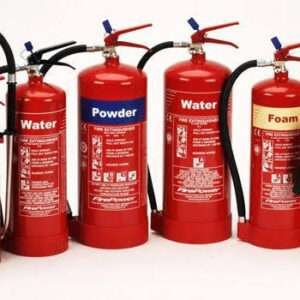
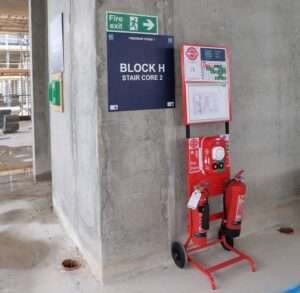
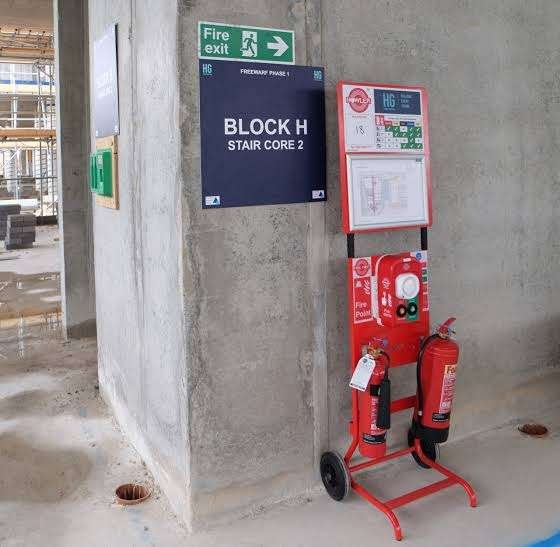
Possible provisions include suitable portable fire extinguishers, fire detection equipment, alarm arrangements, and other protective systems identified by the site’s assessment.
Equipment should be selected for the relevant hazards, positioned so it can be accessed safely, and maintained according to manufacturer instructions and applicable standards.
An extinguisher intended for one type of fire may be unsuitable for another. For example, water must not be used on burning electrical equipment that remains energized or on burning flammable liquids.
Only trained and authorized personnel should consider using firefighting equipment, and only when it is appropriate and safe to do so. Workers should not attempt to fight a spreading fire or place themselves at risk.
When there is immediate danger, the priority is to warn others, evacuate, and contact the appropriate emergency service.
9. Train Workers and Supervisors
Fire-safety equipment is less useful if workers do not understand how to respond when an emergency occurs.
Training should explain the site’s main hazards, reporting procedures, alarm signals, evacuation routes, assembly points, and the responsibilities of designated personnel.
New workers should receive appropriate site induction before starting relevant activities. Refresher training may be necessary when procedures change, new hazards appear, or the project reaches a different construction stage.
Toolbox talks can provide short reminders about specific risks, such as hot work, temporary electrical supplies, housekeeping, or the storage of combustible materials.
The U.S. National Institute for Occupational Safety and Health published a construction fire-safety toolbox talk in September 2026 covering common hazards, prevention, risk identification, and safe response principles. Its educational approach reinforces the value of discussing fire hazards directly with workers. <Cite refs={[“turn705615search0”]}/>
Training should be understandable to the workforce and suited to the tasks being performed. Workers should know that reporting a hazard is encouraged and that unsafe work must be stopped according to site procedures.
10. Prepare an Emergency Response Plan
Every construction project should have emergency arrangements appropriate to its size, hazards, and location.
The plan should explain how workers raise the alarm, who coordinates evacuation, where people assemble, how emergency services are contacted, and how headcounts are completed where appropriate.
It should also identify how workers will be informed about changes to routes or assembly arrangements.
Useful planning steps include:
1. Identify safe evacuation routes from active work areas.
2. Select suitable assembly points away from immediate hazards.
3. Assign emergency responsibilities to designated personnel.
4. Explain how workers report fires and other urgent hazards.
5. Establish arrangements for accounting for workers and visitors.
6. Coordinate access for emergency responders.
7. Review the plan as the site changes.
Drills and practical briefings can help identify problems before a real emergency occurs. Any issues discovered during exercises should be recorded and addressed.
11. Inspect and Maintain Fire-Safety Arrangements
Fire-safety arrangements can become ineffective if they are damaged, obstructed, disconnected, or overlooked as construction progresses.
Regular inspections help identify these problems.
The site team should establish suitable checks for equipment, temporary electrical systems, escape routes, storage areas, and hot-work controls. Specialized systems should be inspected and maintained by qualified personnel according to the applicable requirements.
Records should be kept where required, including relevant inspection findings, maintenance activities, training, and corrective actions.
The Building Code of Pakistan – Fire Safety Provisions 2016 includes requirements concerning the maintenance, inspection, and testing records of fire-protection systems and related safety arrangements. <Cite refs={[“turn705615search25”]}/>
When an inspection identifies a serious hazard, the responsible team should take appropriate corrective action before affected work continues.
12. Follow Applicable Fire-Safety Requirements in Pakistan
Construction teams should identify the requirements that apply to their particular project.
The Building Code of Pakistan – Fire Safety Provisions 2016 is an important reference for fire prevention, life safety, and fire protection in buildings and structures. The Pakistan Engineering Council lists the provisions in its register of building codes and standards. <Cite refs={[“turn705615search1″,”turn705615search2”]}/>
However, the requirements applicable to an individual project depend on its location, building type, construction stage, and the relevant authority’s rules and approvals.
Project owners and contractors should confirm the applicable requirements with the responsible building-control or fire-safety authority and consult qualified professionals where necessary.
A general checklist or equipment list cannot establish that a construction site complies with every relevant rule.
Construction Site Fire-Safety Checklist
Use this checklist as a starting point for routine site reviews.
– [ ] Fire hazards have been assessed for current work activities.
– [ ] Temporary electrical equipment is in suitable condition.
– [ ] Hot-work activities follow the required procedures.
– [ ] Combustible and flammable materials are stored appropriately.
– [ ] Waste is removed regularly.
– [ ] Suitable fire detection and warning arrangements are provided where needed.
– [ ] Fire-safety equipment is accessible and maintained.
– [ ] Escape routes remain clear and usable.
– [ ] Workers know the alarm and evacuation procedures.
– [ ] Emergency assembly points are identified.
– [ ] Inspections and corrective actions are recorded where required.
– [ ] Safety arrangements are reviewed when the site layout changes.
This checklist supports general awareness but does not replace a site-specific risk assessment or professional inspection.
Conclusion
Fire safety for construction sites requires continuous attention. Electrical work, hot-work activities, combustible materials, temporary installations, and changing escape routes can all introduce hazards as a project develops.
The right approach combines hazard identification, safe work practices, suitable equipment, worker training, regular inspections, and a clear emergency plan. Fire detection and alarm arrangements can provide an important warning, but they must be suitable for the site and supported by effective evacuation procedures.
For construction projects in Pakistan, the Building Code of Pakistan – Fire Safety Provisions 2016 and applicable local requirements should be considered when planning fire protection.
By treating fire safety as a daily responsibility rather than a final inspection task, project teams can create a safer working environment and help protect the people who make construction possible.
FAQs
1. What are the most common fire hazards on construction sites?
Common hazards include hot-work sparks, electrical faults, combustible waste, improperly stored flammable materials, and unsafe use of fuel or gas equipment. The risks vary with the work being performed and should be assessed regularly.
2. Why is a fire alarm system important on a construction site?
A suitable alarm arrangement can warn workers about a potential fire and help initiate evacuation. Its design and use should reflect the construction stage, site layout, applicable requirements, and the needs of the workforce.
3. How can contractors reduce fire risks during welding?
Contractors should assess the area, control combustible materials, follow the site’s hot-work procedures, provide appropriate protective arrangements, and check the area after work ends. Only authorized personnel should approve and supervise hot work according to site rules.
4. What should workers do if a fire breaks out?
Workers should raise the alarm, follow the site’s emergency procedure, and evacuate using a safe route. They should contact the appropriate emergency service and should not attempt to fight a spreading fire or re-enter an unsafe area.
5. How often should construction site fire-safety equipment be inspected?
Inspection and maintenance frequency depends on the equipment, manufacturer instructions, site conditions, and applicable requirements. Site teams should establish a documented schedule where required and arrange professional servicing for specialized systems.