Most people looking at a fire extinguisher focus on the gauge, the pin, or the paint on the cylinder. The hose, the flexible tube that carries the extinguishing agent from the cylinder to the nozzle, rarely gets a second glance. Yet a cracked, blocked, or loose hose can turn a fully charged extinguisher into a completely useless piece of equipment the moment someone tries to use it. Understanding how hose inspection works, and why it matters, is an essential part of keeping fire safety equipment genuinely reliable.
In Karachi, where extinguishers are installed everywhere from small retail shops in Tariq Road to large manufacturing units in SITE and Korangi, the hose is one of the most overlooked components during routine checks. This article breaks down what a proper hose inspection actually involves, why it should never be skipped, and how it fits into professional fire extinguisher refilling in Karachi.
What Is the Hose on a Fire Extinguisher?
Fire Safety Trading (Pvt)
ToggleThe hose is the flexible connector, usually rubber or reinforced synthetic material, that runs from the valve assembly at the top of the cylinder to the discharge nozzle or horn. On smaller extinguishers this may be a short rigid nozzle rather than a hose, but on most portable dry powder, foam, and larger CO2 units, a proper hose is what directs the agent toward the fire when the lever is squeezed.
Because it sits under pressure and is handled every time the extinguisher is tested or used, the hose experiences more physical stress than almost any other part of the unit, which is exactly why it deserves close attention during servicing.
Why Hose Condition Is Often Ignored
Technicians and building owners tend to focus on the parts that are easiest to check at a glance, the pressure gauge and the safety pin. The hose is coiled or clipped against the cylinder body and does not show obvious signs of a problem unless someone actually handles it, bends it, and looks closely at both ends. This makes it easy for a cracked or partially blocked hose to go unnoticed for months, especially in extinguishers that are rarely tested and simply hang on a wall waiting for an emergency that never comes.
Common Hose Problems Found During Inspection
- Cracking or brittleness caused by age, heat exposure, or UV exposure near windows
- Blockages from dried powder residue, dust, or insect nests inside the nozzle end
- Loose or corroded couplings where the hose connects to the valve body
- Kinks or flat spots from being coiled the same way for years without movement
- Cuts, abrasions, or perishing rubber from rough handling or storage against sharp edges
Why a Blocked or Cracked Hose Is Dangerous
If the hose is blocked, squeezing the lever during a fire will either produce no discharge at all or a weak, uneven spray that fails to reach the flames with enough force. If the hose is cracked, pressurized agent can escape through the crack instead of the nozzle, reducing both the range and duration of the discharge, or in more serious cases causing the hose to rupture entirely while someone is holding it.
Both scenarios mean the same outcome: an extinguisher that looks ready for use fails at the exact moment it is needed. This is one of the most common reasons a fire that could have been contained in seconds ends up spreading before anyone can respond effectively.
How Technicians Inspect the Hose Properly
A proper hose inspection during servicing goes well beyond a quick glance and involves several specific checks:
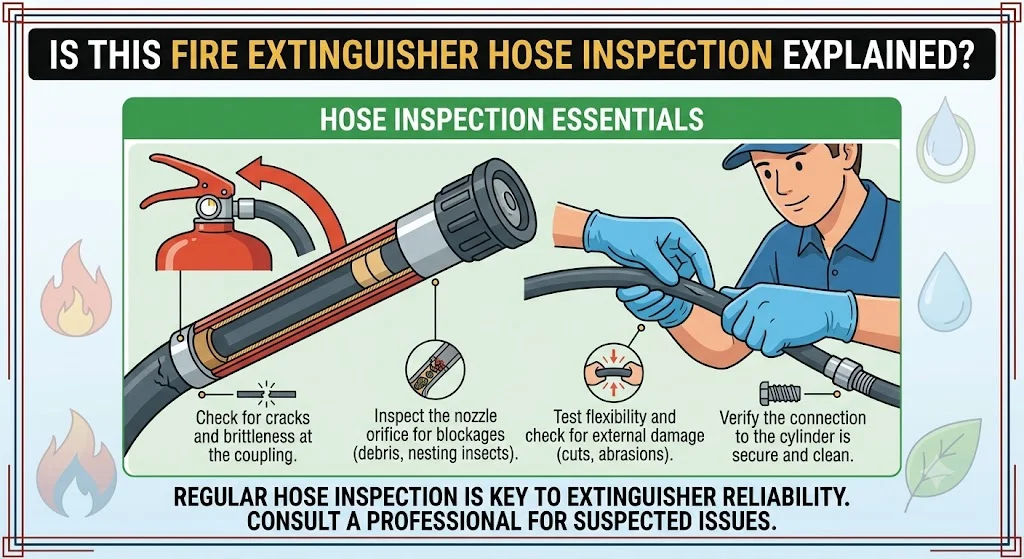
- Detaching or fully extending the hose to examine its entire length for cracks, cuts, or soft spots
- Flexing the hose gently to check for brittleness or stiffness that suggests aging rubber
- Looking through or blowing air through the nozzle end to confirm there is no internal blockage
- Checking the coupling and threaded connection for corrosion, looseness, or a damaged O-ring
- Comparing the hose against the extinguisher’s service history to see if it is due for replacement
If any of these checks reveal a problem that cannot be safely resolved, the correct response is to replace the hose entirely rather than attempt a temporary fix, since a compromised hose under pressure is not something that should be patched.
Why Karachi’s Climate Speeds Up Hose Wear
Karachi’s combination of intense summer heat, high humidity, and coastal salt air is particularly hard on rubber and synthetic hose materials. Extinguishers mounted near windows, in outdoor corridors, or in poorly ventilated storage rooms are exposed to conditions that accelerate cracking and perishing far faster than in cooler, drier environments. This is one of the reasons hose condition should be checked at every service visit rather than assumed to be fine simply because the extinguisher was serviced a year earlier during fire extinguisher refilling in Karachi.
How Hose Inspection Fits Into a Full Servicing Routine
A complete servicing visit should never treat the hose as an afterthought. It belongs alongside the other core checks performed during every visit:
- Visual and physical inspection of the cylinder body, pin, and gauge
- Weighing the cylinder to confirm the agent level is within safe limits
- Full-length inspection and flex test of the hose, including the nozzle and coupling
- Refilling or recharging the agent where required
- Re-sealing with a new tamper-evident pin and an updated inspection tag
A technician who skips the hose step may hand back an extinguisher that has been correctly refilled but is still unsafe to rely on, simply because the discharge path itself has not been verified.
How Often Should the Hose Be Checked?
The hose should be inspected at every annual service at minimum, and more frequently in high-risk or high-heat environments such as commercial kitchens, factories, and warehouses where the extinguisher may sit near heat sources or heavy machinery. Extinguishers exposed to direct sunlight or outdoor conditions, common in Karachi’s rooftop storage areas and open parking structures, often benefit from a six-month check simply because the material degrades faster in those conditions.
Choosing a Servicing Provider That Actually Checks the Hose
Not every provider takes the time to properly inspect the hose during a routine visit. When arranging servicing, it is worth asking directly whether hose inspection, including a check for blockages and a flex test, is part of the standard process, and asking the technician to point out the hose condition before and after the visit. A provider that genuinely inspects every component, not just the parts that are quick to glance at, is far more likely to hand back an extinguisher that will actually work when it matters.
Final Thoughts
A fire extinguisher is only as reliable as its weakest component, and the hose is frequently the part that gets the least attention despite carrying the entire discharge under pressure. A cracked, blocked, or loose hose can silently undo the value of a correctly refilled cylinder. For homes, offices, and factories across Karachi, making sure hose inspection is a standard part of every service visit is a small step that closes one of the most commonly missed gaps in fire safety maintenance.
Frequently Asked Questions
1. Why is the hose on a fire extinguisher important to inspect?
The hose carries the extinguishing agent from the cylinder to the nozzle under pressure. If it is cracked, blocked, or loose, the extinguisher may fail to discharge properly even if the cylinder itself is fully charged.
2. How can I tell if a fire extinguisher hose is blocked?
A blocked hose usually shows no visible external damage, which is why technicians check by looking through the nozzle end or gently blowing air through it during servicing to confirm the path is clear.
3. What causes fire extinguisher hoses to crack over time?
Age, heat exposure, UV exposure from sunlight, and rough handling all contribute to rubber and synthetic hoses becoming brittle and eventually cracking, especially in hot climates like Karachi.
4. Can a fire extinguisher hose be repaired if it is damaged?
No. A hose that shows cracks, cuts, or significant wear should be replaced rather than repaired, since it operates under pressure and a temporary fix is not a safe long-term solution.
5. How often should the hose be checked during servicing?
At minimum, once a year during the standard service visit, though extinguishers in hot, humid, or outdoor locations often benefit from a six-month check due to faster material degradation.
6. Does a blocked hose affect the extinguisher’s ability to put out a fire?
Yes. A blocked or partially blocked hose can produce a weak or uneven discharge, or no discharge at all, meaning the extinguisher will not perform as expected during an actual fire.
7. Is hose inspection included in standard fire extinguisher servicing?
It should be, but not every provider follows this consistently. It is worth confirming directly with the servicing company that hose inspection is part of their standard checklist.
8. Why does Karachi’s climate affect hose lifespan?
High heat, humidity, and salt air in Karachi accelerate the perishing of rubber and synthetic hose materials, making cracking and stiffness more likely compared to cooler, drier climates.
9. What happens if a cracked hose is used during a fire emergency?
Pressurized agent can escape through the crack instead of the nozzle, reducing the discharge range and duration, or in more serious cases the hose can fail entirely while in use.
10. What should I ask a servicing provider about hose inspection?
Ask whether they inspect the full length of the hose, check for blockages, and test the coupling and connection at every visit, rather than only checking the gauge and pin.