Fire safety is an essential part of designing, constructing, and maintaining safe buildings. Whether it is a residential house, commercial office, hospital, school, factory, or shopping centre, the materials used in a building can influence how well it performs during a fire. Some materials can slow the spread of flames, reduce heat transfer, or help maintain the stability of important structures. These are commonly known as fire-resistant materials.
In Pakistan, growing construction activity and increasing awareness of building safety have made fire protection an important consideration. Property owners, architects, contractors, and building managers need to understand how construction materials contribute to overall fire safety. Choosing suitable materials can help protect occupants, limit property damage, and support safer evacuation.
Fire-resistant materials are not a replacement for other essential safety measures. A building also needs suitable fire detection, alarm systems, emergency exits, evacuation plans, and regular inspections. A properly planned Fire alarm system in Pakistan can provide early warnings, giving occupants more time to respond to an emergency.
This guide explains ten important things everyone should know about fire-resistant materials, including their types, uses, benefits, limitations, and role in modern construction.
1. What Are Fire-Resistant Materials?
Fire-resistant materials are products designed to withstand exposure to fire or delay the effects of heat and flames for a specified period. Their performance depends on their composition, thickness, installation, and the conditions in which they are tested.
These materials are commonly used in walls, floors, ceilings, doors, structural components, insulation systems, and other building elements. Their purpose is to help slow the spread of fire and maintain the performance of important building components during an emergency.
It is important to understand that fire-resistant does not mean completely fireproof. No ordinary construction material should be assumed to remain unaffected by fire under every condition.
For example, a fire-resistant door may help restrict the movement of flames and smoke between different sections of a building when correctly installed and maintained. Similarly, fire-resistant wall assemblies can help separate areas and provide additional time for evacuation.
The correct material should always be selected according to the building’s design, applicable requirements, and professional recommendations.
2. Fire Resistance and Fire Reaction Are Different
Fire resistance and reaction to fire are related concepts, but they do not mean the same thing.
Fire resistance describes how long a complete building element, such as a wall, floor, door, or structural assembly, can perform its required function under standardized fire exposure. Depending on its design, that function may include maintaining stability, limiting the passage of flames, or reducing heat transfer.
Reaction to fire describes how a material or product behaves when exposed to fire. It can include factors such as how easily it ignites, how flames spread across its surface, how much heat it releases, and how much smoke it produces.
These differences matter when selecting construction products. A material may have a favourable reaction-to-fire classification without automatically providing a particular fire-resistance period as part of a wall or floor assembly.
Architects and engineers should consider both properties when planning building safety. Product documentation and independent test results can help establish whether a material is suitable for its intended application.
3. Common Types of Fire-Resistant Materials
Different materials offer different forms of protection. Some are naturally less combustible, while others are specially manufactured or treated to improve their performance.
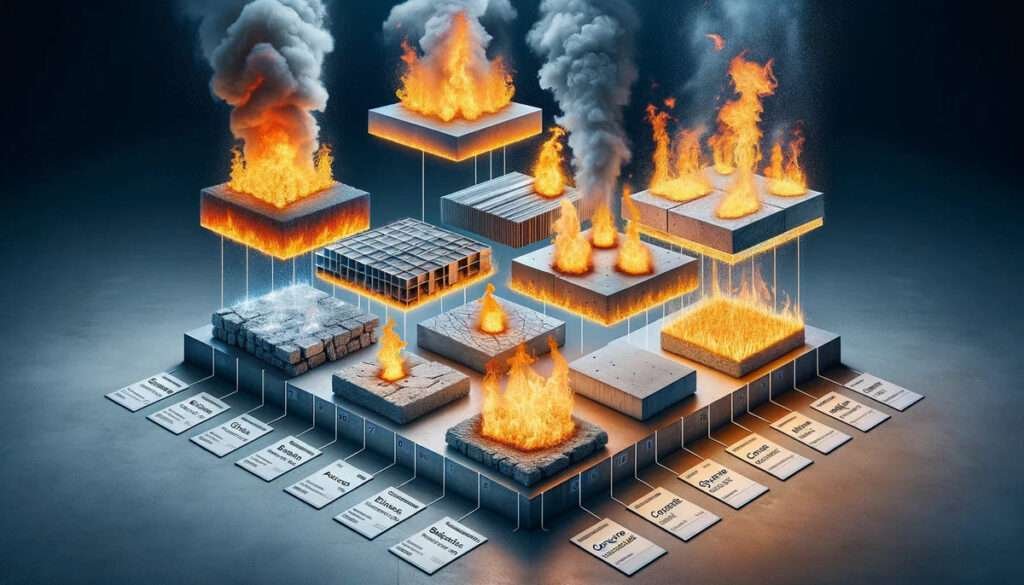
Common examples include:
Concrete
Concrete is widely used in building construction because it is non-combustible and can provide substantial fire resistance when properly designed. It is commonly found in structural columns, beams, floors, and walls.
Its performance depends on factors such as thickness, composition, reinforcement, and exposure conditions. High temperatures can still affect concrete and the reinforcement inside it, so appropriate engineering design is essential.
Gypsum Board
Gypsum board is commonly used for interior walls and ceilings. Its composition includes water in a chemically combined form, which can help delay temperature increases during fire exposure.
Specially manufactured fire-rated gypsum board is available for use in tested wall and ceiling systems. The complete assembly, including framing, joints, fasteners, and insulation, must meet the required specification.
Fire-Rated Glass
Specially designed fire-rated glass can be used in certain doors, partitions, and glazed building systems. Depending on its tested classification, it may help resist flames, limit heat transfer, or provide a combination of these functions.
Ordinary glass should never be assumed to provide the same level of protection.
Mineral Wool
Mineral wool is a non-combustible insulation material commonly manufactured from stone or other mineral-based materials. It is used in selected wall, roof, ceiling, and service installations.
Its suitability depends on the specific product, installation method, and tested assembly.
Fire-Resistant Doors
Fire-rated doors are designed and tested as complete door assemblies. Their performance may depend on the door leaf, frame, seals, hardware, glazing, and installation.
A certified door that has been incorrectly fitted or modified may not provide its intended protection.
4. Fire-Resistant Materials Help Slow the Spread of Fire
One of the most important benefits of fire-resistant construction is that it can help slow the spread of fire from one area to another.
Buildings often contain different rooms, corridors, floors, storage areas, and service spaces. If fire spreads quickly between these areas, occupants may have less time to evacuate and emergency responders may face more difficult conditions.
Fire-resistant walls, floors, doors, and properly protected service openings can help create separate fire compartments. These compartments are designed to limit fire spread for a specified period under defined conditions.
For example, a properly designed fire-rated door between a corridor and another section of a building may help maintain separation during an emergency.
However, this protection depends on the complete system. Unprotected openings, damaged seals, unsuitable materials, and unauthorized modifications can reduce its effectiveness.
Building owners should arrange professional inspections to confirm that fire compartments remain in suitable condition.
5. Fire-Resistant Materials Are Important in Different Buildings
Not every building has the same fire risks. The materials selected should reflect the building’s purpose, occupancy, layout, and potential hazards.
Residential Buildings
Homes and apartment buildings benefit from suitable fire-resistant walls, floors, doors, and protected service areas. These features can help slow fire spread between rooms or separate apartments.
Smoke alarms and suitable escape routes are also essential parts of residential fire safety.
Commercial Offices
Offices may contain electrical equipment, furniture, documents, and storage areas. Appropriate compartmentation and fire-rated construction can help reduce the movement of fire between different sections.
Hospitals
Hospitals require careful fire safety planning because patients may need assistance during evacuation. Fire-resistant construction, protected escape routes, emergency lighting, and reliable alarm systems all contribute to a safer environment.
Schools and Educational Buildings
Schools often accommodate large numbers of students and staff. Suitable fire-resistant building elements can support evacuation planning and help limit fire spread.
Factories and Warehouses
Industrial buildings may contain machinery, packaging, raw materials, and stored products. Their fire safety requirements depend on the specific activities and materials present.
Professional fire risk assessments are important when selecting suitable construction systems for these environments.
6. Fire Ratings and Testing Matter
A product should not be described as fire-resistant simply because its manufacturer uses that phrase in advertising. Reliable performance information should come from appropriate testing and documentation.
Fire resistance is commonly expressed in minutes or hours. For example, a tested building assembly may have a specified rating based on how long it meets particular performance criteria during a standardized fire test.
However, a rating applies to the tested product or assembly under defined conditions. It should not automatically be transferred to a different installation or construction arrangement.
When evaluating a product, building professionals should review:
The manufacturer’s technical documentation.
Relevant fire-test reports.
Product certification, where applicable.
The tested assembly and installation requirements.
The intended application and limitations.
Compatibility with other building components.
In Pakistan, project teams should also consider applicable building regulations, fire safety provisions, and approval requirements.
Choosing products based only on price or marketing claims can create serious gaps in building protection. Independent technical verification is a more reliable approach.
7. Proper Installation Is Just as Important as Material Quality
Even a high-quality fire-resistant product may fail to deliver its intended performance if it is installed incorrectly.
Fire-rated construction systems are designed as complete assemblies. Their performance may depend on several connected components working together.
For example, a fire-rated wall may include a particular board thickness, framing arrangement, insulation, joint treatment, and approved fixing system. Changing one component without professional assessment can affect the performance of the complete assembly.
The same principle applies to fire-rated doors. Suitable frames, seals, hardware, clearances, and installation details all matter.
Common installation concerns include:
Using unapproved replacement components.
Leaving openings without suitable fire protection.
Damaging fire-rated doors or their seals.
Making unauthorized changes to protected walls.
Using unsuitable materials around service penetrations.
Failing to follow the manufacturer’s tested installation details.
Property owners should work with qualified contractors and fire safety professionals. Installation records and product documentation should also be retained for future inspections.
8. Fire-Resistant Materials Have Limitations
Although fire-resistant materials are valuable, they cannot eliminate every fire risk.
Their performance is limited by the conditions for which they were designed and tested. A material rated for a particular application may not be suitable for another use.
For instance, a fire-rated wall system cannot provide reliable protection if large unprotected openings are introduced into it. Likewise, a fire-rated door may not perform as intended if it is damaged, improperly installed, or kept in a condition that prevents it from closing correctly.
Other limitations include:
Temperature exposure: Extremely high temperatures can damage materials and affect their performance.
Installation quality: Incorrect installation may reduce the protection provided by a tested system.
Maintenance: Damaged, altered, or poorly maintained components may lose their intended function.
Smoke movement: A fire-resistant material does not automatically prevent smoke from spreading through every part of a building.
Product suitability: Different products are designed for different applications and may have different performance classifications.
These limitations show why fire-resistant materials must be part of a complete fire safety strategy rather than treated as a single solution.
9. Maintenance and Regular Inspections Are Essential
Fire-resistant building elements need regular attention to remain effective throughout a building’s service life.
Building owners and managers should arrange inspections by competent professionals. These inspections can identify damage, unauthorized alterations, missing components, or other conditions that may affect fire protection.
Important areas to review include:
Fire-rated doors and their closing arrangements.
Walls and ceilings designed for fire separation.
Seals around approved service penetrations.
Fire-resistant insulation and protective coverings.
Signs of damage caused by renovations or building work.
Product labels and available installation records.
Any repairs or replacements should follow the manufacturer’s approved requirements and relevant technical specifications.
Building maintenance teams should also coordinate with contractors before renovation work begins. Changes to walls, ceilings, doors, and service routes can unintentionally affect fire protection.
A documented inspection and maintenance schedule helps building managers monitor the condition of important fire safety features.
10. Fire-Resistant Materials Must Work with a Complete Fire Safety System
Fire-resistant construction is only one part of an effective fire protection plan. A safe building also needs early detection, clear warnings, accessible exits, evacuation procedures, emergency lighting, and appropriate emergency arrangements.
A fire alarm system is particularly important because it alerts occupants when a potential fire emergency is detected. Depending on the building’s design, the system may include smoke detectors, heat detectors, manual call points, control equipment, and audible or visual notification devices.
A properly planned Fire alarm system in Pakistan should be selected according to the building’s size, occupancy, layout, and applicable requirements.
Other important fire safety measures include:
Smoke Detection
Suitable smoke detection can help identify developing fire conditions and provide an early warning to occupants.
Emergency Exits
Escape routes should be clearly identified, accessible, and maintained. Occupants should know how to reach a safe location without relying on lifts during a fire emergency.
Emergency Lighting
Emergency lighting can support safe movement when normal lighting is affected.
Evacuation Planning
Buildings should have clear evacuation procedures, suitable assembly arrangements, and regular awareness activities.
Professional Inspection
Fire alarms, detection equipment, fire doors, compartmentation, and other safety features should be inspected and maintained according to applicable requirements.
If a fire occurs, occupants should prioritize evacuation and contact emergency services from a safe location. They should not attempt to handle a dangerous fire themselves.
Choosing the Right Fire-Resistant Materials in Pakistan
Selecting fire-resistant materials requires more than comparing product prices. Building owners, architects, and contractors should consider the building’s design, intended use, local conditions, and applicable safety requirements.
The following points can help guide the selection process:
Understand the building’s needs: Residential, commercial, industrial, and healthcare buildings may require different levels and types of fire protection.
Check product documentation: Review technical specifications, test reports, and certification details where applicable.
Consider the complete assembly: A product’s performance may depend on how it is combined with other materials.
Use qualified professionals: Architects, engineers, contractors, and fire safety specialists can help identify suitable products and installation systems.
Plan for maintenance: Consider whether the materials can be inspected, maintained, and replaced appropriately throughout the building’s life.
Follow applicable requirements: Check relevant building regulations, fire safety provisions, and approval conditions for the project.
In Pakistan, choosing appropriate fire-resistant products can support safer residential and commercial construction. However, every project should be assessed according to its own requirements rather than relying on a general product recommendation.
Common Mistakes to Avoid When Using Fire-Resistant Materials
Some building safety problems occur because fire-resistant products are misunderstood or used incorrectly.
Common mistakes include:
Assuming every product labelled fire-resistant provides the same level of protection.
Using ordinary glass or doors where a tested fire-rated system is required.
Ignoring the manufacturer’s installation instructions.
Making unauthorized changes to fire-rated walls and ceilings.
Covering or damaging important product labels.
Failing to inspect fire doors and other protective components.
Selecting materials without considering the building’s intended use.
Treating fire-resistant construction as a replacement for alarms and evacuation planning.
Avoiding these mistakes requires proper planning, professional guidance, and regular building maintenance.
Conclusion
Fire-resistant materials play an important role in modern building safety. From concrete and gypsum board to mineral wool, fire-rated glass, and specialist door assemblies, different products can help limit fire spread and improve the protection provided by building structures.
However, their effectiveness depends on correct selection, reliable testing, professional installation, and ongoing maintenance. No single material can make a building completely safe from fire.
A complete fire safety strategy should combine suitable construction materials with smoke detection, alarm systems, emergency exits, evacuation planning, and regular inspections. For property owners and building managers in Pakistan, understanding these measures is an important step toward creating safer homes, workplaces, and public buildings.
Frequently Asked Questions (FAQs)
1. What are fire-resistant materials?
Fire-resistant materials are products designed to withstand fire exposure or delay the effects of heat and flames for a specified period. They are used in building components such as walls, floors, doors, ceilings, and insulation systems.
2. Which materials are commonly used for fire-resistant construction?
Common examples include concrete, specially manufactured gypsum board, mineral wool, fire-rated glass, and certified fire-rated door assemblies. The correct choice depends on the building design and intended application.
3. Are fire-resistant materials completely fireproof?
No. Fire-resistant materials are designed to provide a particular level of protection under defined conditions. Their performance depends on product specifications, installation quality, and maintenance.
4. Why is professional installation important for fire-resistant materials?
Professional installation helps ensure that products are used according to their tested specifications. Incorrect installation, unauthorized changes, or unsuitable replacement components can reduce the performance of the complete system.
5. Do fire-resistant materials eliminate the need for a fire alarm system?
No. Fire-resistant materials and fire alarm systems serve different purposes. Construction materials can help slow fire spread, while alarms provide warnings so occupants can respond and evacuate. Both are important parts of a comprehensive fire safety plan.