

Commercial buildings in Pakistan from shopping malls in Karachi and corporate towers in Islamabad to textile factories in Faisalabad and hospitals in Lahore house thousands of people every single day. Yet fire safety remains one of the most overlooked aspects of building management across the country. Every year, Pakistan witnesses devastating fire incidents that result in massive financial losses and, more tragically, preventable deaths. The common thread running through most of these disasters is the absence or failure of a proper fire alarm system.
A fire alarm system is not merely a box on the wall that makes noise. It is a sophisticated, life-saving network of sensors, detectors, control panels, and notification devices that work together to detect fire in its earliest stages, alert occupants, and trigger emergency responses — all within seconds. In commercial buildings where dozens to thousands of people may be present at any given time, this early warning can mean the difference between life and death.
This article explores the critical importance of fire alarm systems in commercial buildings across Pakistan, the different types available, their key components, legal requirements, and why businesses should invest in high-quality, certified systems from trusted providers like Fire Safety Trading (Pvt) Ltd.
Why Fire Safety Is a Growing Concern in Pakistan
Pakistan’s commercial sector has witnessed explosive growth over the past two decades. New plazas, factories, warehouses, hotels, hospitals, and office complexes are being constructed at a rapid pace in cities like Rawalpindi, Islamabad, Lahore, Karachi, Peshawar, and Quetta. However, this rapid development has not always been matched by adequate fire safety infrastructure.
Some alarming statistics highlight the urgency:
- Pakistan’s fire incidents cause billions of rupees in losses annually
- Many commercial fire tragedies occur in garment factories, where overcrowding and poor fire safety are common
- The 2012 Baldia factory fire in Karachi one of the deadliest industrial fire disasters in history claimed over 250 lives and could have been largely prevented with proper fire detection and alarm systems
The key lesson from these tragedies is clear: early detection through a reliable fire alarm system saves lives. Without it, occupants may only become aware of a fire when it has already grown beyond control.
What Is a Fire Alarm System?
A fire alarm system is an integrated network of devices designed to detect fire-related threats — including smoke, heat, carbon monoxide, and flames — and immediately alert building occupants and emergency services. Modern fire alarm systems can also trigger automatic responses such as closing fire doors, activating sprinkler systems, and notifying the fire brigade without any human intervention.
The core purpose of a fire alarm system can be broken down into four functions:
Detection: The system continuously monitors the environment for signs of fire. Smoke detectors, heat detectors, and flame detectors installed throughout the building sense the earliest indicators of a fire outbreak.
Alert: Once a threat is detected, audible alarms (sirens, bells, electronic sounders) and visual alarms (strobe lights) activate immediately. In advanced systems, voice evacuation messages guide occupants on how to exit safely.
Protection: The system helps contain the fire by automatically closing fire-rated doors and activating fire suppression systems, preventing fire from spreading to other areas.
Notification: Simultaneously, the system sends alerts to building management, security personnel, and fire departments, ensuring the fastest possible emergency response.
Key Components of a Fire Alarm System
Understanding the components of a fire alarm system helps building owners appreciate why professional installation and maintenance are essential. A complete system typically includes:
Fire Alarm Control Panel (FACP): This is the brain of the entire system. It receives signals from all detectors and devices, processes the information, and triggers the appropriate alarms and responses. The control panel also provides fault monitoring and system diagnostics.
Smoke Detectors: These devices sense smoke particles in the air, which is typically the first sign of a fire. There are two main types ionization smoke detectors, which are more responsive to fast-flaming fires, and photoelectric smoke detectors, which are better at detecting slow, smoldering fires.
Heat Detectors: These sensors trigger an alarm when the ambient temperature exceeds a pre-set threshold or when it rises rapidly over a short period. They are commonly used in kitchens and other areas where smoke detectors might produce false alarms.
Manual Call Points (Break Glass Units): These are wall-mounted devices that allow occupants to manually trigger the fire alarm by breaking the glass panel when they spot a fire. They should be installed at all exit routes and are a critical backup to automatic detection.
Sounders and Sirens: These produce the audible alarm that alerts building occupants. Modern systems use electronic sounders that can produce different tones to indicate various alert levels.
Strobe Lights and Visual Alarms: In environments with loud machinery or for hearing-impaired occupants, visual alarms are equally important. Strobe lights flash to indicate an emergency, ensuring everyone is alerted regardless of background noise.
Carbon Monoxide Detectors: CO is a colorless, odorless gas produced by incomplete combustion. CO detectors are essential in enclosed commercial spaces with gas appliances or parking areas.
Flame Detectors: Used in high-risk industrial and commercial environments, these devices detect the presence of actual flames using UV/IR sensors, making them ideal for factories and warehouses.
Types of Fire Alarm Systems for Commercial Buildings
Choosing the right type of fire alarm system depends on the size, layout, and risk level of the commercial building. Here are the main types available in Pakistan:
1. Conventional Fire Alarm System
In a conventional system, detectors and call points are wired in zones back to the main control panel. When a device triggers, the panel identifies which zone is affected. This system is cost-effective and suitable for smaller commercial buildings like shops, small offices, and restaurants.
The control panel displays zone information through indicator lights or text, helping building management and the fire brigade identify the approximate location of the alarm quickly.
2. Addressable Fire Alarm System
An addressable system assigns a unique digital address to every detector and device on the network. When an alarm is triggered, the control panel can identify the exact device not just the zone that has been activated. This pinpoint accuracy dramatically speeds up emergency response, as responders know precisely where to go.
Addressable systems are ideal for medium to large commercial buildings such as hospitals, hotels, shopping malls, and office complexes. Each loop can support up to 99 devices, and multiple loops can be managed from a single panel.
3. Intelligent Fire Alarm System
Intelligent systems represent the most advanced category. Every detector in the system contains its own microprocessor, which constantly monitors environmental conditions and communicates complex data not just simple on/off signals to the control panel. This intelligence allows the system to distinguish between genuine fires and false alarms caused by cooking smoke, steam, or dust.
Intelligent systems can also self-diagnose and report when a detector needs cleaning or servicing, reducing maintenance costs and ensuring the system is always ready to perform.
For large commercial complexes, hospitals, banks, and government buildings in Pakistan, intelligent fire alarm systems offer the highest level of protection and reliability.
4. Wireless Fire Alarm System
Wireless systems use secure radio communication to connect detectors and devices to the control panel, eliminating the need for physical cables. These systems are particularly beneficial in heritage buildings, occupied spaces where cabling would be disruptive, and temporary commercial structures.
Wireless fire alarm systems are increasingly popular in Pakistan’s rapidly developing commercial sector, where retrofitting existing buildings with traditional wired systems can be expensive and disruptive.
Why Fire Alarm Systems Are Critical for Commercial Buildings in Pakistan
Protecting Human Life
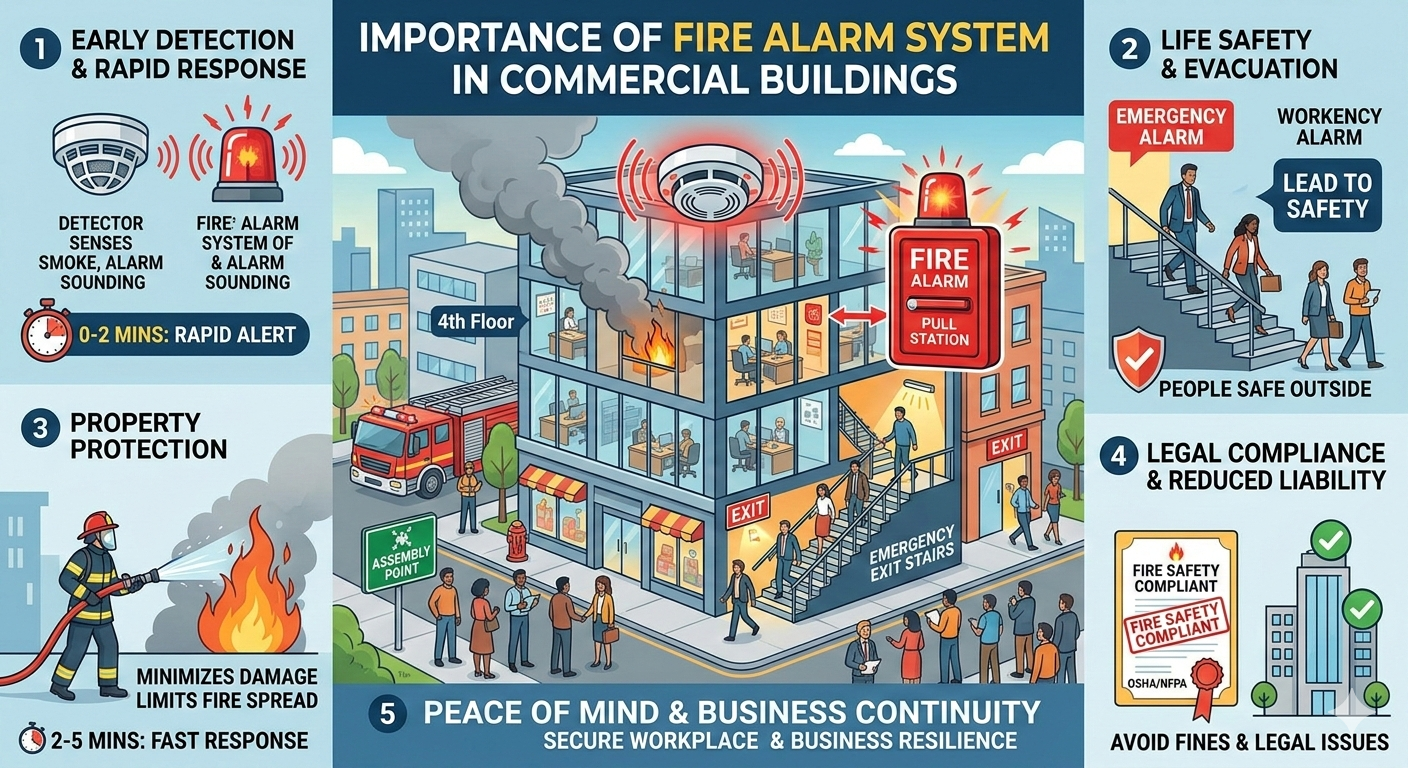
The most fundamental purpose of any fire alarm system is protecting the lives of people inside the building. In commercial settings offices, factories, hospitals, shopping centers the number of occupants can be massive. Early detection and rapid alerting gives people the time they need to evacuate safely before smoke and flames become lethal.
Studies worldwide consistently show that buildings equipped with properly maintained fire alarm systems have dramatically lower rates of fire fatalities compared to buildings without them.
Legal Compliance and Building Codes
Pakistan’s National Building Code (NBC) and various provincial fire safety regulations require commercial buildings to have fire detection and alarm systems installed and maintained to prescribed standards. Non-compliance can result in penalties, closure orders, and, in the event of a fire-related fatality, serious legal liability for building owners and managers.
Businesses operating in industrial zones, particularly those exporting to international markets, are increasingly required to demonstrate compliance with international fire safety standards as part of buyer audits and certifications.
Protecting Property and Assets
Commercial buildings house valuable equipment, machinery, stock, data servers, and documents. A fire that goes undetected for even a few minutes can cause catastrophic damage running into millions of rupees. A fire alarm system minimizes this damage by detecting fire early and enabling swift suppression before it can spread.
Insurance companies in Pakistan also increasingly require fire alarm systems as a condition for commercial property coverage, and their presence can significantly reduce insurance premiums.
Business Continuity
For businesses in Pakistan’s competitive market, downtime caused by fire damage can be devastating. Factories may lose production contracts, hotels may lose their reputation, hospitals may lose patient trust. A reliable fire alarm system significantly reduces the risk of fire damage, protecting not just the physical building but the business itself.
Protecting Sensitive Environments
Certain commercial environments data centers, server rooms, medical facilities, laboratories require specialized fire detection because conventional firefighting methods like water could destroy sensitive equipment. Advanced fire alarm systems can be integrated with clean agent fire suppression systems that extinguish fires without damaging electronic equipment or compromising sterile environments.
Fire Alarm System Requirements for Different Commercial Buildings
Different types of commercial buildings in Pakistan have unique fire alarm requirements:
Hospitals and Healthcare Facilities: These require 24/7 reliable detection with voice evacuation systems and integration with backup power supplies. Patient safety demands both audible and visual alarms, with the ability to direct specific floors or zones to evacuate while others shelter in place.
Hotels and Hospitality Venues: Hotels require sophisticated addressable or intelligent systems that can quickly identify fire locations across multiple floors. Guest rooms need smoke detectors, and common areas need a mix of smoke and heat detection.
Factories and Industrial Buildings: Manufacturing facilities face elevated fire risks due to machinery, flammable materials, and high heat processes. Industrial fire alarm systems often need to integrate with fire suppression systems and may require flame detectors in addition to conventional smoke and heat detectors.
Shopping Malls and Retail Complexes: High footfall, multiple retail units, food courts, and parking areas create complex detection challenges. Addressable systems with multiple zones are essential, along with public address capabilities for orderly mass evacuation.
Office Buildings: Standard smoke and heat detection is typically sufficient for office environments, though server rooms and electrical areas may require specialized detection.
Choosing the Right Fire Alarm System Provider in Pakistan
Selecting a trusted, certified fire alarm system supplier and installer is as important as choosing the right system. Here are the key factors to consider:
Product Quality and Certification: Look for suppliers offering globally recognized brands with international certifications. Fire Safety Trading (Pvt) Ltd, based in Rawalpindi, provides world-class fire alarm systems from renowned manufacturers including COFEM Spain, Gent by Honeywell, and C-TEC all of which meet international fire safety standards.
Professional Installation: Even the best fire alarm system is ineffective if improperly installed. Choose a company with certified installation engineers who follow proper zoning, cabling, and commissioning procedures.
Maintenance and After-Sales Support: A fire alarm system requires regular testing and maintenance to ensure it functions correctly when needed. Choose a provider that offers comprehensive fire alarm maintenance services, including periodic inspections, battery replacements, and detector testing.
Coverage Across Pakistan: For businesses with multiple locations, it is important to choose a provider with nationwide reach. Fire Safety Trading (Pvt) Ltd offers fire alarm installation and maintenance services across Rawalpindi, Islamabad, Lahore, Karachi, Faisalabad, Peshawar, Quetta, Gilgit, Muzaffarabad, Gwadar, and other major cities.
Fire Alarm System Prices in Pakistan
The cost of a fire alarm system in Pakistan varies significantly based on the type of system, the number of devices required, the size of the building, and the brand. As a general guide:
- Smoke detectors range from approximately PKR 2,000 to PKR 5,000 per unit for standard models, with premium addressable detectors costing more
- Conventional fire alarm control panels (2-8 zones) range from PKR 15,000 to PKR 80,000
- Addressable and intelligent fire alarm systems for large commercial buildings can range from PKR 200,000 to several million rupees depending on the scale of installation
For accurate pricing tailored to your specific building and requirements, it is advisable to contact a professional supplier like Fire Safety Trading (Pvt) Ltd directly for a quotation.
Maintenance of Fire Alarm Systems
Installing a fire alarm system is not a one-time task. Regular maintenance is essential to ensure the system performs correctly in an emergency. Best practices include:
- Weekly checks: Visual inspection of control panels and indicator lights
- Monthly tests: Manual activation of call points to verify alarm operation
- Annual inspection: Full inspection of all detectors, wiring, backup batteries, and control panels by a certified engineer
- Detector cleaning: Dust accumulation can cause both false alarms and missed detections; detectors should be cleaned at regular intervals
Fire Safety Trading (Pvt) Ltd provides professional fire alarm maintenance services across Pakistan, ensuring that commercial buildings remain protected and compliant at all times.
Conclusion
The importance of a fire alarm system in commercial buildings cannot be overstated. In a country where fire incidents continue to claim lives and destroy businesses, investing in a high-quality, professionally installed, and regularly maintained fire alarm system is not an option, it is a responsibility.
From conventional systems suitable for small shops to intelligent addressable systems for large hospitals and industrial complexes, there is a fire alarm solution for every type of commercial building in Pakistan. The key is to choose the right system, have it installed by qualified professionals, and maintain it diligently.
If you are looking for the best fire alarm system in Pakistan, Fire Safety Trading (Pvt) Ltd offers a comprehensive range of world-class fire alarm solutions, professional installation, and maintenance services across the country. Protect your building, your assets, and most importantly, the lives of the people inside it.
Contact Fire Safety Trading (Pvt) Ltd today: Call 0315-4233313 or email sales@firesafetytrading.com.pk for a free consultation and quotation.
Fire Safety Trading (Pvt) Ltd provides fire alarm systems, installation, and maintenance services in Rawalpindi, Islamabad, Lahore, Karachi, Faisalabad, Peshawar, Quetta, Gilgit, Muzaffarabad, Gwadar, and all other major cities of Pakistan.


