

Fire safety is not a luxury, it is a legal and moral obligation, especially in a bustling metropolitan city like Karachi. Whether you own a home in DHA, manage a factory in SITE Area, or run a restaurant in Clifton, having a properly charged fire extinguisher can be the difference between a minor incident and a devastating disaster. Yet, one of the most overlooked aspects of fire safety is the regular refilling and maintenance of fire extinguishers.
This comprehensive fire extinguisher refill guide covers everything you need to know why refilling matters, when to do it, how the process works, what it costs in Pakistan, and where to get it done properly in Karachi. Whether you are a homeowner, business manager, or safety officer, this guide is your go-to resource.
What Is a Fire Extinguisher Refill and Why Does It Matter?
A fire extinguisher refill, also known as recharging, is the process of replenishing the extinguishing agent inside the cylinder after it has been fully or partially discharged. Most people assume their extinguisher is ready to use simply because it looks undamaged on the shelf. This is a dangerous misconception. Even a briefly discharged extinguisher, even one used for just a few seconds, may have lost enough pressure to be completely ineffective during an actual fire emergency.
A refill involves several steps: draining any remaining agent, inspecting and cleaning the cylinder, replacing the valve and seals if needed, recharging with the correct agent and pressure, and finally testing the unit. Skipping this process or delaying it puts lives and property at serious risk.
In Karachi, where industrial facilities, commercial buildings, and dense residential areas are often in proximity, the risks of fire are elevated. Facilities from Korangi Industrial Area to Saddar’s commercial markets require dependable, well-maintained fire suppression equipment always.
When Should You Refill Your Fire Extinguisher?
Knowing when to refill is just as important as knowing how. Here are the key scenarios that require an immediate refill:
1. After Any Use Even Partial
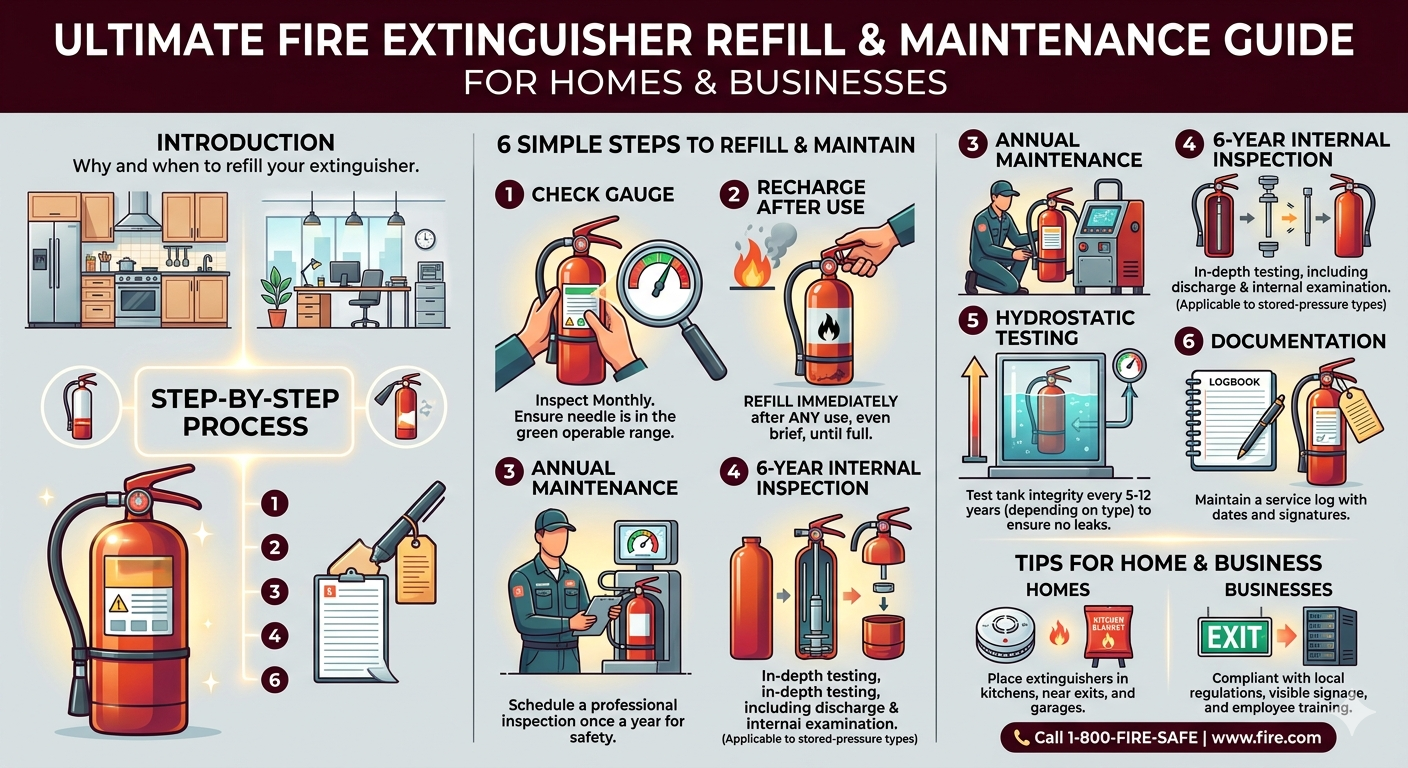
The most critical rule in this fire extinguisher refill guide is this: once used, always refill. Even if you discharged the extinguisher for only a few seconds, it must be professionally recharged. Partial discharge causes pressure loss and can allow moisture to enter the cylinder, degrading the remaining agent.
2. After a Failed Pressure Check
Every fire extinguisher has a pressure gauge. The needle should rest in the green zone. If it falls into the red zone either too high or too low the extinguisher needs to be inspected and likely recharged. In Karachi’s hot and humid climate, pressure can drop faster due to temperature fluctuations, making regular gauge checks essential.
3. On the Annual Maintenance Schedule
Even if an extinguisher has never been used, it still requires annual professional inspection and refilling every 5 to 6 years depending on the type. For businesses in Karachi, NFPA and local civil defense regulations typically require annual servicing records to be maintained.
4. Visible Physical Damage or Corrosion
If you notice rust, dents, a damaged hose, a broken safety pin, or a missing inspection tag, do not wait. Take the unit for immediate service. Karachi’s coastal humidity accelerates metal corrosion, and a structurally compromised cylinder is not just useless it can be dangerous.
Types of Fire Extinguishers and Their Refill Requirements
Different extinguisher types use different agents, and each has specific refill protocols. Understanding these differences is central to any complete fire extinguisher refill guide.
DCP (Dry Chemical Powder) Extinguishers
DCP extinguishers are the most common in Pakistan. They are rated Class A, B, and C fires and are widely used in offices, homes, warehouses, and factories in Karachi. The powder can clump over time due to humidity, so annual inspections are critical. Refilling involves completely emptying the cylinder, drying it internally, replacing the powder, and re-pressurizing with nitrogen gas.
CO2 (Carbon Dioxide) Extinguishers
CO2 extinguishers are ideal for electrical fires and server rooms a necessity for Karachi’s growing technology and banking sectors. They leave no residue and are clean to use. Refilling CO2 extinguishers requires specialized high-pressure equipment and certified technicians, as the gas is stored at extremely high pressure. This type of refill must never be attempted without proper tools.
Foam (AFFF) Extinguishers
Foam extinguishers are suited for Class A and B fires, particularly flammable liquids. They are commonly used in petrol stations, chemical warehouses, and kitchens. The foam concentrate degrades over time, so annual replacement of the agent is recommended even without use.
Wet Chemical Extinguishers
Designed specifically for Class F fires involving cooking oils and fats, wet chemical extinguishers are essential for restaurants, cafeterias, and commercial kitchens throughout Karachi. Refilling requires specialized wet chemical agents and must be handled by certified professionals only.
Halotron and Water Mist Extinguishers
These are more specialized units often found in sensitive environments like data centers and medical facilities. They require specific refill agents and certified equipment. Fire Safety Trading (Pvt) Ltd provides refilling services for all these types across Karachi.
Step-by-Step: How the Fire Extinguisher Refill Process Works
Professional fire extinguisher refilling follows a rigorous process that goes well beyond simply adding more powder or gas. Here is what a standard refill service includes:
Step 1: Collection and Initial Inspection
The technician collects the extinguisher and performs a visual inspection for dents, corrosion, label damage, and hose condition. Any structurally compromised units are flagged for replacement rather than refill.
Step 2: Pressure Release and Disassembly
The extinguisher is safely depressurized before the valve assembly is removed. This step is critical for safety and must only be done by trained professionals using proper pressure-relief tools.
Step 3: Internal Cleaning
The cylinder interior is cleaned and inspected for rust, moisture, or contamination. In DCP units, any caked-on powder is removed completely. The cylinder may be dried with compressed air or subjected to a drying process.
Step 4: Component Replacement
O-rings, seals, and the safety pin are replaced as standard practice. If the hose shows cracks or stiffness, it is replaced. Gauges are tested for accuracy.
Step 5: Refilling with the Correct Agent
The appropriate agent is measured precisely and loaded into the cylinder. For DCP units, quality mono-ammonium phosphate powder is used. CO2 cylinders are filled using high-pressure CO2 gas from certified industrial sources.
Step 6: Re-pressurization and Leak Testing
After sealing, the unit is re-pressurized to the manufacturer’s specified level. A leak test is then conducted to ensure there are no pressure losses.
Step 7: Labeling and Certification
A new service tag is attached showing the refill date, technician name, and next service date. This label is critical for regulatory compliance, particularly for businesses in Karachi that are subject to Civil Defense or insurance inspections.
Fire Extinguisher Refill Costs in Karachi, Pakistan
Cost is often the reason businesses and homeowners delay refilling. However, when you consider the cost of fire damage or worse, loss of life regular maintenance is a very small investment. Here is an approximate breakdown of refill costs in Karachi:
- DCP 1 kg extinguisher refill: Rs. 400 – Rs. 800
- DCP 4 kg extinguisher refill: Rs. 700 – Rs. 1,200
- DCP 6 kg extinguisher refill: Rs. 900 – Rs. 1,600
- DCP 9 kg extinguisher refill: Rs. 1,200 – Rs. 2,000
- CO2 2 kg extinguisher refill: Rs. 1,500 – Rs. 2,500
- CO2 4.5 kg extinguisher refill: Rs. 2,500 – Rs. 4,000
- Foam (AFFF) extinguisher refill: Rs. 1,200 – Rs. 3,000
- Wet Chemical Extinguisher Refill: Rs. 1,500 – Rs. 3,500
Note: Prices vary depending on the extinguisher brand, cylinder condition, and whether valve parts need replacement. Fire Safety Trading (Pvt) Ltd offers competitive and transparent pricing for all types of fire extinguisher refills in Karachi and across Pakistan.
Fire Extinguisher Refill for Homes in Karachi
Many Karachi homeowners do not realize they need a fire extinguisher or think a small one in the kitchen is enough. Modern homes in areas like Gulshan-e-Iqbal, Bahria Town, and North Nazimabad require at least one properly maintained extinguisher per floor, and an additional unit in the kitchen and garage.
For residential use, a 1 kg or 2 kg DCP extinguisher is typically sufficient for kitchens, while a 4 kg unit is better for general home use. CO2 extinguishers are ideal near generator sets and electrical panels, which are common in Karachi homes due to frequent power outages.
Home extinguishers should be refilled or inspected every year and fully recharged every 5 years, even if unused. A home fire extinguisher that has not been serviced in 3 years may fail completely when you need it most.
Fire Extinguisher Refill for Businesses in Karachi
For businesses, fire extinguisher maintenance is not just about safety it is about regulatory compliance and insurance validity. Many insurance companies in Pakistan void fire damage claims if it is found that the fire extinguisher on the premises was not properly maintained or refilled.
Factories and Warehouses (SITE, Korangi, Landhi)
Large industrial facilities require multiple extinguishers of varying types. DCP units cover general fire risks, while CO2 units protect electrical control panels. A formal maintenance contract with a certified provider is highly recommended.
Restaurants and Food Businesses
Commercial kitchens are high-risk environments. Wet chemical extinguishers are mandatory under fire safety codes. Grease fires are common in Karachi’s restaurant sector, and a wrongly used DCP extinguisher on a grease fire can cause dangerous flare-ups.
Offices and Commercial Buildings
Most office buildings in areas like Clifton, I.I. Chundrigar Road, and Korangi require CO2 extinguishers for server rooms and DCP extinguishers for general areas. Annual service records must be available for building inspections.
Hospitals and Healthcare Facilities
Medical facilities require CO2 or clean agent extinguishers that do not harm sensitive equipment or patients. Regular refilling and documentation is both a safety and accreditation requirement.
Schools and Educational Institutions
Fire safety education starts with working equipment. Karachi’s schools and colleges must maintain fully charged extinguishers and conduct annual fire drills with functional equipment.
DIY Fire Extinguisher Refill vs Professional Service
It is tempting to purchase refill kits online and attempt a DIY refill. However, this fire extinguisher refill guide strongly advises against it for several important reasons:
- Safety Risk: High-pressure cylinders can be extremely dangerous if mishandled. CO2 cylinders in particular store gas at very high pressures. Incorrect re-pressurization can cause a cylinder to rupture.
- Agent Compatibility: Using the wrong agent or wrong quantity renders the extinguisher useless or actively dangerous. Different fire classes require different chemical formulations.
- Legal Compliance: In Pakistan, fire extinguishers used in commercial premises must be serviced by certified professionals. A DIY refill will not satisfy inspectors or insurance requirements.
- Equipment Required: Proper refilling requires specialized equipment including pressure gauges, filling machines, and torque wrenches that are not available to the average consumer.
- No Certification: Only a certified technician can issue the service tag and inspection report that your business needs for compliance.
The bottom line: always use a certified, experienced fire safety company for your refills. The cost savings from DIY are never worth the safety, legal, and financial risks involved.
Practical Fire Extinguisher Maintenance Tips for Karachi Conditions
Karachi’s unique environment, high humidity from the sea, extreme summer temperatures, and occasional monsoon flooding creates specific maintenance challenges. Here are practical tips tailored for Karachi conditions:
- Store Away from Direct Sunlight: Karachi’s intense sun can cause pressure buildup in cylinders. Always keep extinguishers in shaded, ventilated areas.
- Check for Salt Corrosion: Karachi’s coastal air is salt-laden. Inspect the cylinder body and valve for salt deposits every 3 months and clean with a dry cloth.
- Monsoon Season Checks: After the monsoon season, inspect extinguishers stored in ground-floor areas for moisture damage or flooding exposure.
- Monthly Visual Inspections: Assign a designated employee or household member to perform a monthly visual check gauge in green, safety pin intact, no visible damage, label present.
- Record Keeping: Maintain a log of all inspection dates, refill dates, and technician details. This is required for insurance and regulatory purposes.
- Train Your Team: All employees should know the location and basic operation of fire extinguishers. The PASS technique Pull, Aim, Squeeze, Sweep is universal and easy to learn.
- Do Not Block Access: Extinguishers must be mounted and accessible at all times. Never place furniture, equipment, or boxes in front of them.
Where to Get Fire Extinguisher Refilling in Karachi
For residents and businesses in Karachi and across Pakistan, Fire Safety Trading (Pvt) Ltd is a trusted name in comprehensive fire safety solutions. They provide:
- Professional fire extinguisher refilling and recharging for all types
- Fire extinguisher testing and inspection services
- Sales of NAFFCO, Chinese, and Automatic fire extinguishers
- Fire alarm installation and smoke detection systems
- Fire suppression system installation and testing
- Fire risk assessments and HSC audits
- On-site services across Karachi, Lahore, Islamabad, and all major cities in Pakistan
To explore their full range of fire extinguisher products, prices, and services, visit: Fire Extinguishers in Pakistan – Fire Safety Trading
Frequently Asked Questions (FAQs)
Fire Extinguisher Refill Guide Karachi Edition
Q1. How often should a fire extinguisher be refilled in Pakistan?
For most fire extinguishers used in Pakistan, an annual professional inspection is recommended. Full recharging is generally required every 5 to 6 years for unused extinguishers, or immediately after any use, even partial. DCP extinguishers should be inspected more frequently in Karachi’s humid coastal climate because the powder can absorb moisture and solidify.
Q2. Can I refill a fire extinguisher myself at home in Karachi?
No. Self-refilling fire extinguishers is not recommended and is potentially dangerous. The process requires specialized tools, proper agents, and certified technicians. CO2 extinguishers operate dangerously with high pressures. Additionally, a self-refilled extinguisher will not carry a valid certification, which may affect your insurance coverage and regulatory compliance.
Q3. How much does it cost to refill a fire extinguisher in Karachi?
Refill costs in Karachi typically range from Rs. 400 for a small 1 kg DCP unit to Rs. 4,000 or more for a large CO2 or wet chemical extinguisher. The final cost depends on the type, size, and condition of the cylinder, as well as whether any parts need to be replaced. Contact Fire Safety Trading (Pvt) Ltd at 0315-4233313 for an accurate quote.
Q4. What happens if I don’t refill my fire extinguisher?
An unrefilled or improperly maintained fire extinguisher may fail to discharge at all during an emergency. It may also lose pressure over time, making it useless even if never used. For businesses, failing to maintain fire extinguishers can result in fines during fire safety inspections, voided insurance policies, and legal liability if a fire causes injury or damage.
Q5. Which type of fire extinguisher is best for a home in Karachi?
For most Karachi homes, a 4 kg DCP (Dry Chemical Powder) extinguisher is the best all-around choice. It covers Class A (paper, wood, fabric), Class B (flammable liquids), and Class C (gas fires). For the kitchen specifically, a 1 kg DCP or wet chemical extinguisher is advisable. For homes with generator sets or electrical panels, adding a CO2 extinguisher is highly recommended.
Q6. How do I know if my fire extinguisher needs to be refilled?
Check the pressure gauge: if the needle is in the red zone (too low or too high), it needs service. Also check for a missing or broken safety pin, a tamper seal that has been broken, visible corrosion or dents, a missing inspection tag, or if the extinguisher has been used at all even briefly. When in doubt, call a certified technician for an inspection.
Q7. Where can I get my fire extinguisher refilled in Karachi?
Fire Safety Trading (Pvt) Ltd provides professional fire extinguisher refilling services across Karachi and other major cities in Pakistan. They are a certified fire safety company offering refilling, testing, and inspection services for all types of extinguishers. Visit firesafetytrading.com.pk or call 0315-4233313 to schedule a service.
Q8. Do fire extinguishers expire?
Fire extinguishers do not have a strict expiry date, but they do have a service life. The cylinder itself typically has a lifespan of 10 to 20 years depending on the material and type. However, the extinguishing agent and internal components must be regularly serviced. After 10 years, a hydrostatic pressure test is usually required to check cylinder integrity. Very old units may need to be replaced entirely.
Q9. Is it mandatory to have fire extinguishers in commercial buildings in Karachi?
Yes. Under Pakistan’s building safety codes and Karachi’s civil defense regulations, commercial buildings, factories, restaurants, schools, and hospitals are legally required to have fire extinguishers. These must be of the correct type for the premises, properly maintained, and accessible. Non-compliance can result in fines, closure orders, and invalidated insurance claims.
Q10. What is the difference between fire extinguisher refilling and hydrostatic testing?
Refilling (or recharging) refers to replenishing the extinguishing agent and restoring proper pressure inside the cylinder. Hydrostatic testing is a separate process where the cylinder is pressurized with water to check for structural integrity and detect any weaknesses that could cause a rupture. Hydrostatic testing is typically required every 5 years for most cylinders and is done by certified facilities with specialized equipment.
Conclusion: Make Fire Safety a Priority in Karachi
Fire emergencies can strike without warning. In a densely populated city like Karachi with its busy commercial markets, industrial zones, residential high-rises, and bustling restaurants the risks are ever-present. A properly maintained, fully charged fire extinguisher is your first and often most critical line of defense.
This fire extinguisher refill guide has walked you through everything you need to know when to refill, how the process works, what it costs, and how to choose the right service provider. The key takeaway is simple do not wait for an emergency to discover your extinguisher is empty or expired.
For homes and businesses across Karachi, schedule your annual fire extinguisher inspection today. Trust only certified professionals for refilling, testing, and compliance. Fire Safety Trading (Pvt) Ltd is ready to help you stay safe, stay compliant, and stay prepared.
Contact Fire Safety Trading (Pvt) Ltd: 0315-4233313 | sales@firesafetytrading.com.pk | firesafetytrading.com.pk


