Fire is one of the most devastating disasters that can strike any building whether it is a residential home, a commercial office, an industrial warehouse, or a public institution. In Pakistan, where rapid urbanization and growing industrial activity have expanded the built environment significantly, fire safety has never been more critical. Every year, hundreds of fire incidents occur across major cities like Karachi, Lahore, Islamabad, and Peshawar, causing massive loss of life, injury, and property damage that could have been prevented with the proper fire safety equipment and preventive measures in place.
The good news is that the vast majority of fire-related tragedies are preventable. With the right fire safety equipment, proper training, and strict adherence to fire prevention protocols, buildings can dramatically reduce the risk of fire and protect everyone inside. Whether you are a building owner, facility manager, safety officer, or a concerned resident, understanding and implementing fire prevention methods is your legal and moral responsibility.
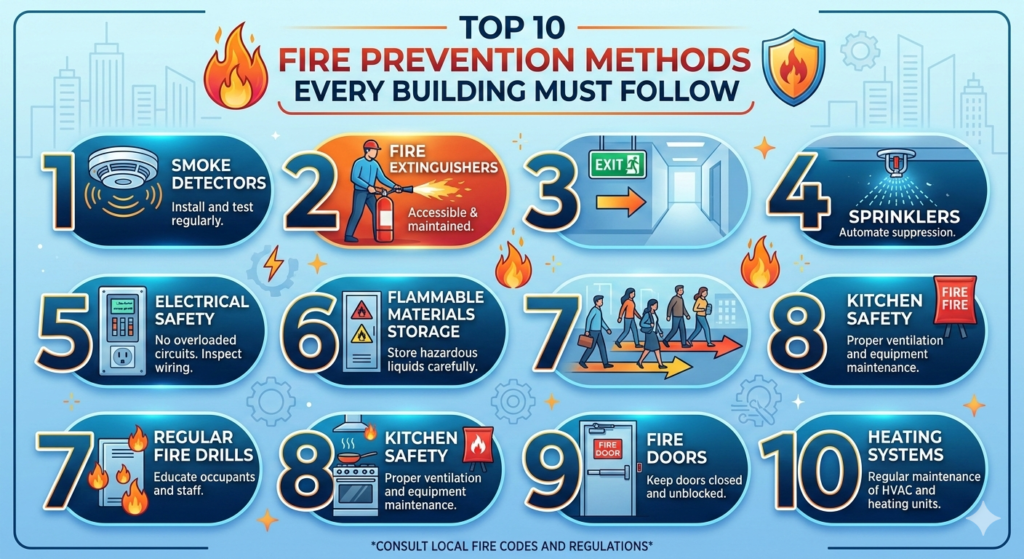
In this comprehensive guide, we walk you through the top 10 fire prevention methods every building must follow, with a special focus on Pakistan’s regulatory environment, climate conditions, and the essential fire safety equipment required to stay compliant and keep people safe.
1. Install and Maintain Proper Fire Safety Equipment
Fire Safety Trading (Pvt)
ToggleThe foundation of any fire prevention strategy is having the right fire safety equipment in place. This is not optional, it is a legal requirement under Pakistan’s building codes and fire safety regulations enforced by local government bodies and the NFPA standards adopted across many Pakistani cities and industrial zones.
Essential fire safety equipment every building needs includes:
- Fire extinguishers (ABC type, CO2, foam, water-based depending on fire class)
- Fire alarm systems with interconnected smoke and heat detectors
- Automatic sprinkler systems for commercial and industrial buildings
- Fire hose reels and wet/dry riser hydrant systems
- Emergency exit signs with battery-backed illumination
- Fire suppression systems for server rooms, generator rooms, and kitchens
- Fire blankets for kitchen and laboratory environments
- Personal protective equipment (PPE) for fire wardens and emergency response teams
For buildings across Pakistan looking to source high-quality, certified fire safety equipment, choosing a trusted local supplier is essential. You can explore a comprehensive range of fire fighting equipment and fire safety products in Pakistan to find everything from portable fire extinguishers to complete automatic sprinkler systems suitable for commercial, industrial, and residential buildings across all major cities.
2. Conduct Regular Fire Risk Assessments
A fire risk assessment is a systematic, documented review of your building to identify potential fire hazards, evaluate who is at risk, and determine what measures are needed to eliminate or reduce those risks. In Pakistan, fire risk assessments are increasingly mandated for commercial buildings, hospitals, schools, factories, and any building that accommodates a large number of occupants.
A thorough fire risk assessment covers the identification of ignition sources such as electrical equipment, gas appliances, and open flames; assessment of fuel sources including paper, textiles, chemicals, and wood stored throughout the building; evaluation of oxygen sources that could accelerate fire spread; identification of people at risk, especially those with disabilities or limited mobility; and documentation of all findings with a clear action plan and timeline for corrective measures.
In Pakistan’s hot and dry climate, particularly in cities like Multan, Hyderabad, Rahim Yar Khan, and Quetta, the risk of fire escalates significantly during summer months. Temperatures exceeding 45 degrees Celsius can cause electrical equipment to overheat, and the extremely dry conditions make building materials, textiles, and stored goods far more flammable than in cooler, humid climates. This makes regular seasonal fire risk assessments a critical necessity. Buildings should conduct formal fire risk assessments at least once a year, and immediately following any significant changes to the building layout, occupancy, or operational activities.
3. Establish a Comprehensive Fire Evacuation Plan
Having fire safety equipment installed is only half the battle people must know exactly how to evacuate safely and quickly when a fire breaks out. A well-designed, regularly practiced fire evacuation plan can mean the difference between life and death. Every building in Pakistan, regardless of its size or purpose, must have a clearly documented fire evacuation plan that is communicated to all occupants.
A complete fire evacuation plan must include clearly marked evacuation routes on floor plans posted throughout the building at eye level; designated assembly points located at a safe distance from the building and away from access roads; appointed fire wardens or marshals for each floor or building section who are responsible for guiding occupants to safety and conducting roll calls at the assembly point; specific procedures for safely evacuating people with disabilities, elderly occupants, and children; a clear process for accounting for all occupants once evacuated and for communicating with emergency services; and documented roles and responsibilities for each designated fire safety officer.
In the rapidly growing multi story buildings that now define the skylines of Karachi, Lahore, and Islamabad, the evacuation plan must explicitly address the prohibition of elevator use during fire emergencies and provide detailed guidance on managing large numbers of people exiting simultaneously via stairwells. Fire drills simulating realistic emergency conditions should be conducted at least twice a year, with debrief sessions afterwards to identify and address any weaknesses in the plan.
4. Ensure Proper Electrical Safety and Maintenance
Electrical faults are among the leading causes of building fires in Pakistan. Faulty wiring, overloaded circuits, substandard electrical components, and improper DIY electrical installations account for a very significant percentage of all fire incidents reported across Pakistani urban and industrial areas every year. Preventing electrical fires requires both correct initial installation and rigorous ongoing maintenance.
Essential electrical safety measures include ensuring all electrical work is performed exclusively by licensed electricians following Pakistan’s Electrical Safety Standards; never overloading electrical sockets, power strips, or extension cords beyond their rated capacity; replacing outdated or damaged wiring, plugs, and electrical fittings immediately upon identification; installing residual current devices (RCDs) and properly rated circuit breakers to prevent overcurrent and short circuit situations; scheduling annual electrical inspections and thermographic surveys by certified electrical engineers; and ensuring all electrical panels, distribution boards, and switchgear are properly housed in fire-resistant enclosures.
The extensive stock of older buildings in cities like Lahore’s historic areas, Karachi’s commercial and industrial districts, and the older residential colonies across Pakistan frequently suffer from severely outdated electrical infrastructure that was not designed to handle modern electrical loads. Upgrading wiring, distribution boards, and electrical panels in such buildings is an urgent fire prevention investment. The relatively modest cost of electrical upgrades is negligible compared to the catastrophic human and financial consequences of a major electrical fire.
5. Install and Regularly Test Smoke Detectors and Fire Alarm Systems
Early warning is the single most critical factor in surviving a building fire. Smoke detectors and fire alarm systems provide those essential extra minutes that allow occupants to evacuate before a fire grows beyond control. Research and fire incident data consistently demonstrate that buildings equipped with properly functioning smoke detection and fire alarm systems have dramatically lower fire fatality rates than those without.
Every building in Pakistan should install interconnected smoke detectors in all rooms, hallways, and common areas; heat detectors in kitchens, boiler rooms, and generator areas where smoke detectors may produce nuisance false alarms; manually operated call points, known as break glass units, at every exit and along all escape routes; a central fire alarm control panel connected to all detection and signaling devices; and audible alarm sounders combined with visual strobe alarm signals to ensure all occupants are warned, including those with hearing impairments.
Fire alarm systems must be tested weekly, functionally tested monthly, and comprehensively serviced by a certified fire alarm engineer at least once per year. Batteries in standalone battery-operated smoke detectors must be replaced annually as a minimum. In Pakistan’s large commercial buildings, hospitals, shopping malls, and factories particularly in the industrial heartlands of Faisalabad, Sialkot, Gujranwala, and Karachi’s SITE area addressable intelligent fire alarm systems that can precisely identify the exact location of any triggered detector are strongly recommended as they significantly reduce emergency response times.
6. Properly Store and Handle Flammable and Hazardous Materials
Industrial facilities, warehouses, chemical plants, paint shops, laboratories, and even commercial kitchens across Pakistan routinely handle and store flammable and hazardous materials. Improper storage or careless handling of these materials represents one of the highest fire risks in any building, and can lead to explosions and rapidly accelerating fires that overwhelm even the best fire safety equipment.
Safe practices for flammable and hazardous material management include storing all flammable liquids exclusively in approved, correctly labelled, sealed containers in purpose built, well ventilated storage rooms separated from ignition sources and the main building by fire-rated walls; keeping quantities of flammable materials in the work area to the absolute minimum needed for current operations; ensuring all flammable material storage areas are equipped with appropriate fire suppression systems and compatible fire safety equipment (foam or CO2 extinguishers, never water); providing comprehensive training to all staff on safe handling, use, spill response, and disposal procedures; maintaining fully updated Material Safety Data Sheets for every hazardous substance on site; and posting prominent, clearly legible warning signs in all areas where flammable materials are stored or used.
Pakistan’s enormous textile industry the backbone of the national economy operates thousands of factories in Faisalabad, Karachi, and Lahore that deal daily with highly flammable raw cotton, synthetic fibres, finishing chemicals, and dyes. Pakistan has suffered numerous devastating factory fires in recent decades, many directly attributable to improper storage of such materials. These tragedies have cost thousands of lives and billions of rupees in economic losses, reinforcing in the most tragic terms the absolute critical importance of proper flammable material storage and management.
7. Maintain Clear and Unobstructed Emergency Exits
Emergency exits are the lifelines of any building during a fire but only when they are genuinely accessible, clearly marked, and permanently free from obstruction. One of the most heartbreaking and consistently repeated findings in fire incident investigations across Pakistan is that emergency exits were blocked, padlocked, poorly marked, or simply non-existent, directly preventing occupants from reaching safety. This is an entirely preventable failure that building owners and managers have both a legal duty and a moral obligation to eliminate.
Every building must ensure all emergency exits are clearly identified with continuously illuminated exit signs powered by an emergency backup power supply; all fire exit doors are designed to open outward in the direction of travel and must never be locked, chained, or blocked during any period of building occupancy; all escape routes and exit corridors are maintained completely free from obstruction at all times, with zero tolerance for stored goods, furniture, vehicles, or any other items blocking the path; emergency lighting along all escape routes and in stairwells is tested monthly and fully serviced annually; fire exit doors in public and commercial buildings are fitted with push-bar panic hardware that allows immediate opening under stress without any prior knowledge of the mechanism; and escape route widths meet the minimum requirements established for the building’s maximum occupancy capacity.
8. Implement a Strict No-Smoking Policy and Control Open Flames
Careless disposal of cigarettes and uncontrolled open flames remain among the most preventable and yet most common ignition sources for building fires globally, and Pakistan is no exception. Implementing and rigorously enforcing no-smoking and open flame control policies is one of the simplest yet most effective fire prevention measures any building can take.
Effective fire prevention policies for smoking and open flames include establishing clearly designated outdoor smoking areas located well away from building entrances, ventilation intakes, and flammable storage areas, equipped with proper non-combustible butt disposal receptacles; posting highly visible, mandatory no-smoking signs throughout all indoor areas and near flammable material storage; enforcing strict no-candle and no-incense policies in offices, commercial premises, hospitals, and hotels; implementing a formal hot work permit system for any activity involving welding, cutting, grinding, or other spark-generating work, requiring prior risk assessment, fire watch during the work, and post-completion monitoring; and providing clear staff briefings on the correct and safe use of gas appliances, portable heaters, and kitchen cooking equipment.
During the holy month of Ramadan, when the use of candles, incense (agarbatti), and decorative fairy lights increases significantly across homes and businesses throughout Pakistan, building managers should proactively communicate specific guidance on safe practices that respect and honour cultural and religious traditions while meaningfully reducing fire risk during this heightened-risk period.
9. Provide Regular, Practical Fire Safety Training
The most sophisticated and comprehensive fire safety equipment installation in the world will only reach its full life-saving potential when the people in the building know how to use it correctly and confidently. Regular, hands-on fire safety training is an absolutely essential component of any genuinely effective fire prevention strategy. In Pakistan, where formal mandatory fire safety training requirements across many sectors are still being developed and strengthened, forward-thinking organisations are already investing significantly in fire safety education and achieving measurably better safety outcomes as a result.
A comprehensive fire safety training programme should cover how to raise the alarm immediately upon discovering a fire; how to correctly select and operate different types of fire safety equipment, with specific hands-on practice in using fire extinguishers on the correct fire class; complete evacuation procedures including the location of all emergency exits and assembly points; techniques for safely assisting vulnerable, elderly, disabled, or mobility-impaired occupants during evacuation; basic first aid for burn injuries, smoke inhalation, and shock; and the critical things that occupants should never do during a fire including going back for personal belongings, using elevators, or opening doors without checking for heat first.
Fire safety training should be provided to every new staff member or occupant during their initial induction and comprehensively refreshed at least once per year for all existing occupants. Practical, live demonstration training sessions where participants physically practice operating fire extinguishers on controlled training fires are proven to be dramatically more effective in building genuine confidence and competence than theoretical classroom instruction alone. Many reputable fire safety equipment suppliers and distributors in Pakistan offer professional fire safety training services as part of a comprehensive fire safety package, making it highly convenient and cost-effective for building managers to arrange training alongside equipment procurement and maintenance.
10. Comply with Pakistan’s Fire Safety Regulations and Building Codes
Compliance with Pakistan’s applicable fire safety regulations and building codes is simultaneously a legal obligation and a fundamental ethical responsibility to everyone who occupies, works in, or visits your building. Pakistan’s fire safety regulatory framework is administered through a combination of provincial building codes, municipal by-laws, and national standards that increasingly draw on international fire safety best practices from organisations like the NFPA, British Standards Institution, and the International Building Code.
Core regulatory compliance requirements for buildings across Pakistan include obtaining a valid Fire Safety No Objection Certificate (NOC) from the relevant provincial or city fire department before occupation of any new commercial, industrial, or multi-storey residential building; ensuring the building design, construction, and fit-out fully meets the applicable minimum fire safety standards for structural fire resistance, fire compartmentalization, and evacuation route specifications; installing and maintaining all categories of fire safety equipment as specified and required by the relevant authority for the building’s use class and occupancy load; maintaining detailed, up-to-date records of all fire safety inspections, equipment tests, maintenance activities, and training sessions; and welcoming and fully facilitating periodic fire safety inspections by the relevant regulatory authorities.
In Pakistan, regulatory bodies including the Sindh Building Control Authority (SBCA) in Karachi, the Lahore Development Authority (LDA), the Capital Development Authority (CDA) in Islamabad, the Peshawar Development Authority (PDA), and equivalent bodies across other provinces all have specific fire safety requirements that must be met before any commercial building can legally operate. Non-compliance exposes building owners and managers to significant fines, closure orders, insurance claim rejections, and in cases involving fire-related injuries or fatalities, serious criminal liability. Beyond the legal dimension, achieving and exceeding fire safety compliance standards is a clear and powerful demonstration of a genuine, values-based commitment to the safety, welfare, and dignity of everyone who enters your building.
Building a Fire Safety Culture Across Pakistan
Beyond the ten technical fire prevention measures detailed in this guide, perhaps the single most powerful and sustainable fire prevention tool is the deliberate cultivation of a genuine, organisation-wide culture of fire safety awareness. In Pakistan where public awareness of fire safety risks and prevention measures has historically lagged behind many comparable developing nations there exists a tremendous opportunity for building owners, facility managers, corporate leaders, educational institutions, and community organisations to collectively lead a meaningful improvement in national fire safety standards.
Building a genuine fire safety culture requires appointing a respected, empowered fire safety officer with sufficient authority and resources to champion fire safety at every level of the organisation; integrating fire safety as a standing, substantive agenda item in regular management and team meetings; publicly celebrating fire safety achievements and formally recognising individuals and teams who demonstrate exemplary fire safety practices; sharing relevant fire safety information, case studies, and learnings through internal communications channels; and proactively engaging all tenants, residents, and staff in the collaborative process of identifying and addressing fire hazards in their immediate environment.
A truly embedded fire safety culture transforms fire prevention from a compliance activity managed by a small number of designated individuals into a shared organisational value that every person takes active personal responsibility for. When every single occupant of a building genuinely understands both the very real risks of fire and their own meaningful role in preventing it, the entire building becomes exponentially safer — not just for the people inside, but for the surrounding community as well.
Conclusion: Invest in Fire Safety Equipment and Prevention Now
Fire prevention is not a one-time project or an annual compliance exercise, it is a permanent, ongoing commitment that requires consistent attention, regular investment, and decisive action. By systematically implementing all ten of the fire prevention methods outlined in this guide, every building in Pakistan from the smallest retail shop to the largest industrial complex can meaningfully reduce its fire risk and genuinely protect the lives of everyone inside.
The essential starting point for any fire prevention strategy is ensuring you have the right fire safety equipment correctly installed and properly maintained throughout your building. From portable fire extinguishers and interconnected smoke detector systems to automatic sprinkler installations and emergency escape lighting, having certified, high-quality fire safety equipment from a trusted supplier is the non-negotiable foundation upon which all other fire prevention measures are built.
For buildings across Pakistan whether in Karachi’s commercial districts, Lahore’s industrial zones, Islamabad’s administrative offices, Faisalabad’s textile factories, or anywhere else in the country sourcing certified, reliable fire safety equipment from a trusted Pakistani supplier is the essential first step. Explore a full range of fire fighting equipment and comprehensive fire safety solutions for Pakistan to equip your building with everything it needs to prevent fires and protect lives.
The cost of investing in proper fire safety equipment and implementing the ten prevention methods in this guide is, without exception, far less than the devastating human cost of lives lost, injuries suffered, and the enormous financial cost of property destroyed by preventable fires. Do not wait for a tragedy to take action. Invest in fire safety today and ensure that your building is a place where people can live, work, and thrive in genuine safety.