
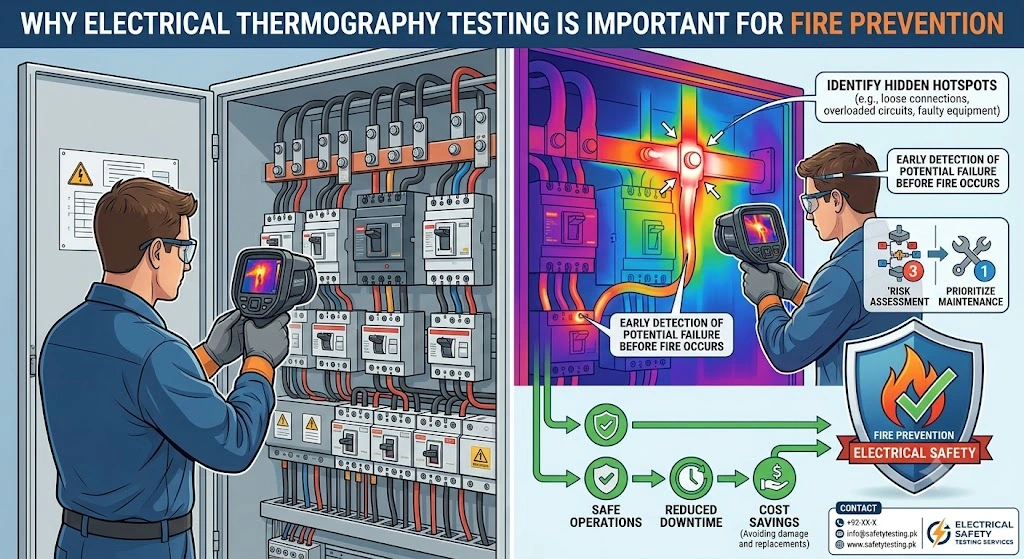
Electrical fires rarely start with a bang. They start quietly, inside a wall, behind a distribution panel, or at the back of a switchboard, where a loose connection has been heating up for weeks without anyone noticing. By the time smoke or sparks appear, the damage is often already done. This is exactly the gap that electrical thermography testing is designed to close. Using infrared cameras, trained technicians can see heat that the human eye cannot, catching dangerous faults long before they turn into a fire.
In Pakistan, where voltage fluctuations, overloaded circuits, and ageing wiring are common in homes, factories, offices, and commercial buildings, this kind of early detection is not a luxury. It is a practical safety measure that saves lives, protects property, and keeps businesses running without unexpected shutdowns. Whether the concern is a single office building in Islamabad or a multi-unit industrial complex in Karachi, the underlying principle is the same: heat that should not be there is a warning, and finding it early is far cheaper and far safer than dealing with the aftermath of an electrical fire. This guide explains what electrical thermography testing actually involves, why it matters so much for fire prevention, and how often it should be carried out.
What Is Electrical Thermography Testing?
Fire Safety Trading (Pvt)
ToggleElectrical thermography testing, also called thermal imaging inspection, is a non-invasive method of checking electrical systems while they are still running. A technician uses a specialised infrared camera to scan wiring, panels, breakers, transformers, motors, and other electrical components. The camera converts heat patterns into a colour-coded image, known as a thermogram, where warmer areas appear in shades of red, orange, and yellow, and cooler areas appear in blue, green, or black.
Under normal conditions, electrical components carrying current will show a fairly even and predictable heat pattern. When something is wrong, such as a loose terminal, a corroded connection, or an overloaded circuit, resistance increases at that point, and the component heats up far more than it should. This unusual hot spot is exactly what the thermal camera picks up, often long before the fault becomes visible, audible, or produces a smell of burning insulation.
Because the inspection is done without switching off the power or opening up equipment, it does not interrupt daily operations. This makes it an efficient way to check large electrical systems in factories, offices, and commercial buildings without causing downtime.
How Electrical Fires Start in Pakistani Buildings and Facilities
Most electrical fires do not happen because equipment suddenly fails. They happen because a small problem is left unaddressed for a long time. A few common causes are especially relevant in Pakistan, where electrical infrastructure is often under more strain than it was originally designed for.
Loose or Corroded Connections
Screw terminals loosen over time due to vibration, thermal expansion, and general wear. Humidity and dust, common across much of Pakistan, speed up corrosion at these joints. A loose connection has higher resistance, which means it generates more heat every time current passes through it.
Overloaded Circuits
As homes and businesses add more appliances, air conditioners, and machinery without upgrading the original wiring, circuits are pushed beyond their safe capacity. Overloaded wires and breakers run hotter than they should, increasing fire risk.
Voltage Fluctuations and Load Shedding
Frequent voltage fluctuations and the repeated stopping and starting of power supply during load shedding put extra stress on electrical components. Equipment that switches on and off repeatedly experiences more thermal cycling, which can loosen connections faster than in a stable power environment.
Ageing Wiring and Equipment
Many buildings across Karachi, Lahore, Islamabad, Rawalpindi, Peshawar, and other cities are still running on wiring and panels installed decades ago. Insulation degrades with age and heat exposure, and old equipment was often not built for today’s higher electrical loads.
How Thermal Imaging Detects Hidden Electrical Faults
The real value of thermography lies in what it reveals that a visual inspection cannot. A technician looking at a panel with the naked eye sees wires, terminals, and breakers that all look perfectly normal. There is no way to tell, just by looking, that one terminal is running at 90 degrees Celsius while everything around it is at 35 degrees. An infrared camera makes that invisible difference immediately obvious.
During a scan, the equipment is kept under its normal working load, since heat patterns only become meaningful when current is actually flowing. The technician moves the camera systematically across panels, busbars, cable joints, switches, transformers, and motor terminals, comparing the temperature of each point to similar components nearby. A single point that is significantly hotter than its neighbours is flagged as a potential fault and investigated further.
This comparative approach is what makes thermal imaging so reliable. Rather than relying on a fixed temperature limit, technicians look at relative temperature differences across a system, which accounts for normal variation in ambient conditions, load, and component type.
Common Electrical Faults Found During Thermography Testing
A professional thermography inspection typically uncovers a fairly consistent set of problems, whether the site is a factory, an office building, or a residential complex.
Loose Terminal Connections
The single most common finding. A screw that has worked itself loose over months of vibration and thermal cycling creates a hot spot that grows worse the longer it goes unnoticed.
Overloaded Circuits and Breakers
When a breaker or cable is carrying more current than it was rated for, it runs consistently warmer across its whole length rather than at a single point, signalling a load problem rather than a connection problem.
Phase Imbalance
In three-phase systems, if one phase is carrying significantly more load than the others, that phase will run noticeably hotter. This imbalance reduces equipment efficiency and shortens the lifespan of motors and transformers.
Damaged or Degraded Insulation
Insulation that has cracked, dried out, or been exposed to excess heat loses its ability to contain current safely, and this often shows up as an irregular heat pattern along a cable run.
Faulty Circuit Breakers and Switches
Internal wear inside a breaker or switch can cause it to run hot even under normal load, which is a strong indicator that the component is close to failure.
Why Electrical Thermography Testing Matters for Fire Prevention in Pakistan
Pakistan’s climate and power supply conditions make electrical systems work harder than they might elsewhere. Long, hot summers push air conditioning and cooling loads to their peak for months at a time, and dust, humidity, and frequent voltage fluctuation all add extra stress on wiring and connections. Add to this the fact that many commercial and industrial buildings were wired years before their current level of electrical demand, and the conditions for a slow-building electrical fault are common rather than rare.
Regular thermography testing addresses this in a very direct way. It finds problems while they are still small and inexpensive to fix, rather than after they have caused a fire, an outage, or expensive equipment damage. For factories and warehouses, this can mean the difference between a planned five-minute repair and an unplanned shutdown that halts production for days.
Insurance providers and fire safety auditors in Pakistan are also increasingly asking for documented thermal inspection reports as part of compliance checks, particularly for commercial, industrial, and high-occupancy buildings. Having a thermography report on file is becoming a practical requirement, not just a good practice.
There is also a human safety dimension that is easy to overlook when discussing property and equipment. Electrical fires in occupied buildings, whether a hospital, a school, a hotel, or a crowded market, put people at direct risk in a way that few other maintenance failures do. Smoke inhalation and rapid fire spread are common causes of injury and loss of life in building fires, and many of these incidents trace back to an electrical fault that had been quietly building for a long time. Thermography testing is one of the few preventive measures that can be scheduled, budgeted, and repeated on a routine basis, rather than something that only gets attention after an incident has already occurred.
Facilities anywhere in Pakistan that want a clear, documented picture of their electrical system’s condition can arrange a professional electrical thermography test to identify hidden risks before they turn into fire hazards or costly breakdowns.
Electrical Thermography Testing vs Traditional Visual Inspection
Many building owners assume that a routine electrical inspection, where a technician visually checks panels, wiring, and connections, is enough to catch problems early. In reality, a visual inspection only catches faults that have already progressed far enough to show a physical sign, such as scorch marks, discolouration, or a burning smell. By the time these signs appear, the connection has often been overheating for weeks or months, and the risk of fire is already significant.
Thermal imaging catches the same faults at a much earlier stage, while the equipment is still functioning normally and shows no visible damage at all. This is the key difference: a visual inspection tells you what has already gone wrong, while a thermography inspection tells you what is starting to go wrong. Used together, the two methods complement each other well, but for genuine fire prevention, thermal imaging is the tool that actually gets ahead of the problem rather than reacting to it.
Another practical advantage is speed. A thermographer can scan an entire distribution panel in the time it would take to visually inspect a handful of individual connections, which makes it far more practical for large sites with hundreds of connection points, such as factories, malls, and multi-storey commercial buildings.
Warning Signs That a Building Needs an Urgent Thermography Inspection
While thermography testing is meant to catch faults before they show any physical symptoms, certain warning signs mean an inspection should not wait for the next scheduled interval. If any of the following are noticed, it is worth arranging a scan as soon as possible.
- A persistent burning smell near an electrical panel, outlet, or switch, even a faint one.
- Switches, sockets, or breaker panels that feel warm to the touch.
- Lights that flicker or dim without an obvious cause, particularly if it happens repeatedly in the same area.
- Circuit breakers that trip more often than usual, especially without a clear change in load.
- Discolouration, scorch marks, or a slightly melted look around outlets or switch plates.
- A buzzing or crackling sound coming from a panel, switch, or outlet.
- Recent additions of heavy equipment, machinery, or air conditioning units without a corresponding electrical upgrade.
None of these signs should be ignored, and if more than one appears at the same time, the building should be treated as a priority for immediate inspection rather than waiting for the next routine check.
Industries and Facilities That Need Regular Thermography Testing
While every building with an electrical system can benefit from thermal inspection, some environments carry a higher risk and should test more frequently.
Factories and Manufacturing Units
Heavy machinery, motors, and continuous production loads mean electrical components in factories run hot for long hours every day, making them especially prone to connection failures.
Warehouses and Storage Facilities
Warehouses often store flammable materials near electrical panels and lighting circuits, so even a small hot spot carries outsized fire risk.
Offices and Commercial Buildings
Server rooms, HVAC systems, and dense electrical panels in office buildings can develop faults that go unnoticed for months in areas with low foot traffic.
Hospitals and Healthcare Facilities
Continuous power for life-support and medical equipment makes early fault detection critical, since even a brief outage can be dangerous.
Shopping Malls and Retail Complexes
High occupancy combined with heavy lighting and cooling loads makes malls a priority for regular thermal scanning.
Hotels
Guests staying on-site around the clock raise the stakes of any undetected electrical fault, making routine thermography an important part of hotel safety programmes.
Schools and Educational Institutions
Older wiring combined with large numbers of people on site makes early fault detection especially valuable in schools.
Residential Apartment Complexes
Shared electrical infrastructure serving many households means a single undetected fault can put an entire building at risk.
How Often Should Electrical Thermography Testing Be Done?
There is no single answer that fits every building, since the right frequency depends on how the electrical system is used and how much strain it is under.
- Industrial and manufacturing facilities: every 6 to 12 months, given continuous heavy loads.
- Commercial buildings, offices, and malls: annually, or every 6 months for older buildings.
- Hospitals and critical facilities: every 6 months, due to the importance of uninterrupted power.
- Residential complexes and smaller commercial units: once a year is generally sufficient.
- After any major electrical upgrade, new equipment installation, or a power surge event: an additional inspection is recommended regardless of the regular schedule.
Buildings that have not had any electrical inspection in several years should schedule an initial thermography test as soon as possible to establish a baseline, even outside these general intervals.
What Happens During a Professional Thermography Inspection
A typical inspection follows a clear, methodical process designed to cover every part of the electrical system without disrupting daily operations.
1. Pre-Inspection Planning
The technician reviews the building’s electrical layout, identifies panels, distribution boards, and equipment to be scanned, and confirms that systems will be under normal operating load during the visit.
2. Live Thermal Scanning
Using an infrared camera, the technician scans panels, busbars, cable terminations, switches, transformers, and motors while the system is running, capturing thermal images of each point.
3. Comparative Analysis
Each hot spot is compared against similar components under similar load to determine whether the temperature difference is a genuine fault or normal variation.
4. Documentation and Reporting
Findings are compiled into a report with thermal images, temperature readings, and a severity rating for each identified issue, along with recommended next steps.
5. Follow-Up Recommendations
Critical faults are flagged for immediate repair, while lower-priority issues are noted for the next scheduled maintenance window.
Factors That Affect the Cost and Duration of a Thermography Inspection
Facility managers often ask what determines the price and length of a thermography inspection before booking one. While every provider prices differently, a few factors consistently influence both cost and time on site.
- Size of the facility: a single-storey office and a multi-building industrial complex naturally require very different amounts of scanning time.
- Number of electrical panels and distribution boards: more panels mean more points to scan and document.
- Accessibility of equipment: panels in tight, cluttered, or hard-to-reach spaces take longer to inspect safely.
- Type of equipment: motors, transformers, and specialised machinery may require additional scanning angles compared to a standard distribution panel.
- Level of detail in reporting: a basic pass/fail summary is quicker to produce than a full report with thermal images and severity grading for every finding.
As a general guide, smaller offices or shops can often be scanned in a couple of hours, while a mid-sized factory may take a full working day, and large industrial complexes with multiple buildings may require more than one visit. Getting a clear scope of work agreed in advance, including which panels and equipment will be covered, helps avoid surprises on cost or turnaround time.
Benefits Beyond Fire Prevention
While fire prevention is the most important reason to carry out thermography testing, it is far from the only benefit.
- Reduced downtime: catching a loose connection during a routine scan avoids the much longer shutdown caused by an equipment failure or fire.
- Lower repair costs: fixing a small connection issue costs a fraction of replacing burnt-out equipment or repairing fire damage.
- Extended equipment lifespan: components running at correct temperatures last longer and perform more reliably.
- Energy efficiency: overheating connections waste energy, so resolving them can lower electricity costs.
- Insurance and compliance support: a documented thermal inspection report is useful evidence of due diligence for insurers and safety auditors.
Choosing the Right Thermography Testing Service in Pakistan
The quality of a thermography inspection depends heavily on the equipment and experience of the technician carrying it out. When selecting a provider, look for a few key things.
- Certified thermographers with proper training in interpreting thermal images, not just operating a camera.
- Industrial-grade infrared cameras with sufficient resolution and temperature accuracy for the type of equipment being tested.
- Detailed written reports with thermal images and clear severity ratings, not just a verbal summary.
- Experience across the specific type of facility being inspected, whether that is a factory, hospital, or commercial building.
- A track record of working with fire safety standards relevant to Pakistan, and the ability to serve sites across different cities.
It is also worth asking a prospective provider how they handle borderline findings, cases where a hot spot is present but not yet severe. A good thermographer will grade findings by urgency rather than treating every warm spot as an emergency, which helps facility managers prioritise repairs sensibly instead of being overwhelmed by a long list of flagged items. Providers who can also advise on the corrective repair, or coordinate with an electrician to fix critical faults quickly, add real value beyond the inspection itself.
For businesses and facility managers across Pakistan, scheduling a professional electrical thermography test is one of the most cost-effective steps available for reducing fire risk and avoiding unplanned electrical failures.
Ultimately, the goal of electrical thermography testing is not just to pass an audit or satisfy an insurance requirement, though it helps with both. It is to give building owners and facility managers a genuine, evidence-based understanding of the condition of their electrical system, so that decisions about repairs and upgrades are based on real data rather than guesswork or waiting for something to visibly go wrong.
Conclusion
Electrical fires are almost always preventable when the warning signs are caught early, and thermal imaging is one of the most effective tools available for catching those signs. In a country where voltage fluctuation, heavy loads, and ageing infrastructure are common realities, routine electrical thermography testing gives building owners, factory managers, and facility teams a clear, evidence-based way to find hidden problems before they become fires. Regular inspection, paired with prompt repair of any flagged issues, is a simple habit that protects lives, property, and the continuity of business operations across Pakistan.
Frequently Asked Questions
- What is electrical thermography testing?
It is an inspection method that uses infrared cameras to detect abnormal heat patterns in electrical systems, helping identify loose connections, overloads, and other faults before they cause a fire.
- Is thermography testing done with the power on or off?
It is done with the power on. Thermal imaging only works when equipment is under its normal operating load, since that is when faulty connections generate visible heat.
- How long does an electrical thermography inspection take?
This depends on the size of the building and the number of panels and components, but most commercial inspections take a few hours, while larger industrial sites may take a full day.
- Can thermography testing prevent electrical fires completely?
It significantly reduces the risk by catching faults early, though it should be part of a broader fire safety programme that also includes regular maintenance and proper wiring practices.
- How often should a factory get thermography testing done?
Most factories and manufacturing units benefit from testing every 6 to 12 months, given their continuous and heavy electrical loads.
- What does a thermal image actually show?
It shows a colour-coded map of surface temperatures, with warmer areas, often red or orange, indicating points that are running hotter than they should compared to similar nearby components.
- Is electrical thermography testing expensive?
It is generally far less expensive than the cost of fire damage, equipment replacement, or unplanned downtime that can result from an undetected fault.
- Who should carry out a thermography inspection?
A certified thermographer with proper training in electrical systems and infrared image interpretation, using industrial-grade equipment suited to the site being inspected.
- Do residential buildings need thermography testing too?
Yes, particularly apartment complexes with shared electrical infrastructure, where a single undetected fault can affect many households.
- What happens after a fault is found during testing?
The technician documents it in a report with a severity rating, and critical issues are flagged for immediate repair, while lower-priority findings are scheduled for the next maintenance cycle.