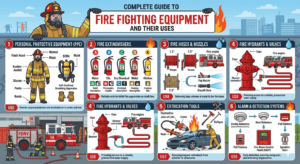
Complete Guide to Fire Fighting Equipment and Their Uses

Fire is one of the most devastating hazards that can strike homes, factories, commercial buildings, and industrial facilities across Pakistan. Fire incidents in Karachi, Lahore, Islamabad, Faisalabad, and other major cities have caused significant loss of life and property in recent years many of which could have been prevented with proper fire fighting equipment in place.

Whether you manage a textile mill in Faisalabad, a high-rise in Karachi, or a hospital in Rawalpindi, having the right fire protection systems is not just a legal requirement it is a moral responsibility. This comprehensive guide covers all major types of fire fighting equipment, how they work, where they are used in Pakistan, and why investing in quality fire safety products from a trusted supplier like Fire Safety Trading (Pvt) Ltd is essential for every establishment across the country.

Why Fire Fighting Equipment is Essential in Pakistan

Pakistan faces unique fire safety challenges due to rapid urbanisation, aging electrical infrastructure, and limited enforcement of safety codes in many regions. Industrial zones in Faisalabad, Sialkot, and Karachi frequently report fire incidents, while residential fires remain a persistent concern in densely populated urban areas.

Investing in the right fire fighting equipment provides multiple critical benefits:

  • Saves human lives by enabling a quick response before fire services arrive
  • Minimises property and asset damage in the critical first minutes of a fire
  • Helps businesses comply with NFPA, OSHA, and local municipal safety regulations
  • Protects business continuity and prevents costly downtime following a fire incident
  • Can significantly reduce insurance premiums for commercial and industrial properties
  • Demonstrates corporate responsibility and duty of care toward employees and visitors

Understanding the different categories of fire fighting equipment is the essential first step toward building an effective and compliant fire safety strategy for any facility in Pakistan.

Understanding Fire Classes

Before selecting fire fighting equipment, it is crucial to understand fire classes, as different types of fire require different suppression agents and approaches. Using the wrong extinguisher on a fire can be ineffective and even dangerous.

  • Class A: Fires involving solid materials such as wood, paper, and fabric common in homes, offices, and warehouses
  • Class B: Fires from flammable liquids like petrol, diesel, and paint typically found in garages and industrial sites
  • Class C: Fires involving electrical equipment and wiring a major risk in factories, offices, and data centres
  • Class D: Fires from combustible metals relevant in chemical manufacturing and metalworking industries
  • Class F/K: Cooking oil and fat fires a critical risk in restaurants, hotels, and commercial kitchens

Proper training alongside the right equipment is equally important. Every facility in Pakistan should ensure staff are trained to identify fire types and use the appropriate fire fighting equipment effectively.

1. Fire Extinguishers The First Line of Defence

Fire extinguishers are the most widely recognised and essential piece of fire fighting equipment in Pakistan. Required by law in nearly every commercial, industrial, and multi-storey residential building, a portable fire extinguisher enables an individual to tackle a small fire before it grows into a major disaster. Choosing the right type for your specific risk is critical.

DCP (Dry Chemical Powder) Fire Extinguishers

DCP extinguishers are the most commonly used type across Pakistan. They are effective against Class A, B, and C fires, making them highly versatile for general workplace and industrial use. NAFFCO and China-manufactured DCP extinguishers are widely available through trusted suppliers. They work by interrupting the chemical chain reaction that sustains fire, quickly knocking down flames.

CO2 (Carbon Dioxide) Fire Extinguishers

CO2 extinguishers are ideal for electrical fires and environments with sensitive electronic equipment such as server rooms, data centres, and offices. They leave no residue, making them perfect for locations where equipment damage from fire-fighting agent must be minimised. NAFFCO CO2 extinguishers are widely specified by Pakistan’s corporate sector.

AFFF (Aqueous Film-Forming Foam) Fire Extinguishers

AFFF foam extinguishers are designed for Class A and B fires, particularly involving flammable liquids. They create a foam blanket over the burning surface, cutting off the oxygen supply and preventing re-ignition. They are commonly used at petrol stations, fuel storage facilities, and airports throughout Pakistan.

Wet Chemical Fire Extinguishers

Wet chemical extinguishers are specifically designed for Class F kitchen fires involving cooking oils and fats. They are mandatory in commercial kitchens, restaurants, hotels, and canteens. The agent reacts with hot cooking oil to form a soap-like layer that cools the oil and seals the surface, preventing dangerous re-ignition.

Halotron Fire Extinguishers

Halotron extinguishers are a clean-agent alternative effective on Class B and C fires. They are used in aircraft hangars, telecommunications facilities, and computer rooms where residue from other agents would cause significant damage to sensitive equipment.

Automatic Fire Extinguishers

Automatic fire extinguishers activate without human intervention when they detect a heat threshold. They are increasingly popular in Pakistan’s industrial sector for protecting generator rooms, electrical panels, server cabinets, and vehicle engine compartments where continuous human monitoring is not possible.

Fire Ball Extinguishers

An innovative product gaining popularity across Pakistan, fire extinguisher balls can be thrown into a fire or mounted in fire-prone areas for passive protection. Products such as the AFO Fire Extinguisher Ball, Elide Fire Ball, and Aqua Fire Ball automatically activate on contact with flames, making them ideal for homes, small offices, and unmanned spaces.

2. Fire Alarm Systems Detect Before Disaster Strikes

A fire alarm system is the backbone of any fire safety plan. It provides the earliest possible warning of a fire, giving occupants precious time to evacuate safely and enabling a rapid fire fighting response to begin before the fire spreads. In Pakistan, fire alarm systems are required in hospitals, schools, shopping malls, hotels, factories, and all multi-storey buildings.

Conventional Fire Alarm Systems

Conventional systems divide a building into zones, with all detectors in a zone connected to the same circuit. When a detector activates, the control panel indicates which zone is affected. Cost-effective and reliable for smaller buildings, conventional systems are widely installed across Pakistan’s mid-size commercial and industrial properties. Brands such as Honeywell Gent and C-TEC offer excellent conventional systems for the Pakistani market.

Addressable Fire Alarm Systems

Addressable systems assign a unique identification address to each individual detector and device. When any device activates, the control panel displays its exact location. This precision is critical for large buildings, hospitals, shopping centres, and industrial facilities in Pakistan where quickly identifying the fire location can save vital time. COFEM Spain and Honeywell Gent addressable systems are available through specialist suppliers.

Key Components of a Fire Alarm System

  • Optical smoke detectors: Detect particles from slow, smouldering fires using light beam interruption
  • Ionisation smoke detectors: More sensitive to fast-flaming fires
  • Heat detectors: Trigger when temperature exceeds a preset level or rises at a dangerous rate
  • Flame detectors: Detect the infrared or ultraviolet radiation from flames, used in high-risk industrial areas
  • Manual call points (break-glass units): Allow any occupant to trigger the alarm manually
  • Sounders and beacons: Provide audible and visual fire alerts throughout the building
  • Fire alarm control panels: The central intelligence of the system, monitoring all devices and coordinating responses

3. Fire Suppression Systems — Automatic Fire Control

Fire suppression systems automatically detect and extinguish fires without human intervention, providing continuous protection in high-risk environments. They are essential in Pakistan’s data centres, server rooms, generator rooms, chemical warehouses, and manufacturing facilities.

FM 200 Fire Suppression System

FM 200 (HFC-227ea) is one of the most widely installed clean-agent fire suppression systems in Pakistan. It suppresses fires within 10 seconds by chemically interrupting the combustion process, without damaging sensitive electronic equipment or leaving harmful residue. It is the standard choice for protecting data centres, telecom rooms, and control rooms across Pakistan.

CO2 Fire Suppression System

CO2 total flood suppression systems discharge carbon dioxide to displace oxygen within an enclosed space, rapidly suppressing the fire. They are effective for electrical hazards in machine rooms and printing facilities. CO2 systems require strict safety protocols as the high concentration of CO2 is dangerous to humans.

Water Mist Fire Suppression System

Water mist systems use fine water droplets at high pressure to absorb heat and displace oxygen with minimal water usage and water damage. They are increasingly used in Pakistan’s hotels, hospitals, and heritage buildings where minimising water damage is a priority alongside effective fire suppression.

Kitchen Fire Suppression System

Dedicated kitchen fire suppression systems are mandatory in commercial kitchens across Pakistan’s restaurants, hotels, and food production facilities. These systems automatically discharge a wet chemical agent over cooking appliances the moment fire is detected, suppressing the fire before it can spread throughout the kitchen.

NOVEC 1230 Fire Suppression System

NOVEC 1230 is a next-generation, environmentally friendly clean agent with zero ozone depletion potential and an ultra-low global warming potential. It provides rapid fire suppression with minimal risk to human health, making it ideal for occupied spaces and critical infrastructure across Pakistan.

Foam and Inert Gas Suppression Systems

Foam-based suppression systems are used in fuel storage areas, aircraft hangars, and flammable liquid facilities. Inert gas systems using nitrogen or argon reduce oxygen levels to suppress fires without chemical residue, suitable for archive rooms, museums, and control rooms.

4. Fire Sprinkler Systems — Proven Automatic Protection

Fire sprinkler systems are among the most proven automatic fire protection technologies available. Each sprinkler head activates independently when heat from a fire causes its heat-sensitive element to rupture, releasing water directly onto the fire. Only the heads closest to the fire activate not the entire system minimising water damage to the rest of the facility.

In Pakistan, fire sprinkler systems are increasingly specified for shopping malls, hotels, hospitals, and large warehouses. The main types include:

  • Wet pipe sprinkler systems: The most common type, with pipes permanently filled with pressurised water for immediate discharge
  • Dry pipe sprinkler systems: Pipes filled with pressurised air, suitable for cold storage facilities and unheated warehouses
  • Pre-action sprinkler systems: Require two triggers (detector and sprinkler head) before water is released, protecting sensitive areas from accidental discharge
  • Deluge sprinkler systems: All heads open simultaneously for high-hazard applications such as aircraft hangars and chemical plants

5. Fire Hydrant Systems — High-Volume Water Supply

A fire hydrant system provides a reliable, high-volume water supply for fire fighting operations, essential in large industrial complexes, commercial developments, and major public infrastructure projects across Pakistan. Key components include:

  • Pillar fire hydrants: Outdoor hydrants providing firefighter access to the mains water supply
  • Fire hose reels: Wall-mounted reels inside buildings providing immediate first-aid fire fighting capability
  • Fire hose and couplings: Flexible hoses connecting the water supply to nozzles and monitors
  • Fire hydrant valves: Including gate valves, check valves, and deluge valves to control water distribution
  • Fire fighting nozzles: Control water stream pattern and flow rate for effective fire fighting
  • Fire fighting cabinets: Protect and house hose reels, extinguishers, and emergency equipment in an accessible location
  • Firewater monitors: High-capacity water cannons for industrial fire fighting and petrochemical protection

For a comprehensive range of fire hydrant system components available in Pakistan, visit firesafetytrading.com.pk/fire-fighting/.

6. Fire Fighting Pumps — Maintaining System Pressure

Fire fighting pumps are critical for maintaining adequate water pressure and flow throughout fire protection systems, especially in multi-storey buildings and large industrial facilities across Pakistan. Without reliable pumps, sprinkler and hydrant systems cannot operate effectively when needed most.

  • EDJ Pump Sets: Combination of electric, diesel, and jockey pumps providing full redundancy and automatic failover
  • Diesel Engine Fire Pumps: Operate independently of the electrical supply, ensuring continued operation during power failures
  • EEJ Pump Systems: Dual electric pumps with jockey pump, for small to mid-size fire protection systems
  • End Suction Fire Pumps: Compact and cost-effective for light to medium fire protection applications
  • Horizontal Split Case Double Suction Pumps: High capacity pumps suitable for large buildings and industrial complexes
  • Vertical Turbine Fire Pumps: Used where the water source is an underground reservoir or below pump level

Regular testing and maintenance of fire fighting pumps is essential to ensure system reliability. Annual flow and pressure tests are recommended for all pump installations in Pakistan.

7. Fire Safety Suits and Personal Protective Equipment (PPE)

Firefighters, industrial workers, and emergency response teams who may be exposed to fire hazards require specialised personal protective equipment. In Pakistan, fire safety suits and PPE are used by industrial fire teams, factory fire brigades, petrochemical facilities, and emergency rescue services.

  • Aluminized Fire Suits Reflective suits providing protection from extreme radiant heat in foundries, steel plants, and chemical facilities. Available in Tacconi Italy and China options
  • Nomex Fire Suits Made from inherently flame-resistant Nomex aramid fibre, providing certified protection for professional firefighters
  • Fire-Resistant Suits General protection for workers in high-risk industrial environments
  • Self-Contained Breathing Apparatus (SCBA) Provides clean breathing air to firefighters in smoke-filled or oxygen-depleted environments
  • Fire Safety Helmets, Gloves, and Boots — Complete the firefighter’s personal protective ensemble

8. Fire Exit Doors — Essential Evacuation Infrastructure

Fire exit doors are a critical but frequently overlooked element of fire safety. In Pakistan, fire-rated exit doors are required in all multi-storey buildings, factories, hospitals, and public assembly areas. Fire exit doors must remain unobstructed, clearly marked with illuminated exit signs, and designed to open outward in the direction of travel.

Fire-rated doors resist fire and smoke penetration for specified periods typically 30, 60, or 90 minutes allowing safe evacuation and preventing fire from spreading between building compartments. NAFFCO fire exit doors and Pakistan-manufactured fire exit doors are both available to suit different specifications and budgets.

9. Fire Blankets — Simple, Effective Protection

A fire blanket is a simple but highly effective piece of fire fighting equipment, ideal for smothering small fires particularly in kitchens, laboratories, and workshops. Made from fire-resistant woven glass fibre material, a fire blanket is used to smother burning pans, small appliances, or to wrap around a person whose clothing has caught fire. Fire blankets are increasingly being installed in Pakistani homes, schools, and commercial kitchens as an accessible, low-cost first-response fire safety measure.

Fire Safety Compliance and Regulations in Pakistan

Fire safety in Pakistan is governed through a combination of the National Building Code of Pakistan, provincial building regulations, and internationally recognised standards such as NFPA (National Fire Protection Association) and BS (British Standards) adopted by many Pakistani industries and organisations.

Key compliance requirements across Pakistan include:

  • Mandatory fire extinguishers in all commercial, industrial, and public buildings based on occupancy and risk classification
  • Approved fire alarm systems in buildings exceeding specified floor areas or occupancy levels
  • Regular inspection, testing, and certification of all fire protection systems
  • Fire safety risk assessments and HSE audits for high-risk facilities
  • Staff fire safety awareness training and regular evacuation drills
  • Emergency lighting and clearly marked evacuation routes in all public and commercial buildings

Non-compliance with fire safety regulations in Pakistan can result in significant fines, closure orders, and in the event of a fire causing injury or death, potential criminal liability for building owners and managers.

Maintenance and Inspection of Fire Fighting Equipment

Owning fire fighting equipment is only the first step regular maintenance and inspection are essential to ensure all systems and equipment perform reliably in an emergency. Inadequately maintained equipment is as dangerous as having no protection at all.

  • Monthly visual inspection of all portable fire extinguishers for pressure, condition, and accessibility
  • Annual professional inspection and testing of fire extinguishers by a certified technician
  • Fire extinguisher refilling following any use, or on the scheduled maintenance cycle
  • Regular testing of fire alarm systems including all detectors, manual call points, and control panels
  • Annual commissioning and performance tests of fire suppression systems
  • Flow and pressure testing of fire hydrant and sprinkler systems at regular intervals
  • Scheduled inspection, testing, and maintenance of fire fighting pumps

Fire Safety Trading offers comprehensive fire extinguisher refilling, testing, fire alarm maintenance, and full fire system inspection services across Pakistan, keeping your fire protection systems compliant and ready for immediate response.

Choosing the Right Fire Fighting Equipment Supplier in Pakistan

Selecting a reputable and experienced supplier is as important as the equipment itself. When choosing a fire fighting equipment supplier in Pakistan, key criteria to evaluate include:

  • Certification and accreditation from relevant Pakistani and international authorities
  • Experience with major international brands such as NAFFCO, Honeywell, COFEM, and Reliable
  • Comprehensive after-sales support including professional installation, commissioning, testing, and maintenance
  • Capability to provide complete fire protection system design, consultancy, and risk assessment services
  • A proven track record with verified references from comparable clients across Pakistan

Fire Safety Trading (Pvt) Ltd is one of Pakistan’s most trusted and established providers of comprehensive fire safety solutions. Their extensive portfolio of fire fighting equipment spans fire extinguishers, alarm systems, suppression systems, sprinklers, hydrant systems, fire pumps, personal protective equipment, and safety signage. With a diverse client base across Pakistan’s industrial, commercial, healthcare, and government sectors, Fire Safety Trading delivers end-to-end fire protection from initial fire risk assessment through to installation, commissioning, certification, and ongoing maintenance.

Conclusion

Fire safety is a fundamental responsibility for every building owner, facility manager, and business operator across Pakistan. The right fire fighting equipment, properly selected, installed, maintained, and supported by trained personnel, can mean the critical difference between a minor controllable incident and a catastrophic, life-threatening disaster.

From portable fire extinguishers and addressable fire alarm systems to advanced clean-agent suppression systems and complete fire hydrant networks, every facility in Pakistan whether a small retail outlet in Islamabad, a large textile factory in Faisalabad, or a major hospital in Lahore requires a carefully tailored fire protection strategy built around the specific risks of that environment.

For professional guidance on selecting, supplying, and installing the right fire fighting equipment for your facility anywhere in Pakistan, contact Fire Safety Trading (Pvt) Ltd today. Their team of experienced fire safety specialists can conduct a comprehensive fire risk assessment and design a complete, standards-compliant fire protection solution to keep your people, property, and business safe.


Get a Free Fire Safety Consultation Today

Phone: 0322-9700008  |  Email: sales@firesafetytrading.com.pk

Website: firesafetytrading.com.pk/fire-fighting/

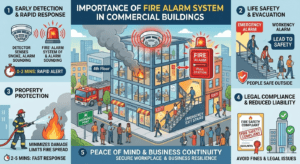
Importance of Fire Alarm System in Commercial Buildings

Commercial buildings in Pakistan from shopping malls in Karachi and corporate towers in Islamabad to textile factories in Faisalabad and hospitals in Lahore house thousands of people every single day. Yet fire safety remains one of the most overlooked aspects of building management across the country. Every year, Pakistan witnesses devastating fire incidents that result in massive financial losses and, more tragically, preventable deaths. The common thread running through most of these disasters is the absence or failure of a proper fire alarm system.
A fire alarm system is not merely a box on the wall that makes noise. It is a sophisticated, life-saving network of sensors, detectors, control panels, and notification devices that work together to detect fire in its earliest stages, alert occupants, and trigger emergency responses — all within seconds. In commercial buildings where dozens to thousands of people may be present at any given time, this early warning can mean the difference between life and death.

This article explores the critical importance of fire alarm systems in commercial buildings across Pakistan, the different types available, their key components, legal requirements, and why businesses should invest in high-quality, certified systems from trusted providers like Fire Safety Trading (Pvt) Ltd.

Why Fire Safety Is a Growing Concern in Pakistan

Pakistan’s commercial sector has witnessed explosive growth over the past two decades. New plazas, factories, warehouses, hotels, hospitals, and office complexes are being constructed at a rapid pace in cities like Rawalpindi, Islamabad, Lahore, Karachi, Peshawar, and Quetta. However, this rapid development has not always been matched by adequate fire safety infrastructure.

Some alarming statistics highlight the urgency:

  • Pakistan’s fire incidents cause billions of rupees in losses annually
  • Many commercial fire tragedies occur in garment factories, where overcrowding and poor fire safety are common
  • The 2012 Baldia factory fire in Karachi one of the deadliest industrial fire disasters in history claimed over 250 lives and could have been largely prevented with proper fire detection and alarm systems

The key lesson from these tragedies is clear: early detection through a reliable fire alarm system saves lives. Without it, occupants may only become aware of a fire when it has already grown beyond control.

What Is a Fire Alarm System?

A fire alarm system is an integrated network of devices designed to detect fire-related threats — including smoke, heat, carbon monoxide, and flames — and immediately alert building occupants and emergency services. Modern fire alarm systems can also trigger automatic responses such as closing fire doors, activating sprinkler systems, and notifying the fire brigade without any human intervention.

The core purpose of a fire alarm system can be broken down into four functions:

Detection: The system continuously monitors the environment for signs of fire. Smoke detectors, heat detectors, and flame detectors installed throughout the building sense the earliest indicators of a fire outbreak.

Alert: Once a threat is detected, audible alarms (sirens, bells, electronic sounders) and visual alarms (strobe lights) activate immediately. In advanced systems, voice evacuation messages guide occupants on how to exit safely.

Protection: The system helps contain the fire by automatically closing fire-rated doors and activating fire suppression systems, preventing fire from spreading to other areas.

Notification: Simultaneously, the system sends alerts to building management, security personnel, and fire departments, ensuring the fastest possible emergency response.

Key Components of a Fire Alarm System

Understanding the components of a fire alarm system helps building owners appreciate why professional installation and maintenance are essential. A complete system typically includes:

Fire Alarm Control Panel (FACP): This is the brain of the entire system. It receives signals from all detectors and devices, processes the information, and triggers the appropriate alarms and responses. The control panel also provides fault monitoring and system diagnostics.

Smoke Detectors: These devices sense smoke particles in the air, which is typically the first sign of a fire. There are two main types ionization smoke detectors, which are more responsive to fast-flaming fires, and photoelectric smoke detectors, which are better at detecting slow, smoldering fires.

Heat Detectors: These sensors trigger an alarm when the ambient temperature exceeds a pre-set threshold or when it rises rapidly over a short period. They are commonly used in kitchens and other areas where smoke detectors might produce false alarms.

Manual Call Points (Break Glass Units): These are wall-mounted devices that allow occupants to manually trigger the fire alarm by breaking the glass panel when they spot a fire. They should be installed at all exit routes and are a critical backup to automatic detection.

Sounders and Sirens: These produce the audible alarm that alerts building occupants. Modern systems use electronic sounders that can produce different tones to indicate various alert levels.

Strobe Lights and Visual Alarms: In environments with loud machinery or for hearing-impaired occupants, visual alarms are equally important. Strobe lights flash to indicate an emergency, ensuring everyone is alerted regardless of background noise.

Carbon Monoxide Detectors: CO is a colorless, odorless gas produced by incomplete combustion. CO detectors are essential in enclosed commercial spaces with gas appliances or parking areas.

Flame Detectors: Used in high-risk industrial and commercial environments, these devices detect the presence of actual flames using UV/IR sensors, making them ideal for factories and warehouses.

Types of Fire Alarm Systems for Commercial Buildings

Choosing the right type of fire alarm system depends on the size, layout, and risk level of the commercial building. Here are the main types available in Pakistan:

1. Conventional Fire Alarm System

In a conventional system, detectors and call points are wired in zones back to the main control panel. When a device triggers, the panel identifies which zone is affected. This system is cost-effective and suitable for smaller commercial buildings like shops, small offices, and restaurants.

The control panel displays zone information through indicator lights or text, helping building management and the fire brigade identify the approximate location of the alarm quickly.

2. Addressable Fire Alarm System

An addressable system assigns a unique digital address to every detector and device on the network. When an alarm is triggered, the control panel can identify the exact device not just the zone that has been activated. This pinpoint accuracy dramatically speeds up emergency response, as responders know precisely where to go.

Addressable systems are ideal for medium to large commercial buildings such as hospitals, hotels, shopping malls, and office complexes. Each loop can support up to 99 devices, and multiple loops can be managed from a single panel.

3. Intelligent Fire Alarm System

Intelligent systems represent the most advanced category. Every detector in the system contains its own microprocessor, which constantly monitors environmental conditions and communicates complex data not just simple on/off signals to the control panel. This intelligence allows the system to distinguish between genuine fires and false alarms caused by cooking smoke, steam, or dust.

Intelligent systems can also self-diagnose and report when a detector needs cleaning or servicing, reducing maintenance costs and ensuring the system is always ready to perform.

For large commercial complexes, hospitals, banks, and government buildings in Pakistan, intelligent fire alarm systems offer the highest level of protection and reliability.

4. Wireless Fire Alarm System

Wireless systems use secure radio communication to connect detectors and devices to the control panel, eliminating the need for physical cables. These systems are particularly beneficial in heritage buildings, occupied spaces where cabling would be disruptive, and temporary commercial structures.

Wireless fire alarm systems are increasingly popular in Pakistan’s rapidly developing commercial sector, where retrofitting existing buildings with traditional wired systems can be expensive and disruptive.

Why Fire Alarm Systems Are Critical for Commercial Buildings in Pakistan

Protecting Human Life

The most fundamental purpose of any fire alarm system is protecting the lives of people inside the building. In commercial settings offices, factories, hospitals, shopping centers the number of occupants can be massive. Early detection and rapid alerting gives people the time they need to evacuate safely before smoke and flames become lethal.

Studies worldwide consistently show that buildings equipped with properly maintained fire alarm systems have dramatically lower rates of fire fatalities compared to buildings without them.

Legal Compliance and Building Codes

Pakistan’s National Building Code (NBC) and various provincial fire safety regulations require commercial buildings to have fire detection and alarm systems installed and maintained to prescribed standards. Non-compliance can result in penalties, closure orders, and, in the event of a fire-related fatality, serious legal liability for building owners and managers.

Businesses operating in industrial zones, particularly those exporting to international markets, are increasingly required to demonstrate compliance with international fire safety standards as part of buyer audits and certifications.

Protecting Property and Assets

Commercial buildings house valuable equipment, machinery, stock, data servers, and documents. A fire that goes undetected for even a few minutes can cause catastrophic damage running into millions of rupees. A fire alarm system minimizes this damage by detecting fire early and enabling swift suppression before it can spread.

Insurance companies in Pakistan also increasingly require fire alarm systems as a condition for commercial property coverage, and their presence can significantly reduce insurance premiums.

Business Continuity

For businesses in Pakistan’s competitive market, downtime caused by fire damage can be devastating. Factories may lose production contracts, hotels may lose their reputation, hospitals may lose patient trust. A reliable fire alarm system significantly reduces the risk of fire damage, protecting not just the physical building but the business itself.

Protecting Sensitive Environments

Certain commercial environments data centers, server rooms, medical facilities, laboratories require specialized fire detection because conventional firefighting methods like water could destroy sensitive equipment. Advanced fire alarm systems can be integrated with clean agent fire suppression systems that extinguish fires without damaging electronic equipment or compromising sterile environments.

Fire Alarm System Requirements for Different Commercial Buildings

Different types of commercial buildings in Pakistan have unique fire alarm requirements:

Hospitals and Healthcare Facilities: These require 24/7 reliable detection with voice evacuation systems and integration with backup power supplies. Patient safety demands both audible and visual alarms, with the ability to direct specific floors or zones to evacuate while others shelter in place.

Hotels and Hospitality Venues: Hotels require sophisticated addressable or intelligent systems that can quickly identify fire locations across multiple floors. Guest rooms need smoke detectors, and common areas need a mix of smoke and heat detection.

Factories and Industrial Buildings: Manufacturing facilities face elevated fire risks due to machinery, flammable materials, and high heat processes. Industrial fire alarm systems often need to integrate with fire suppression systems and may require flame detectors in addition to conventional smoke and heat detectors.

Shopping Malls and Retail Complexes: High footfall, multiple retail units, food courts, and parking areas create complex detection challenges. Addressable systems with multiple zones are essential, along with public address capabilities for orderly mass evacuation.

Office Buildings: Standard smoke and heat detection is typically sufficient for office environments, though server rooms and electrical areas may require specialized detection.

Choosing the Right Fire Alarm System Provider in Pakistan

Selecting a trusted, certified fire alarm system supplier and installer is as important as choosing the right system. Here are the key factors to consider:

Product Quality and Certification: Look for suppliers offering globally recognized brands with international certifications. Fire Safety Trading (Pvt) Ltd, based in Rawalpindi, provides world-class fire alarm systems from renowned manufacturers including COFEM Spain, Gent by Honeywell, and C-TEC all of which meet international fire safety standards.

Professional Installation: Even the best fire alarm system is ineffective if improperly installed. Choose a company with certified installation engineers who follow proper zoning, cabling, and commissioning procedures.

Maintenance and After-Sales Support: A fire alarm system requires regular testing and maintenance to ensure it functions correctly when needed. Choose a provider that offers comprehensive fire alarm maintenance services, including periodic inspections, battery replacements, and detector testing.

Coverage Across Pakistan: For businesses with multiple locations, it is important to choose a provider with nationwide reach. Fire Safety Trading (Pvt) Ltd offers fire alarm installation and maintenance services across Rawalpindi, Islamabad, Lahore, Karachi, Faisalabad, Peshawar, Quetta, Gilgit, Muzaffarabad, Gwadar, and other major cities.

Fire Alarm System Prices in Pakistan

The cost of a fire alarm system in Pakistan varies significantly based on the type of system, the number of devices required, the size of the building, and the brand. As a general guide:

  • Smoke detectors range from approximately PKR 2,000 to PKR 5,000 per unit for standard models, with premium addressable detectors costing more
  • Conventional fire alarm control panels (2-8 zones) range from PKR 15,000 to PKR 80,000
  • Addressable and intelligent fire alarm systems for large commercial buildings can range from PKR 200,000 to several million rupees depending on the scale of installation

For accurate pricing tailored to your specific building and requirements, it is advisable to contact a professional supplier like Fire Safety Trading (Pvt) Ltd directly for a quotation.

Maintenance of Fire Alarm Systems

Installing a fire alarm system is not a one-time task. Regular maintenance is essential to ensure the system performs correctly in an emergency. Best practices include:

  • Weekly checks: Visual inspection of control panels and indicator lights
  • Monthly tests: Manual activation of call points to verify alarm operation
  • Annual inspection: Full inspection of all detectors, wiring, backup batteries, and control panels by a certified engineer
  • Detector cleaning: Dust accumulation can cause both false alarms and missed detections; detectors should be cleaned at regular intervals

Fire Safety Trading (Pvt) Ltd provides professional fire alarm maintenance services across Pakistan, ensuring that commercial buildings remain protected and compliant at all times.

Conclusion

The importance of a fire alarm system in commercial buildings cannot be overstated. In a country where fire incidents continue to claim lives and destroy businesses, investing in a high-quality, professionally installed, and regularly maintained fire alarm system is not an option, it is a responsibility.

From conventional systems suitable for small shops to intelligent addressable systems for large hospitals and industrial complexes, there is a fire alarm solution for every type of commercial building in Pakistan. The key is to choose the right system, have it installed by qualified professionals, and maintain it diligently.

If you are looking for the best fire alarm system in Pakistan, Fire Safety Trading (Pvt) Ltd offers a comprehensive range of world-class fire alarm solutions, professional installation, and maintenance services across the country. Protect your building, your assets, and most importantly, the lives of the people inside it.

Contact Fire Safety Trading (Pvt) Ltd today: Call 0315-4233313 or email sales@firesafetytrading.com.pk for a free consultation and quotation.

Fire Safety Trading (Pvt) Ltd provides fire alarm systems, installation, and maintenance services in Rawalpindi, Islamabad, Lahore, Karachi, Faisalabad, Peshawar, Quetta, Gilgit, Muzaffarabad, Gwadar, and all other major cities of Pakistan.

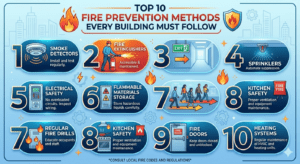
Top 10 Fire Prevention Methods Every Building Must Follow

Fire is one of the most devastating disasters that can strike any building whether it is a residential home, a commercial office, an industrial warehouse, or a public institution. In Pakistan, where rapid urbanization and growing industrial activity have expanded the built environment significantly, fire safety has never been more critical. Every year, hundreds of fire incidents occur across major cities like Karachi, Lahore, Islamabad, and Peshawar, causing massive loss of life, injury, and property damage that could have been prevented with the proper fire safety equipment and preventive measures in place.

The good news is that the vast majority of fire-related tragedies are preventable. With the right fire safety equipment, proper training, and strict adherence to fire prevention protocols, buildings can dramatically reduce the risk of fire and protect everyone inside. Whether you are a building owner, facility manager, safety officer, or a concerned resident, understanding and implementing fire prevention methods is your legal and moral responsibility.

In this comprehensive guide, we walk you through the top 10 fire prevention methods every building must follow, with a special focus on Pakistan’s regulatory environment, climate conditions, and the essential fire safety equipment required to stay compliant and keep people safe.

1. Install and Maintain Proper Fire Safety Equipment

The foundation of any fire prevention strategy is having the right fire safety equipment in place. This is not optional, it is a legal requirement under Pakistan’s building codes and fire safety regulations enforced by local government bodies and the NFPA standards adopted across many Pakistani cities and industrial zones.

Essential fire safety equipment every building needs includes:

  • Fire extinguishers (ABC type, CO2, foam, water-based depending on fire class)
  • Fire alarm systems with interconnected smoke and heat detectors
  • Automatic sprinkler systems for commercial and industrial buildings
  • Fire hose reels and wet/dry riser hydrant systems
  • Emergency exit signs with battery-backed illumination
  • Fire suppression systems for server rooms, generator rooms, and kitchens
  • Fire blankets for kitchen and laboratory environments
  • Personal protective equipment (PPE) for fire wardens and emergency response teams

For buildings across Pakistan looking to source high-quality, certified fire safety equipment, choosing a trusted local supplier is essential. You can explore a comprehensive range of fire fighting equipment and fire safety products in Pakistan to find everything from portable fire extinguishers to complete automatic sprinkler systems suitable for commercial, industrial, and residential buildings across all major cities.

2. Conduct Regular Fire Risk Assessments

A fire risk assessment is a systematic, documented review of your building to identify potential fire hazards, evaluate who is at risk, and determine what measures are needed to eliminate or reduce those risks. In Pakistan, fire risk assessments are increasingly mandated for commercial buildings, hospitals, schools, factories, and any building that accommodates a large number of occupants.

A thorough fire risk assessment covers the identification of ignition sources such as electrical equipment, gas appliances, and open flames; assessment of fuel sources including paper, textiles, chemicals, and wood stored throughout the building; evaluation of oxygen sources that could accelerate fire spread; identification of people at risk, especially those with disabilities or limited mobility; and documentation of all findings with a clear action plan and timeline for corrective measures.

In Pakistan’s hot and dry climate, particularly in cities like Multan, Hyderabad, Rahim Yar Khan, and Quetta, the risk of fire escalates significantly during summer months. Temperatures exceeding 45 degrees Celsius can cause electrical equipment to overheat, and the extremely dry conditions make building materials, textiles, and stored goods far more flammable than in cooler, humid climates. This makes regular seasonal fire risk assessments a critical necessity. Buildings should conduct formal fire risk assessments at least once a year, and immediately following any significant changes to the building layout, occupancy, or operational activities.

3. Establish a Comprehensive Fire Evacuation Plan

Having fire safety equipment installed is only half the battle people must know exactly how to evacuate safely and quickly when a fire breaks out. A well-designed, regularly practiced fire evacuation plan can mean the difference between life and death. Every building in Pakistan, regardless of its size or purpose, must have a clearly documented fire evacuation plan that is communicated to all occupants.

A complete fire evacuation plan must include clearly marked evacuation routes on floor plans posted throughout the building at eye level; designated assembly points located at a safe distance from the building and away from access roads; appointed fire wardens or marshals for each floor or building section who are responsible for guiding occupants to safety and conducting roll calls at the assembly point; specific procedures for safely evacuating people with disabilities, elderly occupants, and children; a clear process for accounting for all occupants once evacuated and for communicating with emergency services; and documented roles and responsibilities for each designated fire safety officer.

In the rapidly growing multi story buildings that now define the skylines of Karachi, Lahore, and Islamabad, the evacuation plan must explicitly address the prohibition of elevator use during fire emergencies and provide detailed guidance on managing large numbers of people exiting simultaneously via stairwells. Fire drills simulating realistic emergency conditions should be conducted at least twice a year, with debrief sessions afterwards to identify and address any weaknesses in the plan.

4. Ensure Proper Electrical Safety and Maintenance

Electrical faults are among the leading causes of building fires in Pakistan. Faulty wiring, overloaded circuits, substandard electrical components, and improper DIY electrical installations account for a very significant percentage of all fire incidents reported across Pakistani urban and industrial areas every year. Preventing electrical fires requires both correct initial installation and rigorous ongoing maintenance.

Essential electrical safety measures include ensuring all electrical work is performed exclusively by licensed electricians following Pakistan’s Electrical Safety Standards; never overloading electrical sockets, power strips, or extension cords beyond their rated capacity; replacing outdated or damaged wiring, plugs, and electrical fittings immediately upon identification; installing residual current devices (RCDs) and properly rated circuit breakers to prevent overcurrent and short circuit situations; scheduling annual electrical inspections and thermographic surveys by certified electrical engineers; and ensuring all electrical panels, distribution boards, and switchgear are properly housed in fire-resistant enclosures.

The extensive stock of older buildings in cities like Lahore’s historic areas, Karachi’s commercial and industrial districts, and the older residential colonies across Pakistan frequently suffer from severely outdated electrical infrastructure that was not designed to handle modern electrical loads. Upgrading wiring, distribution boards, and electrical panels in such buildings is an urgent fire prevention investment. The relatively modest cost of electrical upgrades is negligible compared to the catastrophic human and financial consequences of a major electrical fire.

5. Install and Regularly Test Smoke Detectors and Fire Alarm Systems

Early warning is the single most critical factor in surviving a building fire. Smoke detectors and fire alarm systems provide those essential extra minutes that allow occupants to evacuate before a fire grows beyond control. Research and fire incident data consistently demonstrate that buildings equipped with properly functioning smoke detection and fire alarm systems have dramatically lower fire fatality rates than those without.

Every building in Pakistan should install interconnected smoke detectors in all rooms, hallways, and common areas; heat detectors in kitchens, boiler rooms, and generator areas where smoke detectors may produce nuisance false alarms; manually operated call points, known as break glass units, at every exit and along all escape routes; a central fire alarm control panel connected to all detection and signaling devices; and audible alarm sounders combined with visual strobe alarm signals to ensure all occupants are warned, including those with hearing impairments.

Fire alarm systems must be tested weekly, functionally tested monthly, and comprehensively serviced by a certified fire alarm engineer at least once per year. Batteries in standalone battery-operated smoke detectors must be replaced annually as a minimum. In Pakistan’s large commercial buildings, hospitals, shopping malls, and factories particularly in the industrial heartlands of Faisalabad, Sialkot, Gujranwala, and Karachi’s SITE area addressable intelligent fire alarm systems that can precisely identify the exact location of any triggered detector are strongly recommended as they significantly reduce emergency response times.

6. Properly Store and Handle Flammable and Hazardous Materials

Industrial facilities, warehouses, chemical plants, paint shops, laboratories, and even commercial kitchens across Pakistan routinely handle and store flammable and hazardous materials. Improper storage or careless handling of these materials represents one of the highest fire risks in any building, and can lead to explosions and rapidly accelerating fires that overwhelm even the best fire safety equipment.

Safe practices for flammable and hazardous material management include storing all flammable liquids exclusively in approved, correctly labelled, sealed containers in purpose built, well ventilated storage rooms separated from ignition sources and the main building by fire-rated walls; keeping quantities of flammable materials in the work area to the absolute minimum needed for current operations; ensuring all flammable material storage areas are equipped with appropriate fire suppression systems and compatible fire safety equipment (foam or CO2 extinguishers, never water); providing comprehensive training to all staff on safe handling, use, spill response, and disposal procedures; maintaining fully updated Material Safety Data Sheets for every hazardous substance on site; and posting prominent, clearly legible warning signs in all areas where flammable materials are stored or used.

Pakistan’s enormous textile industry the backbone of the national economy operates thousands of factories in Faisalabad, Karachi, and Lahore that deal daily with highly flammable raw cotton, synthetic fibres, finishing chemicals, and dyes. Pakistan has suffered numerous devastating factory fires in recent decades, many directly attributable to improper storage of such materials. These tragedies have cost thousands of lives and billions of rupees in economic losses, reinforcing in the most tragic terms the absolute critical importance of proper flammable material storage and management.

7. Maintain Clear and Unobstructed Emergency Exits

Emergency exits are the lifelines of any building during a fire but only when they are genuinely accessible, clearly marked, and permanently free from obstruction. One of the most heartbreaking and consistently repeated findings in fire incident investigations across Pakistan is that emergency exits were blocked, padlocked, poorly marked, or simply non-existent, directly preventing occupants from reaching safety. This is an entirely preventable failure that building owners and managers have both a legal duty and a moral obligation to eliminate.

Every building must ensure all emergency exits are clearly identified with continuously illuminated exit signs powered by an emergency backup power supply; all fire exit doors are designed to open outward in the direction of travel and must never be locked, chained, or blocked during any period of building occupancy; all escape routes and exit corridors are maintained completely free from obstruction at all times, with zero tolerance for stored goods, furniture, vehicles, or any other items blocking the path; emergency lighting along all escape routes and in stairwells is tested monthly and fully serviced annually; fire exit doors in public and commercial buildings are fitted with push-bar panic hardware that allows immediate opening under stress without any prior knowledge of the mechanism; and escape route widths meet the minimum requirements established for the building’s maximum occupancy capacity.

8. Implement a Strict No-Smoking Policy and Control Open Flames

Careless disposal of cigarettes and uncontrolled open flames remain among the most preventable and yet most common ignition sources for building fires globally, and Pakistan is no exception. Implementing and rigorously enforcing no-smoking and open flame control policies is one of the simplest yet most effective fire prevention measures any building can take.

Effective fire prevention policies for smoking and open flames include establishing clearly designated outdoor smoking areas located well away from building entrances, ventilation intakes, and flammable storage areas, equipped with proper non-combustible butt disposal receptacles; posting highly visible, mandatory no-smoking signs throughout all indoor areas and near flammable material storage; enforcing strict no-candle and no-incense policies in offices, commercial premises, hospitals, and hotels; implementing a formal hot work permit system for any activity involving welding, cutting, grinding, or other spark-generating work, requiring prior risk assessment, fire watch during the work, and post-completion monitoring; and providing clear staff briefings on the correct and safe use of gas appliances, portable heaters, and kitchen cooking equipment.

During the holy month of Ramadan, when the use of candles, incense (agarbatti), and decorative fairy lights increases significantly across homes and businesses throughout Pakistan, building managers should proactively communicate specific guidance on safe practices that respect and honour cultural and religious traditions while meaningfully reducing fire risk during this heightened-risk period.

9. Provide Regular, Practical Fire Safety Training

The most sophisticated and comprehensive fire safety equipment installation in the world will only reach its full life-saving potential when the people in the building know how to use it correctly and confidently. Regular, hands-on fire safety training is an absolutely essential component of any genuinely effective fire prevention strategy. In Pakistan, where formal mandatory fire safety training requirements across many sectors are still being developed and strengthened, forward-thinking organisations are already investing significantly in fire safety education and achieving measurably better safety outcomes as a result.

A comprehensive fire safety training programme should cover how to raise the alarm immediately upon discovering a fire; how to correctly select and operate different types of fire safety equipment, with specific hands-on practice in using fire extinguishers on the correct fire class; complete evacuation procedures including the location of all emergency exits and assembly points; techniques for safely assisting vulnerable, elderly, disabled, or mobility-impaired occupants during evacuation; basic first aid for burn injuries, smoke inhalation, and shock; and the critical things that occupants should never do during a fire including going back for personal belongings, using elevators, or opening doors without checking for heat first.

Fire safety training should be provided to every new staff member or occupant during their initial induction and comprehensively refreshed at least once per year for all existing occupants. Practical, live demonstration training sessions where participants physically practice operating fire extinguishers on controlled training fires are proven to be dramatically more effective in building genuine confidence and competence than theoretical classroom instruction alone. Many reputable fire safety equipment suppliers and distributors in Pakistan offer professional fire safety training services as part of a comprehensive fire safety package, making it highly convenient and cost-effective for building managers to arrange training alongside equipment procurement and maintenance.

10. Comply with Pakistan’s Fire Safety Regulations and Building Codes

Compliance with Pakistan’s applicable fire safety regulations and building codes is simultaneously a legal obligation and a fundamental ethical responsibility to everyone who occupies, works in, or visits your building. Pakistan’s fire safety regulatory framework is administered through a combination of provincial building codes, municipal by-laws, and national standards that increasingly draw on international fire safety best practices from organisations like the NFPA, British Standards Institution, and the International Building Code.

Core regulatory compliance requirements for buildings across Pakistan include obtaining a valid Fire Safety No Objection Certificate (NOC) from the relevant provincial or city fire department before occupation of any new commercial, industrial, or multi-storey residential building; ensuring the building design, construction, and fit-out fully meets the applicable minimum fire safety standards for structural fire resistance, fire compartmentalization, and evacuation route specifications; installing and maintaining all categories of fire safety equipment as specified and required by the relevant authority for the building’s use class and occupancy load; maintaining detailed, up-to-date records of all fire safety inspections, equipment tests, maintenance activities, and training sessions; and welcoming and fully facilitating periodic fire safety inspections by the relevant regulatory authorities.

In Pakistan, regulatory bodies including the Sindh Building Control Authority (SBCA) in Karachi, the Lahore Development Authority (LDA), the Capital Development Authority (CDA) in Islamabad, the Peshawar Development Authority (PDA), and equivalent bodies across other provinces all have specific fire safety requirements that must be met before any commercial building can legally operate. Non-compliance exposes building owners and managers to significant fines, closure orders, insurance claim rejections, and in cases involving fire-related injuries or fatalities, serious criminal liability. Beyond the legal dimension, achieving and exceeding fire safety compliance standards is a clear and powerful demonstration of a genuine, values-based commitment to the safety, welfare, and dignity of everyone who enters your building.

Building a Fire Safety Culture Across Pakistan

Beyond the ten technical fire prevention measures detailed in this guide, perhaps the single most powerful and sustainable fire prevention tool is the deliberate cultivation of a genuine, organisation-wide culture of fire safety awareness. In Pakistan where public awareness of fire safety risks and prevention measures has historically lagged behind many comparable developing nations there exists a tremendous opportunity for building owners, facility managers, corporate leaders, educational institutions, and community organisations to collectively lead a meaningful improvement in national fire safety standards.

Building a genuine fire safety culture requires appointing a respected, empowered fire safety officer with sufficient authority and resources to champion fire safety at every level of the organisation; integrating fire safety as a standing, substantive agenda item in regular management and team meetings; publicly celebrating fire safety achievements and formally recognising individuals and teams who demonstrate exemplary fire safety practices; sharing relevant fire safety information, case studies, and learnings through internal communications channels; and proactively engaging all tenants, residents, and staff in the collaborative process of identifying and addressing fire hazards in their immediate environment.

A truly embedded fire safety culture transforms fire prevention from a compliance activity managed by a small number of designated individuals into a shared organisational value that every person takes active personal responsibility for. When every single occupant of a building genuinely understands both the very real risks of fire and their own meaningful role in preventing it, the entire building becomes exponentially safer — not just for the people inside, but for the surrounding community as well.

Conclusion: Invest in Fire Safety Equipment and Prevention Now

Fire prevention is not a one-time project or an annual compliance exercise, it is a permanent, ongoing commitment that requires consistent attention, regular investment, and decisive action. By systematically implementing all ten of the fire prevention methods outlined in this guide, every building in Pakistan from the smallest retail shop to the largest industrial complex can meaningfully reduce its fire risk and genuinely protect the lives of everyone inside.

The essential starting point for any fire prevention strategy is ensuring you have the right fire safety equipment correctly installed and properly maintained throughout your building. From portable fire extinguishers and interconnected smoke detector systems to automatic sprinkler installations and emergency escape lighting, having certified, high-quality fire safety equipment from a trusted supplier is the non-negotiable foundation upon which all other fire prevention measures are built.

For buildings across Pakistan whether in Karachi’s commercial districts, Lahore’s industrial zones, Islamabad’s administrative offices, Faisalabad’s textile factories, or anywhere else in the country sourcing certified, reliable fire safety equipment from a trusted Pakistani supplier is the essential first step. Explore a full range of fire fighting equipment and comprehensive fire safety solutions for Pakistan to equip your building with everything it needs to prevent fires and protect lives.

The cost of investing in proper fire safety equipment and implementing the ten prevention methods in this guide is, without exception, far less than the devastating human cost of lives lost, injuries suffered, and the enormous financial cost of property destroyed by preventable fires. Do not wait for a tragedy to take action. Invest in fire safety today and ensure that your building is a place where people can live, work, and thrive in genuine safety.

Fire Safety Tips for Homes in Pakistan

Why Fire Safety Matters in Pakistani Homes

Every year, thousands of homes across Pakistan fall victim to devastating fires that result in the loss of lives, property, and irreplaceable memories. From densely packed neighborhoods in Karachi and Lahore to residential areas in Rawalpindi and Peshawar, fire incidents are alarmingly common and most of them are entirely preventable. The tragic reality is that the majority of fire-related deaths and injuries in Pakistani households occur not because of unavoidable accidents, but due to a lack of awareness and the absence of basic fire safety equipment.
Fire safety in Pakistan is not just a concern for factories and commercial buildings. It starts right at home. Whether you live in a small apartment in Gulberg or a large house in DHA, the risk of a house fire is very real. Faulty wiring, gas leaks, unattended cooking, and the misuse of heating appliances are among the most common causes of home fires in the country.

The good news is that protecting your home and loved ones does not require a massive investment. With the right knowledge, a few essential fire safety equipment’s, and a clear action plan, you can dramatically reduce the risk of fire — and more importantly, ensure that everyone in your home knows exactly what to do if a fire does break out.

In this comprehensive guide, we will cover everything you need to know about fire safety for homes in Pakistan: from understanding common causes of house fires to installing the right fire safety equipment’s, creating an escape plan, and knowing when and how to get professional help.

Common Causes of Home Fires in Pakistan

Before we discuss how to prevent fires, it is important to understand what causes them in the first place. In Pakistani homes, the following are the most common culprits:

1. Faulty Electrical Wiring

Pakistan has millions of older homes with outdated electrical systems that were never designed to handle modern appliances. Overloaded circuits, damaged wires, and loose connections are a recipe for disaster. Load shedding also causes power surges when electricity is restored, which can ignite fires instantly if wiring is faulty.

2. Gas Leaks

Natural gas and LPG are the primary cooking and heating fuels in most Pakistani households. Old or poorly maintained gas pipes, faulty regulators, and cracked hoses can result in dangerous gas leaks. A single spark near a gas leak is enough to cause an explosion and fire.

3. Unattended Cooking

The kitchen is one of the highest risk areas in any home. In Pakistan, where cooking often involves high-flame stoves, deep frying, and the use of open fire, leaving the stove unattended for even a few minutes can lead to a serious fire. Cooking fires are the number one cause of home fires across the country.

4. Candles and Open Flames

During frequent load shedding, many homes in Pakistan rely on candles and oil lamps for light. These open flames placed near curtains, bedding, or other flammable materials can easily start a fire, especially if left unattended or knocked over accidentally.

5. Misuse of Heating Appliances

In the winter months, particularly in cities like Islamabad, Peshawar, and Quetta, the use of gas heaters and electric room heaters significantly increases. Placing these appliances too close to furniture, drapes, or clothing is one of the most common causes of winter house fires in Pakistan.

Essential Fire Safety Equipments Every Pakistani Home Needs

Equipping your home with the right fire safety equipment is one of the most effective steps you can take to protect your family. These tools can mean the difference between a minor incident and a catastrophic loss. Here are the must-have fire safety equipment’s for every Pakistani household:

1. Fire Extinguisher

A fire extinguisher is the most fundamental piece of fire safety equipment for any home. In Pakistan, Dry Chemical Powder (DCP) fire extinguishers are the most widely used because they are effective against Class A (ordinary combustibles), Class B (flammable liquids), and Class C (electrical) fires the three most common types in residential settings.

For your kitchen, a CO2 or wet chemical fire extinguisher is more appropriate as it does not leave a damaging residue. For general home use, a 1 kg or 2 kg ABC dry powder extinguisher is recommended. Every home should have at least one extinguisher on each floor, and ideally one in the kitchen.

You can find a wide range of certified fire extinguishers and other fire safety equipments at Fire Safety Trading Pakistan, one of Pakistan’s most trusted suppliers of fire protection solutions.

2. Smoke Detectors and Fire Alarm Systems

Smoke detectors are life-saving devices that alert you to a fire before it grows out of control. Unfortunately, their use in Pakistani homes is still very limited. A properly installed smoke alarm gives you and your family precious minutes to evacuate safely.

For most homes in Pakistan, battery-operated smoke detectors are the most practical and affordable option. These should be installed on every floor of the house, inside each bedroom, and near the kitchen (but not directly above the stove, as cooking fumes can trigger false alarms). Test your smoke detectors monthly and replace the batteries every year.

For larger homes or those with the budget for more comprehensive protection, interconnected fire alarm systems ensure that when one detector is triggered, alarms sound throughout the entire house.

3. Fire Blanket

A fire blanket is a specially designed sheet made from fire-resistant material that can be used to smother small fires especially kitchen fires involving burning oil or fat. It can also be wrapped around a person whose clothing has caught fire. Every kitchen in Pakistan should have a fire blanket mounted in an easy-to-reach location, away from the stove itself.

4. Emergency Exit Lights

In the event of a fire, smoke can make a home completely dark and disorienting within minutes. Emergency exit lights, which run on battery backup, can guide family members safely out of the house even when there is no visibility. For multi-story homes and apartment buildings in Pakistan, these are especially important.

5. Fire Ball Extinguisher

An innovative and increasingly popular fire safety equipment in Pakistan is the fire ball extinguisher. This device activates automatically when it comes into contact with fire, dispersing extinguishing powder over a radius of up to 3-5 square metres. It is ideal for placing in areas where a manual extinguisher might not be reached in time such as inside electrical panels, server rooms, or storage areas.

6. Gas Detectors and Carbon Monoxide Alarms

Given the heavy reliance on natural gas in Pakistani homes, gas detectors are an extremely valuable yet woefully underused piece of fire safety equipment. These devices detect the presence of dangerous gas concentrations in the air and alert you before an ignition source can cause an explosion. Carbon monoxide alarms are equally important if you use gas heaters indoors.

Fire Prevention Tips Specifically for Pakistani Homes

Owning fire safety equipments is only part of the solution. Preventing fires from starting in the first place requires a combination of vigilance, good habits, and regular home maintenance. Here are actionable fire prevention tips tailored to the realities of Pakistani homes:

  • Get your electrical wiring professionally inspected at least once every 3-5 years. If your home is more than 20 years old, a full rewiring may be necessary.
  • Never overload electrical sockets. Avoid using multiple multi-plug adapters daisy-chained together a common and dangerous practice in Pakistani homes.
  • Have your gas lines and appliances serviced annually. Listen for hissing sounds near gas pipes and act immediately if you smell gas — open windows, leave the house, and call your gas utility provider.
  • Never leave cooking unattended, especially when using high heat or deep frying. If you must leave the kitchen, turn off the stove.
  • Keep a safe distance of at least one metre between heaters and any flammable materials such as curtains, rugs, sofas, and clothing.
  • Use LED lanterns or rechargeable lights instead of candles during load shedding. If you must use candles, place them in stable holders far from any flammable items and never leave them unattended.
  • Do not store flammable materials such as petrol, paint, or chemicals in living areas. Keep them in well-ventilated storage areas away from heat sources.
  • Install spark-proof guards on open fireplaces or traditional chulhas if used in rural homes or during winter.


How to Create a Home Fire Escape Plan in Pakistan

Even with the best fire safety equipments and prevention habits, no home is 100% immune from fire. A clear, practised fire escape plan can save lives when every second counts. Here is how to create one for your Pakistani home:

Step 1: Draw a Floor Plan

Sketch a simple layout of each floor of your home and mark all doors, windows, and staircases. Identify at least two exit routes from every room typically a door and a window.

Step 2: Choose a Meeting Point

Designate a specific meeting place outside the home — such as in front of the main gate or at a neighbour’s house where all family members will gather after evacuating. This makes it easy to confirm everyone is safe.

Step 3: Practise the Escape Plan

Run a fire drill with the entire household at least twice a year. Include children and elderly members of the family. Practice escaping in darkness or with eyes closed to simulate smoke conditions. Everyone should be able to evacuate the house in under two minutes.

Step 4: Teach Children What to Do

Children in Pakistan are often home alone with maids or in the care of older siblings. Teach every child in your household the STOP, DROP, and ROLL technique, how to check a door before opening it during a fire, and the importance of staying low to avoid smoke inhalation.

Step 5: Know Emergency Numbers

Post the following numbers in a visible location in your home and ensure all family members know them. The Rescue helpline in Pakistan is 1122, which operates in Punjab and most other provinces. For Karachi, the Fire Brigade number is 16 or 021-32224400. In Islamabad, fire emergency services can be reached at 16 or 051-9265000.

Fire Safety for Apartments in Pakistani Cities

Apartment living is increasingly common in cities like Karachi, Lahore, and Islamabad. High-rise residential buildings present unique fire safety challenges that require additional awareness:

  • Never use the lift during a fire emergency. Always use the stairs.
  • Close all doors behind you as you evacuate — closed doors significantly slow down the spread of fire and smoke, buying time for others to escape.
  • Ensure your apartment building has a working fire alarm system, fire hose reels, and fire extinguishers on each floor. If it does not, raise this with your building management committee.
  • Know the location of the fire exits in your building before an emergency occurs.
  • If you are trapped and cannot escape, go to a room with a window, seal the gap under the door with clothing or towels, and signal for help from the window.


Kitchen Fire Safety: The Most Critical Room in Pakistani Homes

Given that cooking fires are the leading cause of home fires in Pakistan, the kitchen deserves special attention. Here are kitchen-specific fire safety measures every Pakistani household should follow:

  • Keep your stove and surrounding area clean and free of grease buildup, which is highly flammable.
  • Install a fire blanket within easy reach of the stove — not above it. In the event of a small grease fire, a fire blanket can smother it quickly and safely.
  • Never pour water on a grease fire — it will cause the fire to explode outward. Use a fire blanket, a pot lid, or a CO2/wet chemical fire extinguisher.
  • Turn pan handles inward to prevent them from being knocked over accidentally.
  • Wear close-fitting clothing when cooking and keep loose dupattas, sleeves, and scarves away from open flames.
  • Check the gas regulator and hose on your LPG cylinder regularly for signs of wear, cracking, or damage.


Where to Buy Fire Safety Equipments in Pakistan

Sourcing reliable and certified fire safety equipments in Pakistan has never been easier. However, it is essential to purchase from reputable suppliers to ensure quality and effectiveness. Substandard or uncertified fire extinguishers and smoke detectors can fail precisely when you need them most.

For homeowners across Pakistan looking for high-quality, certified fire safety equipments, Fire Safety Trading (Pvt) Ltd is one of the country’s most trusted and comprehensive fire protection suppliers. Their fire fighting equipment range includes:

  • Fire extinguishers (DCP, CO2, AFFF foam, wet chemical, and automatic) from brands like NAFFCO
  • Fire suppression systems (FM200, CO2, water mist, kitchen suppression)
  • Fire alarm systems (addressable and conventional) including Honeywell GENT and COFEM Spain
  • Fire blankets and fire ball extinguishers
  • Fire exit doors, emergency exit lights, and safety signs
  • Fire sprinkler systems and fire hydrant systems

Whether you are equipping a single apartment or a large family home, their team of fire safety experts can guide you to the right fire safety equipments for your specific needs and budget. You can reach them at 0322-9700008 or email sales@firesafetytrading.com.pk.

Maintaining Your Fire Safety Equipments

Buying fire safety equipments is just the first step. Regular maintenance and inspection ensure these devices work reliably when needed. Here is a simple maintenance schedule:

  • Fire extinguishers: Inspect the pressure gauge monthly. Have them professionally serviced and refilled annually, or immediately after use.
  • Smoke detectors: Test monthly by pressing the test button. Replace batteries annually. Replace the entire unit every 10 years.
  • Fire blankets: Check that they are stored correctly in their quick-release container and have not been damaged or used.
  • Gas detectors: Test them monthly and replace them every 5-7 years as their sensors degrade over time.
  • Emergency exit lights: Test the battery backup monthly by holding down the test button.


Conclusion: Make Fire Safety a Priority in Your Pakistani Home Today

Fire safety in Pakistan remains a critically underappreciated issue at the household level. Thousands of preventable fires claim lives and destroy homes every year, largely because families are unprepared. The combination of faulty wiring, gas leaks, open flames, and the absence of basic fire safety equipments creates a dangerous environment that puts every member of the household at risk.

But change starts with awareness and action. By understanding the common causes of house fires, equipping your home with essential fire safety equipments, practising a clear evacuation plan, and maintaining your equipment regularly, you can turn your home into a much safer place for your family.

The investment in fire safety is modest compared to the irreplaceable value of human life and the years of hard work that go into building a home. Do not wait for an emergency to take action. Start today.

Visit firesafetytrading.com.pk to explore a complete range of fire safety equipments available across Pakistan, and take the first step toward making your home fire-safe today.


Also Read: